How to Choose a Flow Meter That Meets SPARING’s ±10% Accuracy Requirement
Indonesia's SPARING requires ±10% flow accuracy but does not specify meter type. Compare Parshall Flumes, Doppler, electromagnetic, transit-time options.
Indonesia’s SPARING regulation requires continuous wastewater flow measurement with accuracy within ±10% of the actual value. The requirement comes from PermenLHK P.80/2019 (amending P.93/2018), Annex III, and applies to all 12 mandatory industrial sectors. Flow must be reported in m³/hour matched to the actual outlet discharge rate. The regulation sets the accuracy threshold but does not mandate a specific meter type. That leaves each plant to select, install, and maintain a flow measurement system that can hold ±10% under the conditions at its discharge point.
Choosing the right method depends on whether your effluent flows through an open channel or a closed pipe, and how much suspended solids the water carries. The sections below cover each method and its tradeoffs so you can match the meter to your discharge conditions.
SPARING’s Flow Measurement Requirements
PermenLHK P.80/2019 Annex III specifies sensor accuracy for each SPARING parameter:
- pH: ±0.1
- COD: ±10%
- TSS: ±10%
- NH₃-N: ±10%
- Flow: ±10%, range in m³/hour matched to actual discharge
The regulation requires continuous data transmission to the SPARING portal. Flow data must be logged, timestamped, and reported alongside quality parameters.
The ±10% figure refers to accuracy across the normal operating range, not at a single calibration point. A meter calibrated at 80% of its range may drift beyond ±10% at 20% flow if turndown ratio is insufficient. Indonesian regulators can audit both the installed meter and its calibration records. Companies in any of the mandatory SPARING sectors need to demonstrate that their flow measurement holds ±10% during routine operations, not only during commissioning.
The regulation does not distinguish between open-channel and closed-pipe installations. Both are acceptable as long as the accuracy threshold is met and the signal feeds into the continuous monitoring data chain.
Open Channel: Parshall Flumes and Weirs
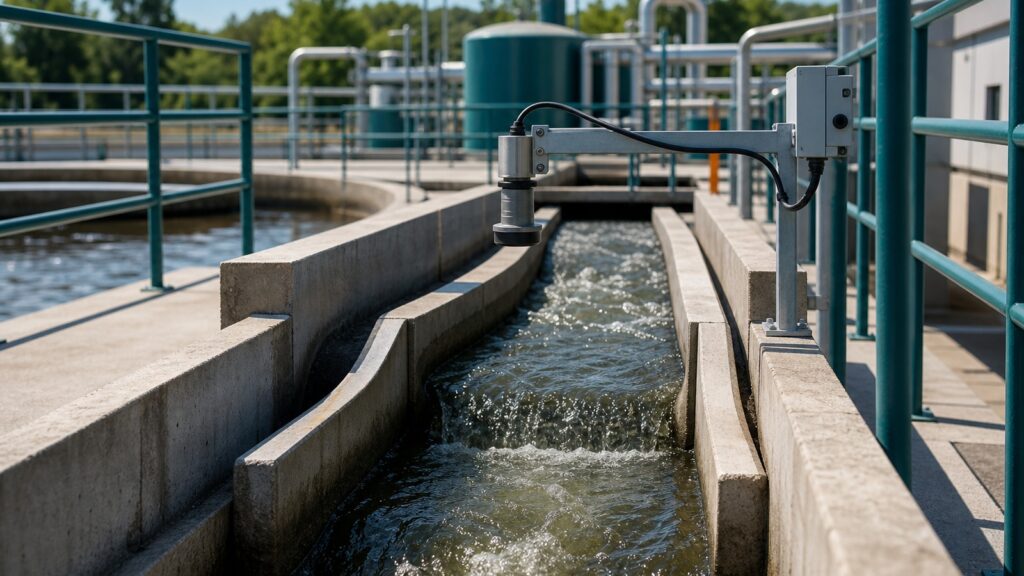
Most Indonesian wastewater treatment plants discharge through open channels or gravity outfalls. Two established approaches for open-channel flow measurement are primary devices (flumes and weirs) paired with level sensors.
Parshall Flume. A Parshall flume is a fixed hydraulic structure with a converging section, a throat, and a diverging section. Water accelerates through the throat, creating a predictable relationship between upstream water level and flow rate. Parshall flumes are the most common primary device recommended by EPA for wastewater applications. With proper installation (level approach, no downstream submergence beyond the design limit), a Parshall flume delivers ±3–5% accuracy under ISO 9826 conditions. The design has a self-cleaning effect because flow acceleration through the throat reduces sediment buildup. The tradeoff is civil works: the flume must be built to exact dimensions and installed level. Retrofitting one into an existing channel may require construction work.
V-notch weir. A thin-plate V-notch weir is simpler to install and works well at low flows, with a turndown ratio up to 500:1. Accuracy reaches ±2–5% at properly maintained installations (ISO 1438). However, weirs create a dam across the channel, and sediment or debris accumulates upstream. In wastewater with high solids loading, that buildup changes the approach conditions and degrades accuracy. Weirs also produce a head loss that may not be acceptable where the available channel gradient is limited.
Both methods require a level sensor upstream of the structure. An ultrasonic level sensor such as the RKL-03 converts the water level reading into a flow rate using the known hydraulic equation for that specific structure. The level sensor accuracy (0.5–1% for the RKL-03, IP68-rated) adds to the total measurement uncertainty, so the combined system (structure plus sensor) is what must meet the ±10% SPARING threshold.
Doppler Ultrasonic for Dirty Wastewater
When installing a flume or weir is impractical, or when the wastewater carries high suspended solids, Doppler ultrasonic flow sensors are an alternative that requires no hydraulic structure.
A Doppler sensor transmits an ultrasonic signal into the flow. Particles and bubbles in the water reflect the signal back with a frequency shift proportional to flow velocity. Combined with a depth measurement (from a built-in or separate level transducer), the sensor computes volumetric flow rate.
Doppler sensors need suspended solids concentration of ≥80–100 mg/L TSS to produce a reliable return signal. Raw wastewater from textile, palm oil, pulp and paper, or food processing plants usually exceeds that threshold by a wide margin. In these conditions, a Doppler ultrasonic flow sensor achieves ±2% accuracy with no physical obstruction in the channel and minimal maintenance. The sensor can be installed in open channels or pipes, giving it more installation flexibility than flumes or weirs.
The limitation: Doppler does not work on clean water. If the effluent has been treated to the point where suspended solids drop below the minimum threshold, the return signal is too weak for stable readings. In that case, transit-time ultrasonic becomes the better option.
Transit-time ultrasonic works on the opposite principle: it measures the difference in travel time of ultrasonic pulses sent upstream and downstream through the flow. Transit-time does not depend on particles; it relies on direct signal transmission through the liquid. Accuracy reaches ±0.5–1%, but only in clean water with low particle content. High particle concentrations scatter the signal and degrade accuracy.
The decision between Doppler and transit-time is driven by the fluid itself. High solids and turbidity favor Doppler. Clean, treated effluent favors transit-time.
Electromagnetic and Transit-Time for Closed Pipes
Some wastewater systems use pressurized or full-bore closed pipes for pumped effluent or final discharge. Two technologies dominate closed-pipe flow measurement.
Electromagnetic (mag) meters. A mag meter applies a magnetic field across the pipe and measures the voltage induced by the conductive fluid moving through it (Faraday’s law). Mag meters deliver ±0.5% accuracy, have no moving parts, create no pressure drop, and handle suspended solids without degradation. They require the liquid to have a minimum electrical conductivity of ≥5 µS/cm, which virtually all wastewater satisfies. EPA rates mag meter accuracy at ±1% of full scale for wastewater applications. Mag meters need no routine maintenance since there are no moving parts.
Full-bore mag meters require cutting into the pipe and installing flanged sections. Insertion-type mag meters reduce installation effort but measure velocity at a single point and rely on a profile factor to estimate average velocity. They are less accurate than full-bore models.
Clamp-on transit-time meters. For situations where cutting the pipe is not possible, clamp-on transit-time sensors mount externally and measure flow through the pipe wall. Accuracy is ±0.5–1% under favorable conditions (full pipe, clean fluid, known pipe material and wall thickness) but degrades with pipe corrosion, liner delamination, or high solids content.
Mag meters are the standard choice for closed-pipe wastewater applications. Their ±0.5% accuracy exceeds the SPARING ±10% requirement by a wide margin. Clamp-on transit-time is a retrofit option for clean-water systems where pipe modification is impractical.
Comparison Table: Accuracy, Installation, and Application
| Method | Typical accuracy | Channel type | Best for | Key limitation | Meets SPARING ±10%? |
|---|---|---|---|---|---|
| Parshall Flume + level sensor | ±3–5% | Open channel | Wastewater with moderate to high solids | Requires civil works, exact installation geometry | Yes |
| V-notch weir + level sensor | ±2–5% | Open channel | Low-flow, relatively clean wastewater | Sediment buildup at notch, head loss | Yes |
| Doppler ultrasonic | ±2% | Open channel or pipe | Dirty wastewater (TSS ≥80 mg/L) | No signal in clean water | Yes |
| Electromagnetic (magmeter) | ±0.5% | Full closed pipe | Any conductive wastewater (≥5 µS/cm) | Requires pipe cut-in, full-pipe condition | Yes |
| Transit-time ultrasonic | ±0.5–1% | Full closed pipe | Clean, treated effluent | Signal loss in high-solids or aerated flow | Yes |
All five methods can meet the SPARING ±10% requirement under appropriate conditions. The choice comes down to two factors: channel type (open channel or closed pipe) and wastewater characteristics (dirty with high TSS, or relatively clean after treatment).
For a quick guide: plants with open channels and dirty wastewater should consider a Parshall Flume with level sensor or a Doppler ultrasonic installed directly in the channel. Plants with closed pipes and conductive wastewater get the best accuracy from a magmeter. Clamp-on transit-time works for retrofit on pipes carrying clean effluent without cutting or modifying the pipe.
Flow Sensors in Argatech’s SPARING System
Fortuna Argatech supplies several sensors that support flow measurement within SPARING configurations, matched to site-specific channel conditions.
Doppler Ultrasonic Flow Sensor measures flow velocity in channels that lack a flume or weir structure. It fits installations where building a permanent hydraulic structure is impractical, such as existing channels with non-standard geometry or locations with limited construction access.
Rika RKL-03 works as a level-to-flow converter. This ultrasonic sensor mounts above a Parshall Flume or V-notch weir to measure water level non-contact, and the data logger converts the level reading to flow rate using the head-discharge equation matched to the flume dimensions. Level measurement accuracy of 0.5–1% with IP68 rating makes it suitable for wet, splashy conditions at WWTP outlet points.
GRD-900 is a non-contact radar sensor designed for hydrology and river applications. In SPARING installations, the GRD-900 is the fallback when measurement distance or environmental conditions (vapor, foam, or extreme temperature swings) exceed the working range of ultrasonic sensors.
All three sensors connect to the Argatech data logger, which handles level-to-flow conversion, interval logging, and telemetry transmission to the KLHK server per SPARING protocol.
Flow sensor configuration depends on channel conditions, wastewater characteristics, and existing infrastructure at the site. Contact Fortuna Argatech’s technical team for consultation on method selection and sensor configuration for your WWTP. Comparing COD vs BOD monitoring tradeoffs and TSS vs turbidity measurement differences for the quality parameters helps complete the system design.
Sources
- PermenLHK Nomor P.80/Menlhk/Setjen/Kum.1/10/2019, amending Permen LHK P.93/2018, Annex III: sensor specifications and accuracy requirements for SPARING.
- ISO 9826:1992, Measurement of liquid flow in open channels: Parshall and SANIIRI flumes.
- ISO 1438:2017, Hydrometry: Open channel flow measurement using thin-plate weirs.
- EPA 832-F-06-044: Wastewater flow measurement fact sheet overview.
- Fuentes et al., “Doppler Ultrasonic Flow Measurement in Wastewater Applications,” Flow Measurement and Instrumentation, 2019.
- ISO 6817:1992 / IEC 60534-8-4, Electromagnetic flow measurement principles.
Share this article
Share this insight with your team.
Related Articles
Similar topics from the same category.
Poor weather station placement can cause 50% data bias. Learn the WMO-No. 8 and Indonesian BMKG siting standards for AWS sensors in industrial and mining sites.
Explore a technical engineering comparison between solid-state ultrasonic anemometers and mechanical cup-and-vane sensors for industrial weather stations.

Technical guide to conductivity sensors: comparing toroidal (inductive), 2-electrode, and 4-electrode contacting probes for industrial water and wastewater.