Locking Physical Evidence During Wastewater Spikes: Interfacing Refrigerated Autosamplers with SPARING Telemetry
Wire datalogger relay pulses to refrigerated autosamplers at SPARING outfalls. Persistence filters, 4 °C preservation, and ISO 17025 Chain of Custody.
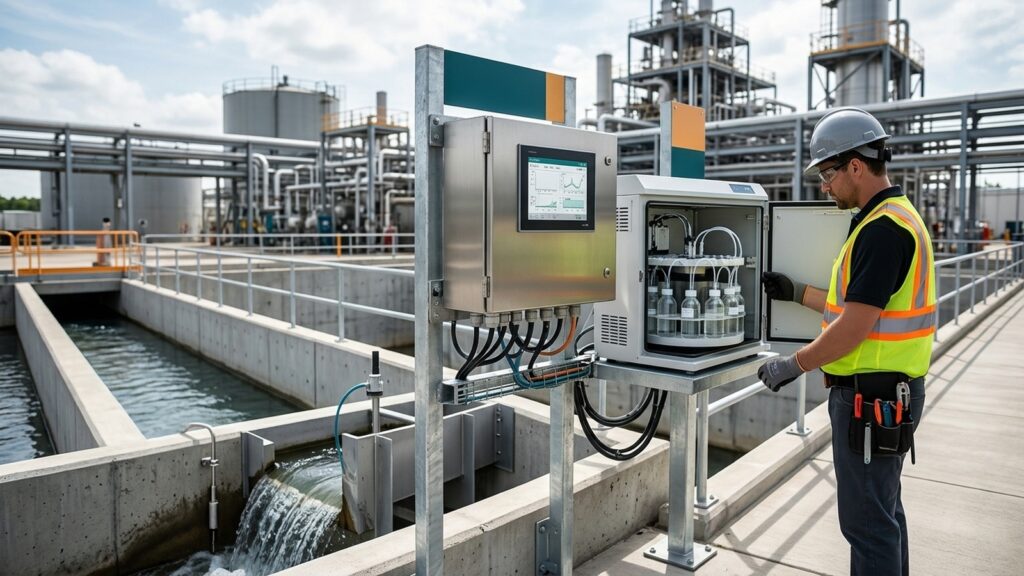
Your SPARING station just flagged COD at 350 mg/L. The permit says 250. That effluent is already past the weir and heading downstream. Three weeks from now, the Ministry’s fine notice lands on your desk under Permen LHK 14/2024, and you have no physical sample to prove that reading was biofilm on the probe window, not actual pollution. This is the problem an event-triggered autosampler SPARING telemetry system solves: it wires your datalogger’s digital relay output to a refrigerated sampler so the instant telemetry crosses a threshold, a real bottle of effluent gets captured, chilled to 4 °C per ISO 5667-10 / SNI 8995:2021, and locked under Chain of Custody.
Why Telemetry Data Alone Cannot Defend Your Facility
Indonesian regulatory monitoring now runs through Pengawasan Reguler Tidak Langsung under Permen LHK 14/2024 Articles 8 and 10. Ministry supervisors pull continuous digital telemetry from SPARING stations and impose fines up to Rp 3 billion per violation (Article 39) without ever setting foot on site. The fine formula (DA = UBP × TD × W) multiplies excess concentration by flow rate. Run the numbers: a false COD spike of 100 mg/L at 5,000 m³/day means Rp 25 million in daily exposure if you cannot counter it with a lab result.
Optical and electrochemical sensors sitting in open channels pick up transient garbage all the time. Biofilm. Aeration bubbles. Power glitches. Wiper cleaning interference. The effluent keeps moving. Without automated physical capture at the exact second of the anomaly, that water mass is gone, and your ability to challenge the digital record goes with it.
SNI 8995:2021 Article 5.4 formally recognizes automatic water samplers for physicochemical testing. ISO 5667-10:2020 Clause 3.10 defines event-triggered sampling as automated collection initiated when a concentration threshold is exceeded. Those two standards make a physically captured sample admissible before auditors and courts.
The Compliance Dilemma: Continuous Data Needs Physical Corroboration
Online instruments and lab analysis measure different things. A UV-Vis COD probe estimates from light absorption; a lab dichromate titration measures on a preserved aliquot. When a sensor reads 350 mg/L COD against a 250 mg/L limit, it could be genuine degradation or algae fouling the window. Without a physical sample at the same timestamp, there is no verification pathway.
The asymmetry here is brutal. The Ministry’s digital record is timestamped, continuous, and auto-transmitted to SISPEK. Your defense requires an ISO/IEC 17025 lab report on a sample with documented preservation and unbroken Chain of Custody. SNI 8995:2021 Article 13 lays out the documentation: unique bottle ID, temperature log, collection time, parameters, seal numbers, collector/receiver signatures. An event-triggered autosampler closes this gap by capturing the physical matrix the moment telemetry flags an exceedance.
Standards Framework: ISO 5667-10 and SNI 8995:2021
ISO 5667-10:2020 sets the technical baseline. Event-triggered sampling (Clause 3.10) activates when a parameter crosses a preset threshold. Minimum suction velocity: 0.5 m/s, to prevent solids settling in the line (Clause 7.3.4). Each cycle runs air pre-purge before drawing sample, then post-purge to prevent cross-contamination.
SNI 8995:2021 matches the ISO framework while adding Indonesian context. Article 5.4 approves automatic samplers. Article 13 codifies Chain of Custody. The standard mandates active compressor cooling at 4 °C ± 2 °C per ISO 5667-3:2018. In Indonesia’s tropical climate, uncooled samples degrade within hours, so passive insulation is not an option.
MCERTS (UK Environment Agency, 2023) adds ±5% dosing accuracy and 6–8 m vertical suction lift as performance benchmarks.
Discrete bottle configuration, typically 24 bottles at 1,000 mL each, isolates every anomaly event. Bottle 7 holds the 03:14 spike. Bottle 12 holds the 14:22 spike. Timestamp correlation between the datalogger log and bottle index creates an auditable link that a single composite sample never can.
Integration Architecture: GEOVOS 1000 to Autosampler
The interface runs on dry-contact Digital Output (DO) relay pulse or Modbus RS-485. The GEOVOS 1000 provides configurable DO channels rated for 24 VDC. When edge firmware confirms trigger conditions, it closes the normally-open contact for a programmable pulse (500 ms to 2 s), and the autosampler starts its cycle.
[SPARING Sensors] → [GEOVOS 1000 Edge] → [DO Relay Pulse] → [Autosampler Trigger]
                      ↓
          [MQTT/Telegram/SMS Alert + Digital Event Log: timestamp, parameter, peak, bottle #]
Hydraulic Sequence (ISO 5667-10 / MCERTS):
| Step | Action | Purpose |
|---|---|---|
| 1 | Air pre-purge (pressurized blow-back) | Clear stagnant liquid from intake tubing |
| 2 | Sample draw (≥0.5 m/s line velocity) | Transport effluent without solids settling |
| 3 | Aliquot measurement (volumetric/timed) | ±5% volume accuracy per MCERTS |
| 4 | Bottle indexing (carousel advance) | Isolate event-specific sample |
| 5 | Post-purge (air blow-back) | Clean line for next cycle |
Suction Line: Medical-grade silicone for the pump head; PTFE or reinforced PVC for the suction run with a stainless steel strainer. All chemically inert, preventing analyte adsorption.
Electrical Interface (Dry-Contact DO):
| Terminal | Function | Rating |
|---|---|---|
| DO+ / DO- | Normally-open dry contact | 24 VDC, 0.5 A max |
| Pulse width | Configurable 500 ms to 2 s | Matches autosampler spec |
| Isolation | Galvanic from logger supply | Prevents ground loops |
Modbus RS-485 adds bidirectional metadata (bottle number, cycle state, faults) but requires shared register maps between devices.
Edge Trigger Logic: Preventing False Triggers and Bottle Waste
Plant teams worry about burning through bottles on false triggers during wiper cycles or electrical noise. Fair concern. GEOVOS 1000 firmware handles this with layered logic:
1. Early Warning Threshold at 85–90% of regulatory limit (e.g., 212–225 mg/L COD for a 250 mg/L standard). Arms the logic without firing.
2. Persistence Duration Filter. Concentration must stay above limit continuously for 3–5 minutes before the relay fires. A 30-second bubble spike does not trigger.
3. Wiper Gating. The datalogger receives the sensor’s cleaning status flag. During cleaning (30–60 s), trigger evaluation pauses entirely.
4. Rate-of-Change Filter (Optional). A dC/dt threshold rejects step-changes that are implausible for the hydraulic residence time.
5. Event Metadata Capture. At trigger: ISO 8601 timestamp, triggering parameter, peak value, bottle index, sensor flags. All transmitted instantly via MQTT/Telegram/SMS.
IF (sensor.cleaning_active) SKIP                          // wiper gating
ELSE IF (concentration > limit) {
    trigger_armed = TRUE
    timer += scan_interval
    IF (timer >= dwell_minutes * 60) {
        fire_relay(); log_event(); send_alerts()
        trigger_armed = FALSE; timer = 0
    }
}
ELSE IF (concentration > early_warning) {
    trigger_armed = TRUE; timer = 0              // arm, log warning
}
ELSE { trigger_armed = FALSE; timer = 0 }
This reserves the 24-bottle carousel for genuine exceedances, not maintenance artifacts.
Cold Preservation and Chain of Custody
ISO 5667-3:2018 and SNI 8995:2021 require 4 °C ± 2 °C from collection to lab receipt. In 30–35 °C ambient, passive insulation fails within hours. Active compressor refrigeration is the only option that suppresses microbial degradation and ammonia volatilization.
For holding beyond 24 hours: concentrated H₂SO₄ to pH < 2 for COD/NH₃-N. The plant chemist typically adds acid manually at retrieval; automatic acid-dosing modules exist but are uncommon in field units.
Split Sample (SNI 8995:2021 Clause 3.25): Homogenize the bottle, split into two aliquots. One goes to internal rapid screening. The other gets sealed under Chain of Custody for ISO/IEC 17025 lab analysis. The form documents bottle ID, temperature history, collection time, parameters, seal numbers, and dual signatures.
The GEOVOS 1000 digital event log (timestamp, parameter, peak, bottle #) pairs with the paper Chain of Custody to prove the physical sample corresponds to the specific telemetry event under review.
Operational Workflow
- Spike Detected. SPARING sensor exceeds the permit limit.
- Persistence Satisfied. Concentration holds above limit for 3–5 min.
- Relay Fired. GEOVOS 1000 closes the DO contact; autosampler runs pre-purge, draw, post-purge.
- Sample Secured. Aliquot sits in a discrete bottle at 4 °C ± 2 °C.
- Alert Dispatched. Operations receives the event metadata.
- Bottle Retrieved. Chemist collects within 24 h, adds H₂SO₄ to pH < 2.
- Split and Seal. Homogenized split; Chain of Custody initiated.
- Lab Submittal. Sealed aliquot goes to ISO/IEC 17025 lab; internal aliquot runs rapid check.
- Regulatory Response. If the lab result shows compliance, submit evidence citing the timestamped sample and digital log.
Fortuna Argatech’s Role
Fortuna Argatech builds the SPARING architecture: GEOVOS 1000 with edge trigger logic and DO/Modbus interfaces, continuous sensors, and integration engineering to industrial-grade refrigerated autosamplers. The result is a telemetry station that goes beyond reporting exceedances. It captures physical proof when it counts.
Every plant running mandatory SPARING will eventually see a sensor anomaly. The question is whether you will have a bottle in the fridge when the Ministry comes asking. An integrated event-triggered autosampler SPARING telemetry system puts that bottle there, automatically, with a paper trail that holds up.
Next Steps: Audit your outfall SPARING station for DO relay availability and autosampler mounting. Engage Fortuna Argatech engineering to specify trigger logic, suction line hydraulics, and Chain of Custody SOP for your permit limits and site geometry.
Related Resources:
- SPARING solutions: https://argatech.com/produk/sparing/
- Permen LHK 14/2024 fine framework: https://argatech.com/sanksi-denda-permen-lhk-14-2024-mitigasi-telemetri-sparing/
- SPARING data completeness: https://argatech.com/kelengkapan-data-sparing/
- Effluent flow measurement: https://argatech.com/pengukuran-debit-air-limbah-sparing/
- Sensor calibration: https://argatech.com/kalibrasi-sensor-lingkungan-sparing-onlimo/
Share this article
Share this insight with your team.