Why SPARING Measures COD Online, Not BOD: What That Means for Your Monitoring System
SPARING mandates online COD monitoring, not BOD. Learn the technical reason, how UV254 sensors work, and Indonesian effluent limits by industry sector.
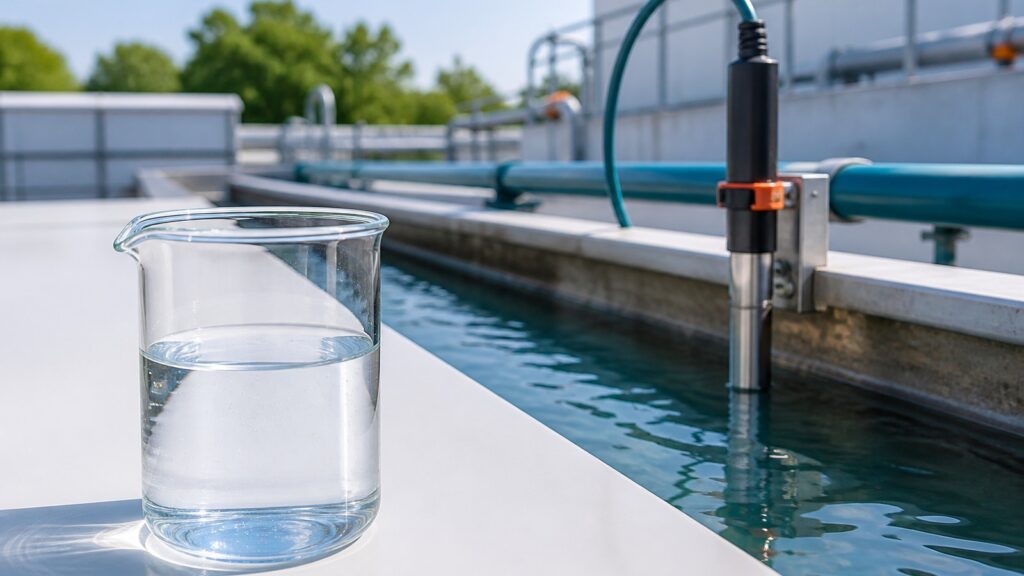
Indonesia’s SPARING regulation (PermenLHK P.80/2019) requires continuous online COD monitoring across 9 of 12 mandatory industry sectors. BOD is not included. That decision is not arbitrary. BOD₅ relies on a 5-day biological incubation that no sensor technology can compress into a real-time reading. The sections below cover the technical differences in COD vs BOD wastewater parameters, how online COD sensors actually work (and where they fall short), and the effluent limits that apply to major Indonesian industry sectors.
What COD and BOD Actually Measure
COD (Chemical Oxygen Demand) quantifies the oxygen needed to chemically oxidize all organic matter in a wastewater sample, both biodegradable and non-biodegradable, using potassium dichromate (K₂Cr₂O₇) under acidic, high-temperature conditions. Results are available in 2–3 hours (EPA 410.4, ISO 15705).
BOD₅ (Biochemical Oxygen Demand) measures the oxygen consumed by microorganisms over a 5-day incubation at 20 °C in darkness (ISO 5815 / Standard Methods 5210B). Only the biodegradable fraction registers. Refractory compounds such as lignin, synthetic dyes, and industrial solvents do not contribute to the BOD₅ value.
For any given sample, COD is always equal to or higher than BOD. The gap between them? That is the organic fraction resisting biological degradation.
A technical nuance: COD does not oxidize inorganic ammonia, while BOD₅ can include nitrogenous oxygen demand if the test runs without a nitrification inhibitor. This matters when comparing results from laboratories using different protocols.
| Parameter | COD | BOD₅ |
|---|---|---|
| Measurement principle | Chemical oxidation (K₂Cr₂O₇) | Biological oxygen consumption |
| Analysis time | 2–3 hours | 5-day incubation |
| Fraction measured | Biodegradable + non-biodegradable | Biodegradable only |
| Real-time capable? | Yes (via UV254 proxy) | No |
| SPARING status | Mandatory (9 of 12 sectors) | Not included |
Why SPARING Requires COD, Not BOD
The reason comes down to physics, not regulatory preference. The BOD₅ method has a hard limitation.
BOD₅ is a standardized biological response (ISO 5815 / Standard Methods 5210B) requiring 5 days of incubation at a controlled temperature. No faster sensor can eliminate this delay. Microorganisms need those 5 days to metabolize organic substrates. No online BOD sensor replaces the BOD₅ laboratory test for regulatory compliance reporting, in Indonesia or anywhere else.
Real-time BOD estimation alternatives do exist: respirometry (15–60 minutes), UV optical surrogates, and microbial biosensors (5–20 minutes). All of these produce approximations, not the actual BOD₅ value recognized by regulation.
COD, by contrast, can be monitored continuously using UV254 sensors. PermenLHK P.80/2019 sets the minimum sensor specification for SPARING compliance: a measurement range of 10–1,400 mg/L with accuracy of ±10% or better (Annex III). Sensors meeting this specification can transmit data automatically to KLHK’s server every two minutes. That is something physically impossible for BOD₅.
To check whether your facility falls under one of the 12 mandatory SPARING sectors, see the guide on how to check SPARING applicability.
Indonesian Effluent Limits for COD and BOD by Industry
Allowable COD and BOD discharge limits vary by industry sector and the specific regulation that governs it. The table below summarizes limits for three major sectors:
| Industry Sector | Max COD | Max BOD | Regulation |
|---|---|---|---|
| Palm oil (CPO mills) | 350 mg/L | 100 mg/L | PermenLH 5/2014 |
| Pulp and paper | 150–350 mg/L | 60–150 mg/L | PermenLH 5/2014 Ann. XXXV |
| Textile (new regulation) | 30–50 mg/L | 125–150 mg/L | PermenLH 12/2025 |
| Textile (old, superseded) | 150 mg/L | 50 mg/L | PermenLH 5/2014 (superseded) |
PermenLH 12/2025 sharply tightened textile effluent limits. It comes with a 2-year transition period. Companies should verify the implementation timeline applicable to their specific sub-sector and discharge permit.
These limits also vary by sub-process and discharge volume. The figures above are summaries; always refer to the specific Annex of the applicable PermenLH for your operation.
How Online COD Sensors Work, and Where They Fall Short
Online COD sensors used in SPARING systems typically operate on the UV254 method, measuring ultraviolet absorbance at 254 nm. This is not a direct dichromate COD measurement like the laboratory test.
The COD value on a monitoring dashboard is the output of a mathematical model: a correlation between UV254 readings and laboratory dichromate COD results. This correlation is site-specific, valid only for the wastewater composition at that location.
If influent composition shifts noticeably (process chemical switch, seasonal variation, or cross-contamination), the UV254-to-COD correlation can become inaccurate and recalibration against fresh lab samples becomes necessary.
Interferences to watch for:
- Turbidity: suspended particles scatter the UV beam and cause COD overestimation. For more on how turbidity relates to suspended solids, see turbidity vs TSS: which measurement fits your water system.
- Nitrate: absorbs UV at wavelengths close to 254 nm, creating a false COD signal.
- Dyes and color: textile effluent with concentrated synthetic dyes can shift the absorbance spectrum disproportionately.
- Optical window fouling: deposits on the sensor window gradually drift readings over time.
UV254 sensors have clear advantages. Response time is under 10 seconds. There are no hazardous chemical reagents (no Cr(VI) waste like the lab dichromate method), and the data stream is continuous. COD sensors such as the BOQU and RK500-25 are designed for continuous field operation, but reading accuracy depends on maintained calibration and periodic validation against lab results. Managing sensor data quality is an integral piece of the SPARING reporting chain.
When Online COD Is Sufficient, and When Lab BOD Still Matters
Online COD via UV254 already satisfies SPARING compliance reporting to KLHK. It also gives operators real-time data for WWTP process control. But laboratory BOD₅ remains necessary in several contexts:
- Biological treatment optimization. The BOD/COD ratio determines whether a biological WWTP is running efficiently or needs additional pre-treatment such as AOP (Advanced Oxidation Process). Without BOD₅ data, operators cannot directly evaluate the effectiveness of aerobic or anaerobic treatment stages.
- Internal management reporting. Environmental departments still use BOD₅ as a primary indicator in sustainability reports and internal audits because it communicates more intuitively to non-technical stakeholders.
- Periodic environmental audits. Inspections by regional environmental agencies or third-party auditors may require BOD₅ data as a separate confirmation alongside online COD records.
A practical approach: establish a COD/BOD ratio from at least 10 historical sample pairs with stable composition. Once that ratio is stable, online COD can serve as an indirect BOD estimate, and laboratory BOD₅ testing frequency drops without losing visibility into biodegradability.
One caveat: BOD₅ laboratory variability is itself quite high. A multi-laboratory study in the UK recorded inter-laboratory coefficients of variation from 12.5% to 53%. BOD₅ is not a perfectly consistent gold standard. Factor this in when comparing results from different laboratories.
COD/BOD Ratio: What It Tells You About Your Wastewater
The BOD/COD ratio is a practical biodegradability indicator that directly informs treatment design:
- ≥ 0.5: highly biodegradable, suitable for biological treatment (aerobic or anaerobic)
- 0.3–0.5: moderately biodegradable, biological treatment can work with optimization
- 0.1–0.3: poorly biodegradable, requires AOP or chemical pre-treatment first
- < 0.1: refractory, conventional biological treatment is not effective
Sector-specific data puts these ranges in context:
Palm oil (raw POME). COD ranges from 15,000–100,000 mg/L, BOD from 10,250–43,750 mg/L, with a BOD/COD ratio around 0.5. Highly biodegradable; staged anaerobic-aerobic treatment is generally effective before discharge.
Textile (dyeing). COD 800–3,000 mg/L, BOD 200–600 mg/L, BOD/COD ratio only 0.15–0.30. Synthetic dyes and process auxiliaries resist biological breakdown. AOP or coagulation-flocculation is needed as pre-treatment before the biological stage.
Food and beverage (dairy, brewery). BOD/COD ratios reach 0.55–0.70, which is highly biodegradable. Biological treatment performs well, and removal efficiency can be very high without complex chemical pre-treatment.
The practical implication: these ratios help determine whether an existing biological WWTP is operating within its design capacity, or whether changes in wastewater characteristics indicate the need for additional pre-treatment. Online COD monitoring covers half of this equation continuously; periodic BOD₅ testing fills in the rest.
If you need a COD sensor for SPARING compliance or to improve WWTP process control, contact the Fortuna Argatech technical team for specification and configuration guidance matched to your industry sector.
Share this article
Share this insight with your team.
Related Articles
Similar topics from the same category.

Poor weather station placement can cause 50% data bias. Learn the WMO-No. 8 and Indonesian BMKG siting standards for AWS sensors in industrial and mining sites.

Explore a technical engineering comparison between solid-state ultrasonic anemometers and mechanical cup-and-vane sensors for industrial weather stations.

Technical guide to conductivity sensors: comparing toroidal (inductive), 2-electrode, and 4-electrode contacting probes for industrial water and wastewater.