NH₃-N Sensor for Wastewater Monitoring: ISE or Colorimetric?
A guide to choosing an NH₃-N sensor for wastewater monitoring: ISE vs colorimetric, K⁺ interference, and SPARING compliance implications.
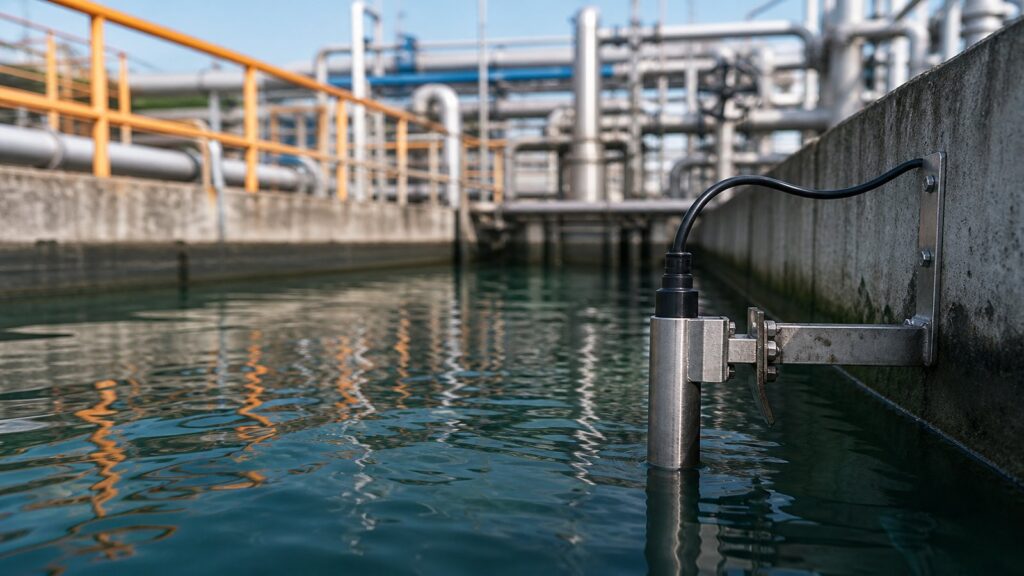
NH₃-N (ammonia nitrogen) sits in a different position from other continuous monitoring parameters like COD or pH. The difference is not that it is harder to measure, but that the sensor technologies available for it run on fundamentally different principles and carry different limitations. Which NH3-N wastewater sensor an operator installs, and how it is configured, determines whether the data reaching the regulatory server is actually dependable.
In Indonesia, PermenLHK P.93/2018 (as amended by P.80/2019) mandates continuous online monitoring through the SPARING system for 12 industry types. Four parameters are universal across all of them: pH, COD, TSS, and flow rate. NH₃-N is not one of those four. It is an additional parameter required only for specific sectors, and the accuracy standard set by the regulation is the same as for other parameters: plus or minus 10%.
The two main technologies for online NH₃-N measurement differ more than most operators expect. What follows covers how each one works, where it falls short, and what to verify before connecting a sensor to a compliance reporting system.
NH₃-N in SPARING: Which Industries Are Required?
NH₃-N is a supplementary parameter mandated for specific sectors: textiles, petrochemicals, palm oil processing, and industrial estates, among others. The full sector-by-sector breakdown is in the annexes of PermenLHK P.93/2018. Operators should check the annex that applies to their specific industry.
One distinction matters here: discharge limits (the maximum concentration allowed in industrial effluent) are not the same thing as ambient water quality standards (the quality thresholds for receiving water bodies). PermenLHK 5/2014 sets NH₃-N discharge limits per industry sector, while PP 22/2021 sets ambient surface water quality at 0.5 mg/L for Class I. They regulate different things and serve different purposes.
Representative discharge limits under PermenLHK 5/2014:
| Industry | NH₃-N Discharge Limit (mg/L) | Source |
|---|---|---|
| Leather tanning | 0.5 | PermenLHK 5/2014 |
| Plywood | 4 | PermenLHK 5/2014 |
| Rubber (dry form) | 5 | PermenLHK 5/2014 |
| Tobacco (primary process) | 3 | PermenLHK 5/2014 |
| Rubber (latex concentrate) | 15 | PermenLHK 5/2014 |
Limits vary by industry and subprocess. Operators must check the applicable annex for their specific sector.
This variation is not a regulatory footnote. It directly shapes which sensor technology is appropriate, because the accuracy a sensor needs depends on how tight the limit is.
Two Technologies for NH₃-N Measurement: ISE and Colorimetric
Ion Selective Electrode (ISE) sensors use an ion-selective membrane to measure the activity of NH₄⁺ ions in solution, then convert that reading to NH₃-N concentration. ISE sensors need no reagents at all. They respond in seconds and can be deployed directly immersed in a wastewater channel without a complex sample extraction setup. Operating costs stay low because there are no consumable chemicals to purchase, store, or dispose of.
The limitation shows up at low concentrations. Below 0.5 mg/L NH₄-N, ISE calibration becomes unreliable. That threshold is directly relevant for industries like leather tanning, where the discharge limit sits exactly at 0.5 mg/L, so the sensor needs to be accurate right at the regulatory boundary.
Colorimetric sensors (wet chemistry) use a chemical reaction (typically the indophenol or Berthelot method) to quantify NH₃-N. Their main advantage is accuracy at very low concentrations, reaching detection limits down to 0.02 mg/L NH₄-N. The trade-off: colorimetric sensors require reagents that generate chemical waste, each measurement cycle takes 15 to 45 minutes, and routine maintenance includes replacing reagent stocks and tubing. Operating costs run higher than ISE.
A practical framework based on multiple sources (not an absolute rule): for discharge limits below 1 mg/L, colorimetric tends to deliver more dependable accuracy. For limits above 5 mg/L, ISE is generally adequate.
K⁺ Interference: A Physical Limitation ISE Operators Should Know
Potassium ions (K⁺) interfere with ISE ammonia readings. The reason is physical: the ionic radius of K⁺ (0.133 nm) is nearly identical to NH₄⁺ (0.143 nm), so the ion-exchange membrane cannot fully distinguish between the two. This is not a flaw in a particular sensor design. It is a material-level limitation of ISE membranes.
The K⁺ selectivity coefficient is 0.1. In practical terms, for every 1 mg/L of K⁺ present in the sample, the ISE adds approximately 0.1 mg/L of false NH₄-N to its reading. As an illustrative example: if a wastewater stream contains 20 mg/L K⁺ and 5 mg/L actual NH₄-N, an uncompensated ISE would read approximately 7 mg/L, an error of +2 mg/L above the true value. This is an illustrative example; actual K⁺ concentrations vary by site and industry.
The engineering solution is a secondary K⁺ electrode that independently measures potassium concentration and subtracts its contribution from the NH₄⁺ reading. This option is available from several ISE sensor manufacturers and is particularly relevant for industrial wastewaters with elevated potassium content.
NH₃-N, NH₄-N, NH₄⁺, and TAN: Units That Matter for Compliance Reporting
NH₃-N (ammonia nitrogen), NH₄-N (ammonium nitrogen), NH₄⁺ (ammonium ion), and TAN (total ammonia nitrogen) are not interchangeable quantities. The conversion operators need to remember: mg/L NH₄⁺ = mg/L NH₄-N x 1.288.
Indonesian regulations (including PermenLHK 5/2014 and SPARING requirements) report in NH₃-N (ammonia as nitrogen). Before connecting a sensor to a SPARING reporting system, operators should verify what unit the sensor outputs and whether the data logger or platform performs automatic conversion. A unit mismatch at the sensor level can cause incorrectly formatted data to be transmitted to Indonesia’s KLHK server. The problem may not surface during daily operations; it tends to show up during audits.
Online Monitoring and Formal Compliance: Where the Boundary Lies
Online ISE sensors work well for process control, early warning, and operational trend monitoring. For formal compliance reporting, particularly where discharge limits are tight, operators should confirm whether the sensor’s measurement method satisfies the requirements specified in their environmental permit. WizSensor explicitly recommends using the permit-specified method for formal regulatory reporting.
SPARING regulations require plus or minus 10% accuracy. To verify that an NH₃-N sensor meets this threshold consistently, operators should run periodic comparison checks against laboratory reference analysis. This is not optional paperwork. It is the mechanism that confirms whether the data entering the KLHK server is actually representative. For ISE sensors in industrial wastewater, recommended calibration intervals are 14 to 21 days, depending on the wastewater matrix.
Choosing the right NH₃-N sensor starts with knowing the discharge limit for your specific industry and subprocess, assessing the K⁺ concentration in your wastewater, and determining whether your primary need is real-time process visibility or high-accuracy compliance data. From there, sensor maintenance scheduling and integration with a data quality validation system are the next practical steps. For guidance on whether your industry is subject to SPARING requirements and which parameters apply, see the mandatory SPARING industries guide.
Share this article
Share this insight with your team.
Related Articles
Similar topics from the same category.

Poor weather station placement can cause 50% data bias. Learn the WMO-No. 8 and Indonesian BMKG siting standards for AWS sensors in industrial and mining sites.

Explore a technical engineering comparison between solid-state ultrasonic anemometers and mechanical cup-and-vane sensors for industrial weather stations.

Technical guide to conductivity sensors: comparing toroidal (inductive), 2-electrode, and 4-electrode contacting probes for industrial water and wastewater.