Guard Bands and Decision Rules: When Can an Online Sensor Declare Compliance?
Guard bands and decision rules for monitoring sensors: ILAC G8 4-zone model, SPARING pH example, documenting compliance decisions.

A pH sensor on your effluent line reads 8.95. The regulatory limit is 9.0. Is the discharge compliant? If you compare the number directly to the limit and conclude yes, you have made a compliance decision, but not a defensible one. That sensor carries measurement uncertainty. With a specification of ±0.3 pH units, the true value could be anywhere between 8.65 and 9.25. The reading falls within the limit, but the uncertainty interval extends well beyond it.
This is the problem guard bands and decision rules are designed to solve. Measurement uncertainty sensor readings near a regulatory boundary create an ambiguous zone where a direct comparison is insufficient. International frameworks (Eurachem/CITAC, ILAC G8, and ISO 17025) give structured methods for interpreting those borderline readings. Applying them to continuous environmental monitoring, where SPARING and ONLIMO sensors generate hundreds of data points per day, turns a theoretical laboratory concept into a daily operational question.
What Is a Guard Band?
A guard band is a margin between the regulatory limit and the point at which you accept a measurement as conforming. Instead of treating the limit itself as the dividing line, the effective acceptance limit is pulled inward by a distance g, the guard band width.
The purpose is quantitative: reducing the probability of false acceptance (PFA). Under simple acceptance (any reading at or below the limit is declared conforming), a measurement exactly at the limit has up to a 50% probability that the true value actually exceeds it (Eurachem MUC 2021 Section 4.2; ILAC G8 Table 1). That probability drops sharply once a guard band is applied. Setting the guard band equal to the expanded uncertainty U reduces PFA to less than 2.5%. Setting it to 1.64 times the standard uncertainty u gives a PFA of 5% (Eurachem MUC 2021 Section 4.3). A guard band of 1.5U pushes PFA below 0.16%.
These calculations assume a normal distribution, which holds when relative standard uncertainty is below approximately 15–20%. Above that range, other distributions may apply, and the guard band sizing needs a more detailed uncertainty budget.
Four Decision Zones
ILAC G8:09/2019 defines four types of decision rules: binary simple acceptance, binary with guard band, non-binary with guard band, and shared risk. For environmental monitoring sensors (where a single data point rarely triggers immediate enforcement action but patterns near the limit accumulate), the non-binary 4-zone model is the most informative.
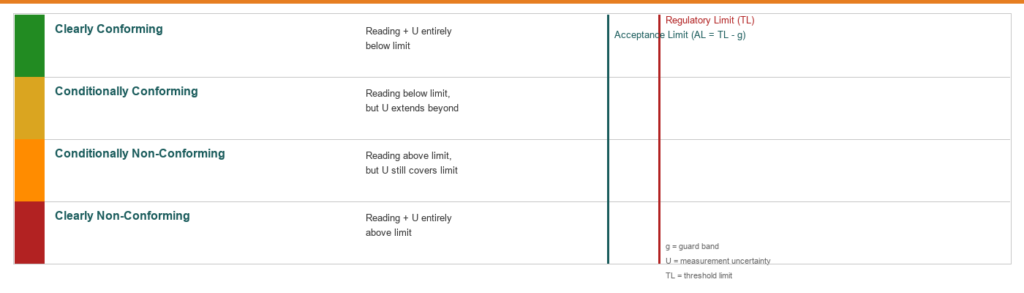
The four zones, defined relative to a regulatory upper limit and the expanded uncertainty U of the sensor:
- Clearly conforming: the measured value plus its uncertainty interval falls entirely below the limit. Compliance can be stated with high confidence.
- Conditionally conforming: the measured value is below the limit, but the uncertainty interval extends beyond it. Conformance is stated at a defined probability, not absolute certainty.
- Conditionally non-conforming: the measured value exceeds the limit, but the uncertainty interval extends below it. Non-conformance is stated at a defined probability.
- Clearly non-conforming: the measured value minus its uncertainty interval falls entirely above the limit. Non-compliance can be stated with high confidence.
The conditional zones are where operational judgment applies. A reading in the conditionally conforming zone is not the same as a failure, but neither is it the same as a reading deep within the acceptable range. The 4-zone model makes that distinction visible rather than hiding it behind a binary pass-or-fail comparison.
Worked Example: SPARING pH Sensor Near the Limit
PermenLHK P.80/2019 specifies a SPARING pH sensor accuracy requirement of ±0.3. Typical SPARING pH sensors have accuracy from ±0.05 to ±0.3 pH units depending on the sensor model.
Take a sensor with accuracy ±0.3 pH units. Using a coverage factor k = 2, the expanded uncertainty is approximately U = 0.3 pH units. This is a simplified illustration. The actual expanded uncertainty depends on the complete uncertainty budget, including calibration state, drift since last verification, temperature compensation, and data logger resolution.
The regulatory upper limit for pH is 9.0. The sensor reads 8.95.
- Measurement interval: 8.95 ± 0.3, so 8.65 to 9.25.
- Zone determination: the reading (8.95) is below the limit (9.0), but the upper bound of the uncertainty interval (9.25) exceeds it. This falls in the conditionally conforming zone.
- Under simple acceptance: the reading 8.95 < 9.0 is declared conforming. PFA is high: the true value could exceed 9.0.
- Under guarded acceptance (guard band g = U = 0.3): the acceptance limit becomes 9.0 − 0.3 = 8.70. The reading 8.95 is above the acceptance limit of 8.70, so it does not pass guarded acceptance. It sits in the conditional zone. The reading alone cannot confirm compliance with high confidence.
The same framework applies to COD (±5% of full scale), TSS (±1%), and any ONLIMO parameter with a defined accuracy specification and a regulatory limit.
Does Indonesian Regulation Require Guard Bands?
PermenLHK P.80/2019 (amending P.93/2018) specifies sensor accuracy requirements for SPARING systems: pH ±0.3, COD ±5% FS, TSS ±1%, NH₃-N ±5% FS. It does not explicitly address guard bands, decision rules, or how measurement uncertainty should factor into compliance assessment near regulatory limits.
ISO/IEC 17025:2017 Clause 7.1.3 requires that decision rules be agreed when conformity statements are issued. Clause 7.8.6.1 requires documented decision rules that include consideration of the risk level, specifically the probability of false acceptance or false rejection. KAN Pd-01.01 Rev.1 implements ILAC G8 decision rule requirements for accredited Indonesian laboratories, though most SPARING operators are industrial companies rather than accredited laboratories.
The regulatory gap is clear: sensor accuracy is specified, but the framework for interpreting borderline results is not. Guard bands and documented decision rules are not an Indonesian regulatory mandate for SPARING operators. They are international best practice under ISO 17025 and ILAC G8. Applying them is a risk-management decision: how much false-acceptance probability is your compliance program willing to carry?
Practical Steps: Document Your Decision Rule
Knowing that measurement uncertainty sensor data carries an ambiguous zone near any regulatory limit leads to a specific set of actions:
- Know the expanded uncertainty U for each sensor parameter. The sensor specification sheet gives the starting point. Drift since the last field calibration verification, temperature compensation error, and data logger resolution add to the budget.
- Choose a decision rule and document it. Simple acceptance (no guard band) is a valid choice, but it should be a documented, deliberate choice with acknowledged PFA, not a default that nobody examined. Binary guarded acceptance or the non-binary 4-zone model are alternatives.
- Apply the 4-zone model near limits. When a sensor reading falls within U of a regulatory limit, flag it for review rather than treating it as an unambiguous pass or fail. Data quality flag systems can incorporate this logic.
- Cross-reference with laboratory analysis. For conditionally conforming readings, comparing the online sensor value against a concurrent laboratory sample gives independent evidence for the compliance decision.
- Review periodically. Sensor uncertainty changes with calibration state. After each field verification cycle, reassess whether the guard band width is still appropriate.
When the Test Uncertainty Ratio (TUR, the ratio of the regulatory tolerance to the sensor expanded uncertainty) is 4:1 or better, ILAC G8 Section 5.2 permits simple acceptance without a guard band. For most environmental monitoring sensors, TUR is well below 4:1, which is precisely why the question of guard bands arises.
The underlying point is not that every borderline reading is a violation. It is that declaring compliance without accounting for measurement uncertainty is a decision with undisclosed risk. Documenting the decision rule, whichever one you choose, makes the risk explicit and the compliance record defensible.
Share this article
Share this insight with your team.
Related Articles
Similar topics from the same category.

Poor weather station placement can cause 50% data bias. Learn the WMO-No. 8 and Indonesian BMKG siting standards for AWS sensors in industrial and mining sites.

Explore a technical engineering comparison between solid-state ultrasonic anemometers and mechanical cup-and-vane sensors for industrial weather stations.

Technical guide to conductivity sensors: comparing toroidal (inductive), 2-electrode, and 4-electrode contacting probes for industrial water and wastewater.