Field Calibration Verification: Procedure, Standards, and Acceptance Criteria
Field calibration verification for pH, DO, conductivity, turbidity, parameter order, reference standards, EPA drift criteria.
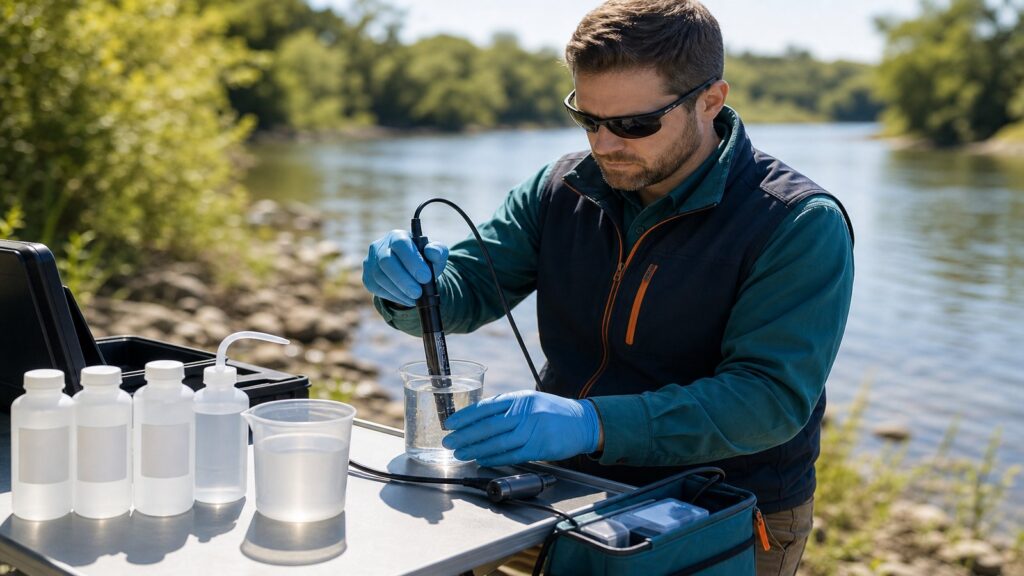
Sensors drift. A pH probe that passed lab calibration three months ago could be reading 0.4 units off right now, and nobody would know until the next grab sample comes back from the lab. Field calibration verification catches that drift on-site, using traceable reference standards and documented acceptance criteria, before weeks of compromised data pile up. ISO 17025:2017 (Clause 6.4.10) requires intermediate checks of equipment between calibrations according to a defined procedure. For monitoring systems like ONLIMO and SPARING, where sensors report pH, dissolved oxygen, conductivity, and turbidity continuously, those intermediate checks are the only real defense between scheduled lab calibrations.
This article consolidates EPA post-calibration drift criteria and the USGS-recommended parameter order with ISO 17025 intermediate check requirements into a single multi-parameter field verification procedure.
Verification Is Not Recalibration
Verification checks whether a sensor still reads within acceptable limits. Calibration adjusts the sensor response to match traceable standards. Different operations, different consequences. Verification preserves the existing calibration: if the sensor passes, the data collected since the last check remains valid without qualification. Recalibration resets the reference point. Any data collected under a drifted calibration must then be evaluated against the magnitude of the drift.
ISO 17025:2017 Clause 6.4.4 also requires that equipment be verified before being placed or returned into service. A sensor returning from maintenance or storage should pass a field verification check before its readings are treated as valid.
In practical terms: bring reference standards to the monitoring station and compare the sensor reading against them. Record the result. Do not adjust the sensor unless it fails. The goal is evidence, not correction.
Equipment and Reference Standards Needed
Field calibration verification requires traceable reference standards for every parameter the station monitors. Each standard must have a documented lot number and expiration date. Storage history matters too: expired or improperly stored standards invalidate the entire verification. I have seen teams drive two hours to a remote station only to discover their pH 7 buffer expired the previous month. Check before you leave.
For a typical environmental monitoring station measuring temperature, specific conductance (SC), pH, dissolved oxygen (DO), and turbidity, the equipment list includes:
- Temperature: NIST-traceable thermometer or certified RTD probe.
- Specific conductance: Certified conductivity standard (e.g., 1000 µS/cm), matched to the expected measurement range.
- pH: At least two certified pH buffers (e.g., pH 4.00, 7.00, and 10.00), selected to bracket the expected measurement range.
- Dissolved oxygen: Air-saturated water prepared on-site or a zero-oxygen solution (sodium sulfite). Record barometric pressure and water temperature to calculate the expected saturation value.
- Turbidity: Formazin primary standard or a stable secondary standard (e.g., StablCal) with a certified NTU value.
Additional supplies: deionized or distilled rinse water, clean beakers or calibration cups, lint-free wipes, and a field verification log sheet. Bring a barometer if DO verification requires a saturation calculation.
Check expiration dates and storage conditions of all reference solutions before leaving for the station.
Parameter Verification Order: Start with Temperature
The order in which parameters are verified is not arbitrary. USGS TM 9-A6.8 recommends verifying from low to high ionic strength of calibration standards to reduce the possibility that residual standards will bias subsequent checks.
The recommended order is:
- Temperature – verify first because pH, DO, and conductivity readings are temperature-compensated. An inaccurate temperature reference propagates errors into every other parameter.
- Specific conductance – uses a relatively clean standard that is less likely to contaminate the pH electrode.
- pH – buffer solutions are more concentrated; verify after SC to avoid contaminating the conductivity cell.
- Dissolved oxygen is typically verified against air-saturated water, which does not introduce ionic contamination. No special sequencing concern here.
- Turbidity – verified last. Formazin and similar standards leave residue that is difficult to rinse from other sensor surfaces.
Rinse sensors at least three times with deionized water between different standard solutions. Wait for readings to stabilize within USGS criteria before recording. Temperature stabilization should reach ±0.2 °C. pH readings should settle within ±0.1 pH units before the value is considered final.
Acceptance Criteria and Actions per Parameter
Field calibration verification produces a measurable drift value for each parameter. Without a threshold, that number means nothing. EPA EQASOP-FieldCalibrat3 (Rev. 3, 2017) provides post-calibration drift criteria for multiparameter instruments, summarized in the table below.
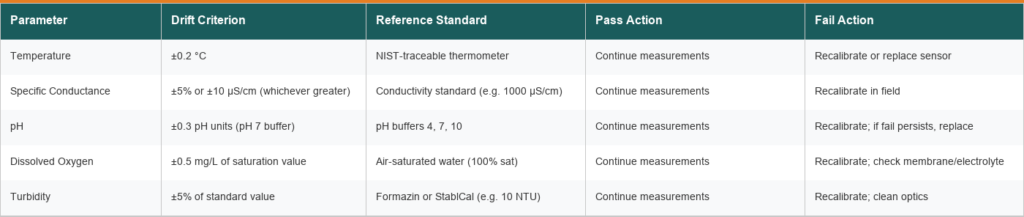
| Parameter | EPA drift criterion | Action if within criterion | Action if exceeded |
|---|---|---|---|
| Temperature | ±0.2 °C | Pass — continue monitoring | Investigate thermometer or RTD; verify against a second reference |
| Specific conductance | ±5 % of standard, or ±10 µS/cm (whichever is greater) | Pass — continue monitoring | Recalibrate; qualify data collected since last passing check |
| pH | ±0.3 pH units (checked in pH 7 buffer) | Pass — continue monitoring | Recalibrate with fresh buffers; qualify data since last passing check |
| Dissolved oxygen | ±0.5 mg/L of saturation value | Pass — continue monitoring | Recalibrate; check membrane or optical cap condition; qualify data |
| Turbidity | ±5 % of standard value | Pass — continue monitoring | Recalibrate with fresh formazin or StablCal; qualify data |
These are EPA default criteria. Actual acceptance thresholds depend on the project’s quality assurance project plan (QAPP) and applicable regulatory requirements. Manufacturer specs may be tighter. When drift exceeds acceptance criteria, qualify all data collected since the last passing verification and schedule recalibration.
For SPARING-connected systems operating under Indonesian regulations, PermenLHK P.93/2018 (Pasal 9) requires sensor calibration monthly but defers SOP details to manufacturer manuals or other valid references. EPA and USGS criteria serve as internationally recognized references for defining the intermediate check procedure that the regulation does not specify.
A sensor that fails verification should be recalibrated on-site if the field team has the approved procedure and equipment. Otherwise, flag it. Document the drift magnitude, schedule a service visit. Do not leave a failed sensor reporting data without a qualification flag. That is how you end up with a month of pH readings that regulators later throw out.
Documenting and Tracing Verification Results
Verification without documentation is not traceable. It cannot support compliance claims. Each field verification event should record, at minimum:
- Station and sensor identification – which instrument at which location.
- Date, time, and conditions – ambient temperature, weather, water conditions during verification.
- Parameter verified and the reference standard used, including lot number and certified value. Note the expiration date.
- Measured value – the sensor reading in the reference standard, after stabilization.
- Acceptance result – pass, marginal, or fail, referencing the applied criterion.
- Action taken – none (pass), data qualified and recalibration scheduled (fail), or sensor removed if no field recalibration option exists.
- Technician name and signature.
This log connects to ISO 17025:2017 Clause 6.4.10, which requires that intermediate check results be maintained and accessible. For stations reporting under PermenLHK P.93/2018, the verification log provides evidence that the monthly calibration obligation is being met with a documented procedure.
Where online sensor readings and lab results differ, the verification log is the first place to check whether the sensor was within acceptance criteria at the time of the discrepancy. It also supports pH-specific troubleshooting by establishing whether drift was already present before a fault was reported.
Integrate the field verification log into the station’s preventive maintenance program so that verification events are tracked alongside sensor replacement and calibration history.
Next Step
Define a field verification schedule for each monitoring station based on the sensor types deployed and the local environmental conditions. Factor in manufacturer guidance and regulatory requirements. Use EPA drift criteria as the baseline acceptance thresholds, adapt them to local QAPP requirements, and assign clear responsibility for executing each verification event.
ONLIMO and SPARING stations use pH, DO, conductivity, and turbidity sensors that all require periodic field calibration verification. The data logger connects sensor readings to the dashboard, but the logger trusts whatever the sensor reports. Sensor accuracy must be verified independently. In my experience, the stations that run verification on a fixed schedule rather than waiting for anomalies produce far fewer data qualification events over the course of a year.
Sources
- EQASOP-FieldCalibrat3: Calibration of Field Instruments, Rev. 3, US EPA Region 1, March 2017.
- TM 9-A6.8: Use of Multiparameter Instruments for Routine Field Measurements, US Geological Survey, November 2023.
- ISO/IEC 17025:2017 — General requirements for the competence of testing and calibration laboratories, ISO, 2017.
- PermenLHK P.93/MENLHK/SETJEN/KUM.1/8/2018 — Pemantauan Kualitas Air Limbah Secara Terus Menerus dan Dalam Jaringan (SPARING), Kementerian LHK, 2018.
- ONLIMO, Fortuna Argatech.
- SPARING, Fortuna Argatech.
Share this article
Share this insight with your team.
Related Articles
Similar topics from the same category.

Poor weather station placement can cause 50% data bias. Learn the WMO-No. 8 and Indonesian BMKG siting standards for AWS sensors in industrial and mining sites.

Explore a technical engineering comparison between solid-state ultrasonic anemometers and mechanical cup-and-vane sensors for industrial weather stations.

Technical guide to conductivity sensors: comparing toroidal (inductive), 2-electrode, and 4-electrode contacting probes for industrial water and wastewater.