What Monitoring Station Infrastructure Needs Preventive Maintenance?
A preventive maintenance guide for remote monitoring stations covering solar panels, batteries, enclosures, antennas, grounding, and data loggers.
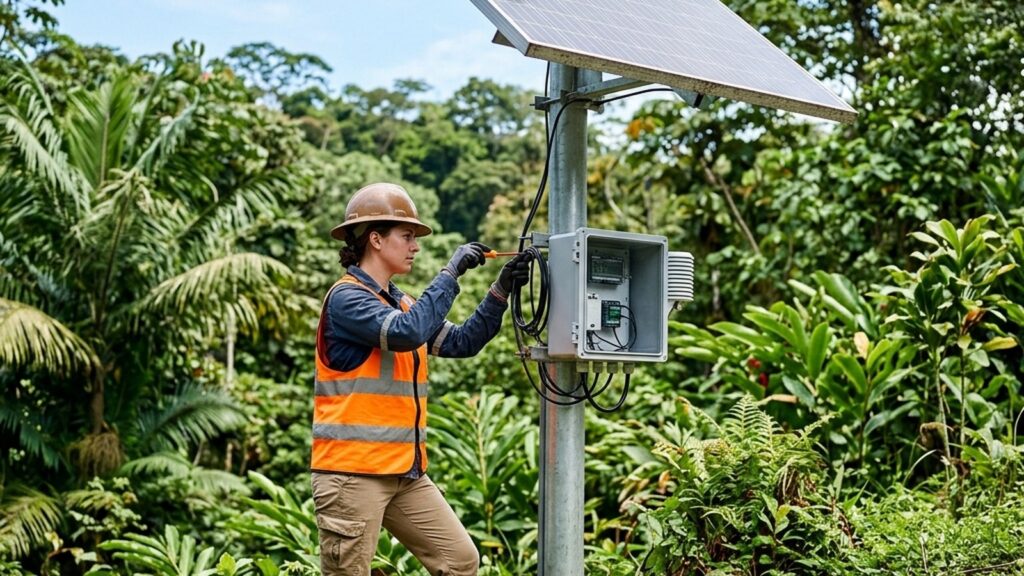
When data suddenly stops appearing on a dashboard, the first instinct is to check the sensor. In practice, the cause is often upstream — a depleted battery, a corroded terminal, or an expired SIM subscription. Preventive maintenance for monitoring stations means maintaining the entire support infrastructure, not just sensor probes, and that distinction determines whether a remote station delivers continuous data or recurring gaps.
This guide identifies the station infrastructure components that need scheduled attention and provides a framework for setting intervals based on site conditions rather than a fixed calendar.
Station Infrastructure Fails Differently from Sensors
Sensor probes have established calibration schedules and cleaning procedures that field teams know well. Station infrastructure — the solar power system, batteries, enclosure, connectivity hardware, and grounding — degrades gradually and often goes unnoticed until an entire station goes dark.
Infrastructure failures can look identical to sensor failures on a dashboard: missing readings, timestamp gaps, or halted transmissions. The distinguishing pattern is that infrastructure problems typically affect all data channels simultaneously, not just a single parameter. If every channel goes dark at once, check the power supply and connectivity before replacing sensors.
At remote sites, the time between detecting a failure and completing a repair can be significant. One planned maintenance visit is far more efficient than three emergency trips.
Solar Panel and Charge Controller Maintenance
Solar panels are the primary power source for off-grid monitoring stations. Panel output drops when the surface accumulates dust, bird droppings, pollen, or organic debris. Output losses from soiling can reach 15–25 % if panels are left uncleaned through a prolonged dry period. At dusty sites or near mining operations, soiling rates can be considerably higher and may require monthly cleaning.
Solar power maintenance includes:
- Surface cleaning — wash with water and a soft cloth; avoid abrasive materials that scratch the anti-reflective coating.
- Wiring and connector inspection — check for terminal corrosion, loose connections, and UV-damaged insulation.
- Shading assessment — vegetation growth and new structures can shade panels that were originally unobstructed.
- Charge controller status — verify that LED indicators or display show normal charging mode, and confirm settings have not been reset after a power event.
Battery Health and Replacement Planning
Batteries are frequently the single point of failure at remote monitoring stations. Corroded battery terminals increase resistance and can prevent proper charging or discharge.
Voltage measured under load provides a more useful indication of battery health than open-circuit voltage alone. Open-circuit voltage can appear normal even when capacity has dropped significantly. Measure voltage while the data logger and modem are actively transmitting — that is when peak load occurs.
Battery capacity degrades over charge-discharge cycles and with exposure to temperature extremes. In hot climates, degradation can outpace the manufacturer’s nominal cycle-life figures. Plan replacements based on actual capacity measurements rather than calendar age alone.
Enclosure, Cable, and Connector Integrity
Enclosure seals — gaskets and cable glands — degrade from UV exposure, temperature cycling, and material aging. An IP rating describes new-condition performance; field protection depends on the current state of the seals.
Corroded connectors and terminal blocks inside enclosures cause intermittent signal loss or measurement errors that are difficult to trace. These issues do not always present as clear errors on a dashboard — they sometimes appear as data drift or sporadic readings.
Check cable gland tightness as well, especially after any site work or cable movement. A loose cable gland is an entry path for water and insects.
Antenna, Connectivity, and Data Logger Checks
Cellular signal strength at a site can change over time due to carrier infrastructure changes, vegetation growth around the antenna, or degradation of the antenna cable and connectors. SMA and N-type connectors exposed to weather over time can gradually increase signal loss. Track RSSI trends, not just online/offline status.
Verify the following connectivity items during each visit:
- SIM card — confirm the subscription is active and data allocation is sufficient; expired plans cause silent transmission failures with no alarm.
- Data logger clock — RTC drift accumulates over time; verify time accuracy or confirm that NTP/GPS synchronization is functioning.
- Firmware — record the current firmware version and check whether relevant updates are available.
Grounding and Lightning Protection Verification
Ground electrode resistance increases over time as soil moisture changes, the electrode corrodes, and the surrounding soil is disturbed. Periodic ground resistance measurements confirm that the lightning protection system remains effective.
Surge protection devices (SPDs) have status indicators that show whether the device has been triggered and may need replacement. Check these indicators during every maintenance visit — a triggered SPD may no longer provide full protection. In regions with high lightning density, SPD inspection should be part of every quarterly visit.
Also inspect bonding conductors and grounding connections for corrosion or detached joints.
Building a Site-Specific Maintenance Schedule
Fixed maintenance intervals — such as “clean panels every three months” — do not fit every site. Coastal stations need more frequent corrosion checks, dusty locations need more frequent panel cleaning, and stations in extreme temperatures need more intensive battery monitoring.
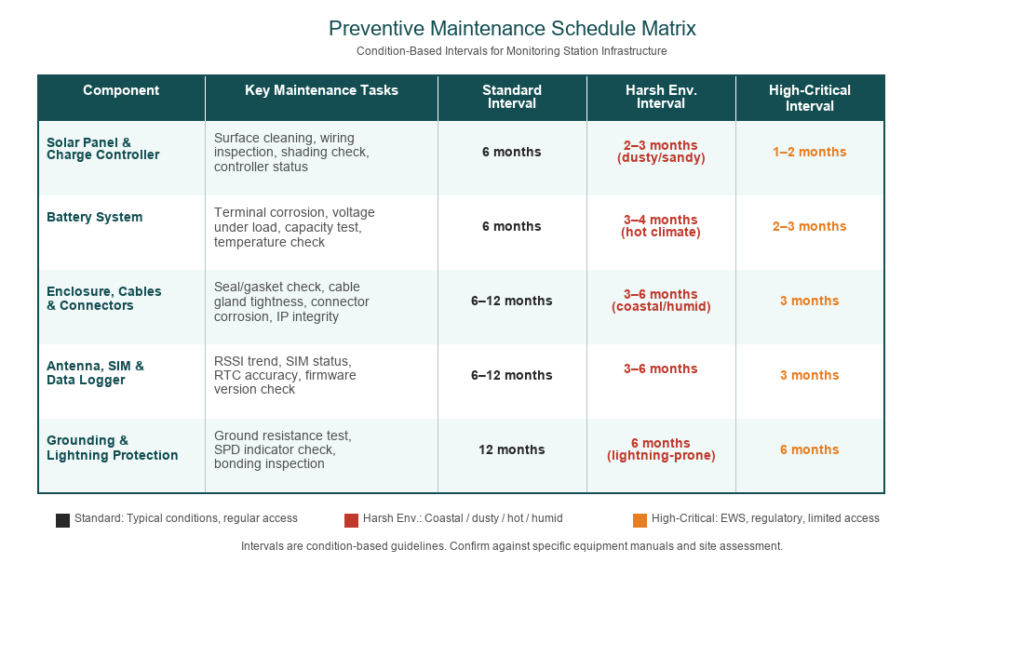
A more effective approach adapts intervals based on:
- Environmental conditions — coastal, dusty, humid, high-temperature, or a combination.
- Access frequency — sites that can only be visited quarterly require more thorough checks at each visit.
- Data criticality — stations supporting early warning systems or regulatory compliance need tighter intervals.
Record conditions, actions, and findings at every visit. A consistent maintenance log supports trend analysis and schedule optimization — the result is a schedule that improves over time, not just a routine.
After the initial commissioning is complete, preventive infrastructure maintenance determines whether a monitoring station continues delivering reliable data or becomes a source of recurring gaps. Fortuna Argatech provides maintenance and after-sales support for monitoring systems — contact our team to discuss a maintenance schedule suited to your site conditions.
Share this article
Share this insight with your team.
Related Articles
Similar topics from the same category.
Poor weather station placement can cause 50% data bias. Learn the WMO-No. 8 and Indonesian BMKG siting standards for AWS sensors in industrial and mining sites.
Explore a technical engineering comparison between solid-state ultrasonic anemometers and mechanical cup-and-vane sensors for industrial weather stations.

Technical guide to conductivity sensors: comparing toroidal (inductive), 2-electrode, and 4-electrode contacting probes for industrial water and wastewater.