Outdoor Monitoring Station Enclosure Design: 5 Decisions That Prevent Field Failures
Five enclosure design decisions that determine whether your outdoor monitoring station survives or fails: material, IP, thermal, cable entry, layout.
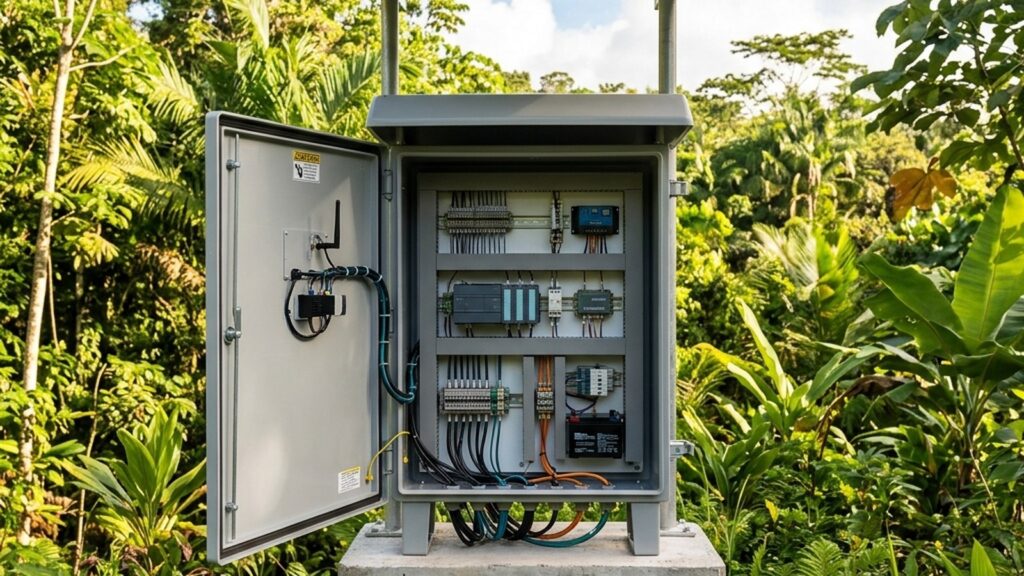
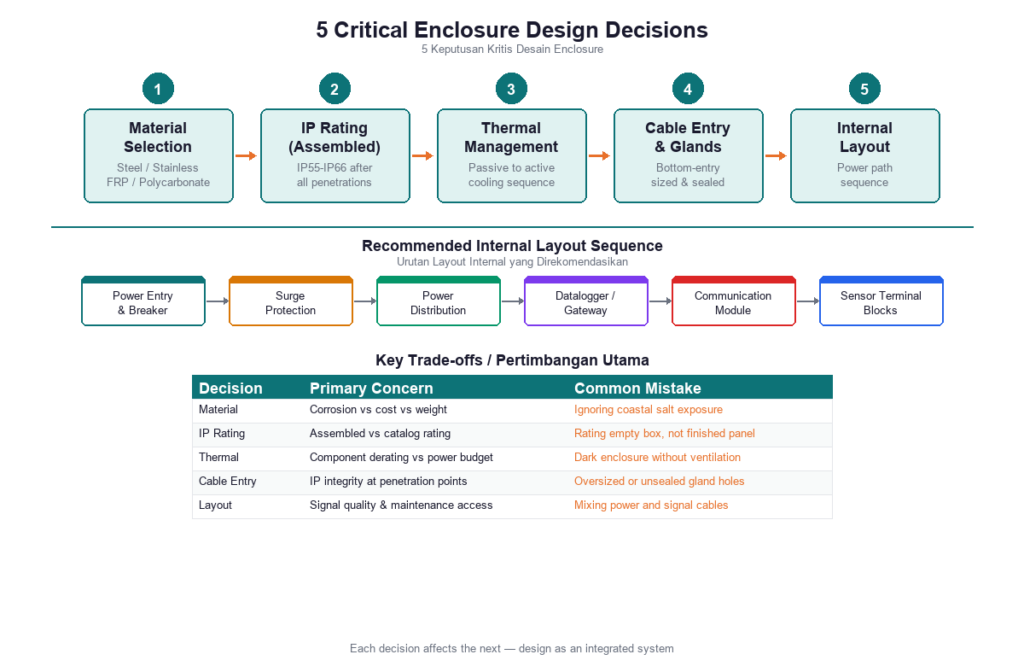
The datalogger, power system, and communication module inside your outdoor monitoring enclosure face direct sun, driving rain, dust, humidity, insects, and sometimes vandalism. When the enclosure design is treated as an afterthought—selected by price or availability—it becomes the first point of failure, not the sensors. Five design decisions determine whether your field station runs reliably or generates recurring service calls: material, IP rating, thermal management, cable entry, and internal layout.
Decision 1: Enclosure Material—Steel, Stainless, Fiberglass, or Polycarbonate?
Material selection drives corrosion resistance, weight, field-modification options, and cost. Four common choices and their trade-offs:
- Powder-coated mild steel: Strong and affordable. Vulnerable to corrosion wherever the coating is scratched or penetrated, especially in coastal or chemically aggressive environments. Suitable for dry industrial sites with limited salt or chemical exposure.
- Stainless steel (304 or 316): Better corrosion resistance than mild steel. Grade 316, with its molybdenum content, handles chloride environments—coastal stations, wastewater treatment plants—more reliably. Heavier and more expensive.
- Fiberglass (FRP/GRP): Lightweight, corrosion-proof, and a better thermal insulator than metal. Easy to drill and modify for cable entries. Less resistant to heavy mechanical impact than metal enclosures.
- Polycarbonate: Transparent or translucent variants allow visual inspection without opening the door. Lightweight and UV-resistant in outdoor grades. Less rigid than metal or fiberglass for larger enclosure sizes.
No single material works for every site. Evaluate corrosion exposure at your installation location, the likelihood of field modifications, and your project budget before deciding. For monitoring stations in coastal or heavy-industrial environments, stainless steel 316 or fiberglass typically offers more protection than standard mild steel.
Decision 2: IP Rating for the Assembled Enclosure
Many project specifications list the IP rating from the empty-enclosure catalog. The problem: that rating applies to the enclosure as tested at the factory—before anyone drills holes for cable glands, antennas, vents, or additional connectors.
Under the IP code structure defined in IEC 60529, enclosure protection depends on the complete assembly: the body, door seal, every cable gland, and every penetration. A single improperly sealed cable entry can reduce the effective IP rating of the entire enclosure.
For most outdoor monitoring stations, IP55 to IP66 provides adequate protection against dust ingress and water jets. IP67 or IP68 ratings are typically relevant for submersible sensor probes, not for the main panel enclosure. The critical point is to verify that the IP rating you specify remains valid after all field modifications are complete.
Decision 3: Thermal Management in Tropical Conditions
Under direct sunlight, the internal temperature of a dark-colored metal enclosure can rise well above ambient. This accelerates battery degradation, shortens the lifespan of electronic components, and introduces drift in temperature-sensitive sensor readings.
Thermal management approaches, ordered from passive to active:
- Sun shield or rain canopy — A shade structure above the enclosure reduces direct solar radiation. Simplest solution with zero power consumption.
- Light-colored exterior finish — White or light gray enclosures reflect more solar radiation than dark finishes—basic physics that is frequently overlooked during procurement.
- Filtered ventilation — Vent openings with dust filters allow natural convection without compromising protection against insects and particulates.
- Thermostatically controlled fans — Fans activated by a thermostat draw outside air when internal temperature exceeds a set threshold. Low power draw, but they add one maintenance point.
- Active cooling — Thermoelectric coolers or small air conditioning units for extreme conditions. Significant power consumption—justified only when critical components cannot tolerate elevated temperatures.
For solar-powered monitoring stations, every watt consumed by active cooling must be factored into the solar panel and battery sizing for the system.
Decision 4: Cable Entry and Gland Planning
Cable entries are the weakest point of IP protection on a field enclosure. Three principles to follow:
Bottom-entry placement. Positioning cable glands at the bottom of the enclosure uses gravity as natural protection—water does not travel upward into glands. If the design requires side or top entries, install a drip loop on each cable before it enters the gland.
Size glands to the cable diameter. Every cable gland must match the diameter of the cable passing through it. An oversized gland cannot lock its seal properly, creating a gap for water and dust.
Seal every unused opening. Gland holes prepared for future expansion or spare cables must be closed with blanking plugs rated to the same IP level as the enclosure. One open hole negates the entire IP investment.
Plan the number and size of cable entries before fabrication. Field modifications to the entry plate—drilling new holes, enlarging existing ones—almost always compromise IP integrity.
Decision 5: Internal Layout and Component Arrangement
How you arrange components inside the panel affects safety, signal quality, and maintenance efficiency. A practical layout approach follows the power path from entry to distribution:
- Power entry and main breaker — the point where solar panel or AC power enters the enclosure, with the main circuit breaker.
- Surge protection device (SPD) — lightning and surge protection, installed as close to the power entry point as possible.
- Power distribution — solar charge controller, battery, and DC-DC converters if needed.
- Datalogger or gateway — the data processing unit, positioned after clean power is available.
- Communication module — cellular modem, radio, or satellite module, typically requiring an external antenna.
- Sensor terminal blocks — termination points for sensor cables (4-20 mA, RS-485, or other protocols) from the field.
Separate power wiring from signal wiring. Running power cables close to analog signal cables introduces electrical noise that affects sensor data quality. Use cable ducts or physical dividers inside the panel.
Finally, allow adequate service clearance. Technicians need to access terminals, remove components, and read labels without dismantling the entire panel. A tight layout may look clean, but it slows down every maintenance visit.
From Design to Deployment
These five decisions—material, IP rating, thermal management, cable entry, and internal layout—form an interconnected design system. The enclosure material determines available thermal management options. The cable entry plan affects effective IP rating. The internal layout determines space requirements and ventilation needs.
Fortuna Argatech designs and deploys complete outdoor monitoring stations—including enclosure integration—for AWLR, weather station, AQMS, SPARING, and extensometer systems. If your team is planning a new monitoring station or evaluating an existing enclosure design, contact our engineering team for a configuration assessment tailored to your site conditions.
Predicted TruSEO Checks
English (EN)
| Check | Status | Evidence or action |
|---|---|---|
| Focus keyphrase in SEO title | PASS | “Outdoor Monitoring Enclosure Design: 5 Key Decisions” contains “outdoor monitoring enclosure” |
| Focus keyphrase in URL | PASS | Slug outdoor-monitoring-enclosure-design contains keyphrase |
| Focus keyphrase in meta description | PASS | Meta description contains “outdoor monitoring enclosure” |
| Focus keyphrase in introduction | PASS | First paragraph contains “outdoor monitoring enclosure” naturally |
| Focus keyphrase in H2/H3 | WARNING | No H2 contains exact keyphrase; headings use decision-specific phrasing for naturalness |
| Keyword density | MANUAL_CHECK | Assess naturalness on staging |
| Images or video in content | PASS | Inline image present in body |
| Flesch, passive voice, transition words | MANUAL_CHECK | English readability checks applicable |
| Actual WordPress rendering and score | MANUAL_CHECK | Validate on staging |
Share this article
Share this insight with your team.
Related Articles
Similar topics from the same category.
Poor weather station placement can cause 50% data bias. Learn the WMO-No. 8 and Indonesian BMKG siting standards for AWS sensors in industrial and mining sites.
Explore a technical engineering comparison between solid-state ultrasonic anemometers and mechanical cup-and-vane sensors for industrial weather stations.

Technical guide to conductivity sensors: comparing toroidal (inductive), 2-electrode, and 4-electrode contacting probes for industrial water and wastewater.