How to Write a Procurement Specification for Environmental Monitoring Systems
Sensor procurement specification guide: six measurable requirement groups, supplier evidence, and FAT/SAT acceptance tests to write into your RFQ before the PO.
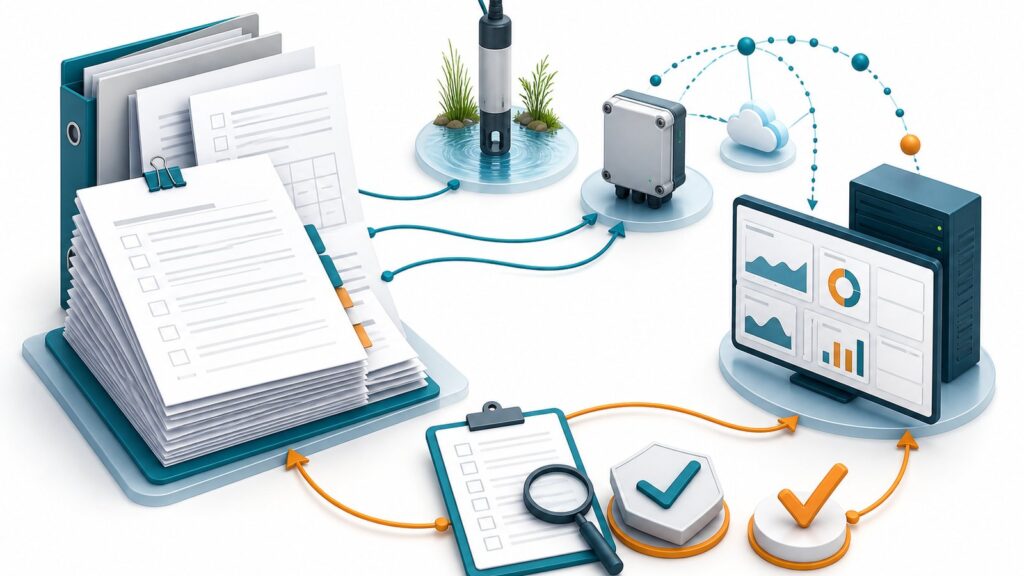
A monitoring sensor can hit every spec on its datasheet and still bomb its acceptance test. This usually happens when a procurement team copies numbers straight from a vendor’s brochure without asking how those numbers will be tested in the real world. The specification document decides whether a system actually works, not the hardware sitting in the box. This guide breaks down six sets of measurable requirements, the exact evidence you need from suppliers, and the testing steps that belong in your RFQ before anyone signs a purchase order. You can apply this framework to SPARING wastewater stations, ONLIMO river monitors, and similar setups.
Start from Operational Decisions, Not Copied Datasheets
Don’t open a product catalog yet. The first step in writing a solid procurement specification is answering basic operational questions. What parameters are you measuring? Where exactly are the probes going? How often do you need a reading? And where does that data actually need to go?
If you copy a single vendor’s datasheet into your RFQ, you lock out the competition. That is a bad idea anywhere, and it violates Indonesian government procurement rules. Under Perpres 16/2018 (updated through Perpres 46/2025), specifications have to be based on function and performance. Naming a brand is only allowed for specific spare parts or e-catalog items. A good specification also documents real market research so the requirements stay competitive. While these specific rules apply to Indonesia, the principle of performance-based procurement holds up everywhere.
Lock down the operational basics before you write down a single technical metric. Know the goal: is this for regulatory compliance, process control, or early warning? Know the environment: open channel, closed pipe, brackish water, or thick industrial sludge? Map out the data architecture from the sensor to the data logger, up to the server, and out to the dashboard. Finally, decide how long the station has to run before someone needs to drive out and clean it. Your answers here will drive every technical requirement.
Six Requirements You Actually Need to Measure
Every requirement in an RFQ should trigger a simple yes or no when tested. Skip the vague adjectives. The six groups below cover the technical details that actually matter in an environmental monitoring specification.
Performance. List the parameters, working range, accuracy class, resolution, response time, and the maximum allowable drift. The ISO 15839:2003 standard covers test procedures for online water-quality sensors, and the industry still relies on it today. It defines exactly how to test accuracy, precision, and drift in both the lab and the field. If you are buying a SPARING station in Indonesia, Annex III of PermenLHK P.80/2019 dictates the minimum ranges and accuracy for every parameter. Always pull the latest numbers from the legal text before you finalize the RFQ.
Environment and installation. Demand a specific IP rating. State the operating temperature range and the housing material you need (like 316L stainless, titanium, or PVC). Add requirements for corrosion resistance, the mounting bracket style, and automatic cleaning cycles. Tie these demands to the actual weather and water conditions at the site, not generic brochure text.
Interface and integration. Pick the communication protocol. Whether it is Modbus RTU/TCP, 4-20 mA, RS-485, SDI-12, or MQTT, state it clearly. Demand the register map, the data payload format, and proof of server compatibility. For SPARING projects, you must write in the direct connectivity requirement to the KLHK server and the site’s reporting UID.
Data and power. Spell out the logger’s storage capacity and logging interval. Specify exactly how long the system needs to buffer data when the cell network drops. Detail the primary power source and how long the backup battery must last. If the station runs on solar, force the supplier to submit their panel and battery sizing calculations with their bid.
Maintenance and lifecycle. The purchase price is just the down payment. Ask for the maintenance schedule and a full list of spare parts with lead times. Require a breakdown of consumables like reagents, membranes, and O-rings. Lock down the warranty terms, the SLA response time when things break, and the expected lifespan of the sensor.
Compliance and documentation. Gather the paperwork requirements. If this is an Indonesian government job, that means TKDN certificates under Perpres 46/2025. Ask for SNI evidence, KLHK connectivity letters for SPARING, the operator training syllabus, SOPs, and as-built drawings. Do not forget cybersecurity requirements. If this system touches the public internet, you need proof that it is secure.
The Evidence You Actually Need
Your RFQ needs to ask for specific types of proof, because each document answers a different question:
- Product datasheet. This is just marketing. It shows what the factory claims, not what an independent lab verified.
- Calibration certificate (ISO/IEC 17025). Proves an accredited lab tested the exact instrument at specific points.
- Performance test report (ISO 15839). Proves the sensor actually works under controlled conditions. If the vendor lacks an official ISO report, make them submit a self-declaration that spells out their exact test conditions.
- Protocol and register map. Proves the sensor will actually talk to your data logger instead of throwing error codes.
- Installation drawings. Proves the hardware will physically fit on the bridge or pipe.
- Maintenance manual and consumable list. Lets you calculate what this thing will cost to run for the next five years.
- Warranty and draft SLA. Puts the vendor on the hook for repairs and sets a legal clock on their response time.
Put FAT and SAT in the RFQ Before You Cut the PO
Write your acceptance tests into the RFQ. If you try to negotiate testing after the equipment shows up, you have already lost. The Indonesian highway authority (Bina Marga) handles this well. Their SKh-1.7.42 spec for bridge monitoring demands four strict stages: a Factory Acceptance Test (FAT), a Site Acceptance Test (SAT), pre-commissioning for the subsystems, and final commissioning. Even though that spec is for bridges, the four-stage framework works perfectly for environmental sensors.
FAT (Factory Acceptance Test). You test the sensor and the logger in a controlled workshop before anything ships. The numbers you get here become the baseline for the site test.
SAT (Site Acceptance Test). You test the installed system in the mud and the rain. This proves the data connection works, the sensor reads real river water correctly, and the enclosure survives the local weather.
Pre-commissioning and commissioning. The final hurdle. You test the whole chain—sensor, logger, cell link, server, and dashboard. If you dip the sensor in a calibration fluid at the river bank, you need to see that exact spike on the dashboard back at the office.
The EPA used to run the Environmental Technology Verification (ETV) program. It is archived now, but the testing methods are still solid. They judged sensors on accuracy, precision, reproducibility between units, and field toughness. You can lift those exact metrics for your acceptance criteria. If you need more ammo for your spec, USGS Technical Methods 1-D3 covers station operation, calibration, and data review in heavy detail.
The Requirement, Evidence, and Test Matrix
The table below maps out the six requirements, the proof you need, the tests you run, and the exceptions you can allow. You still have to pull the hard numbers—the durations, intervals, and tolerances—from your local regulations and the final RFQ.
| Requirement group | What to specify | Supplier evidence | Acceptance test | Exception |
|---|---|---|---|---|
| Performance | Parameter, range, accuracy, resolution, response time, drift (per ISO 15839 definitions) | Datasheet, ISO 15839 test report or self-declaration, ISO/IEC 17025 calibration certificate | Laboratory comparison against accredited reference method; field validation per approved test procedure | If ISO 15839 report unavailable: accept self-declaration with explicit test conditions |
| Environment and installation | IP rating, operating temperature, housing material, corrosion resistance, mounting method, auto-cleaning mechanism | IP test certificate, material certificate, installation drawing, cleaning mechanism specification | Visual inspection, IP certificate verification, installation method SAT, cleaning cycle functional test | If IP test certificate unavailable: require manufacturer warranty covering specified conditions |
| Interface and integration | Protocol (Modbus, 4-20 mA, SDI-12, MQTT), register map, data format, server compatibility | Protocol specification, register map, integration test plan, connectivity test evidence | End-to-end data test: sensor to data logger to server; KLHK UID integration test for SPARING | If register map not available pre-contract: require delivery within RFQ-defined timeframe |
| Data and power | Logger capacity, logging interval, offline buffer duration, power source, backup duration, solar/battery sizing, alert | Logger technical manual, memory specification, power-sizing calculation, solar/battery specification | Offline buffer test (simulate connectivity loss), data recovery test, power autonomy test, alert test | If power-sizing calculation unavailable: autonomy and test duration must be defined in the RFQ |
| Maintenance and lifecycle | Maintenance schedule, spare parts with lead time, consumables, warranty, SLA response time, sensor lifespan | Maintenance manual, spare parts catalog with pricing, consumable usage rate, warranty document, draft SLA | Consumable availability verification, spare parts delivery test, warranty scope review, SLA benchmark | If consumable pricing not available pre-tender: define evidence requirements per applicable rules |
| Compliance and documentation | TKDN certificate (Indonesian procurement), SNI evidence if applicable, KLHK connectivity certificate, training plan, SOP package, as-built | TKDN certificate, SNI certificate if applicable, KLHK connectivity letter, training curriculum, draft SOP | TKDN verification per applicable Indonesian regulations, training completion record, SOP sign-off, documentation check | If TKDN certificate not yet issued: verify SIINAS registration; document status as contractual milestone |
Getting TKDN and the Regulations Right
If you are spending Indonesian state funds, domestic product (Produk Dalam Negeri) rules are mandatory. Perpres 46/2025 sets up a strict preference hierarchy based on TKDN scores. You have to write this requirement into the planning phase, the RFQ, and the final tender documents. Permenperin 35/2025 handles the actual certification process. Always double-check the Ministry of Industry database before you publish, because these rules shift frequently. Obviously, if you are buying for a private company or operating outside Indonesia, you can skip this part.
Buying a SPARING system means dealing with PermenLHK P.93/2018 and its update, PermenLHK P.80/2019. You have to read them together. P.80/2019 does not work on its own. Annex III lists the hard minimums for range and accuracy for every effluent parameter. Copy those exact numbers into your RFQ. The entire SPARING architecture—sensor, logger, network, server, and power—acts as a ready-made framework for your spec. If you are outside Indonesia, lean on ISO 15839:2003. It defines the testing terminology everyone understands.
One last warning: environmental and procurement laws change all the time. Verify the current rules on JDIH LKPP or the BPK databases before you sign off on a spec. I write engineering guides, not legal advice. Talk to your procurement officer before you go to tender.
A strong procurement specification is an engineering document, not just paperwork. It is the only thing standing between a working monitoring station and a very expensive pile of junk on the riverbank. Every single requirement needs a paper trail and a physical test. Check your next RFQ against the six groups above. Make sure the FAT, SAT, and commissioning rules are locked in tight before you ever issue that purchase order.
Share this article
Share this insight with your team.
Related Articles
Similar topics from the same category.

Poor weather station placement can cause 50% data bias. Learn the WMO-No. 8 and Indonesian BMKG siting standards for AWS sensors in industrial and mining sites.

Explore a technical engineering comparison between solid-state ultrasonic anemometers and mechanical cup-and-vane sensors for industrial weather stations.

Technical guide to conductivity sensors: comparing toroidal (inductive), 2-electrode, and 4-electrode contacting probes for industrial water and wastewater.