Why You Should Never Set Extensometer Alarms on Cumulative Millimeters
An operational guide to developing extensometer TARP thresholds based on deformation velocity and the inverse velocity method to prevent false alarms.
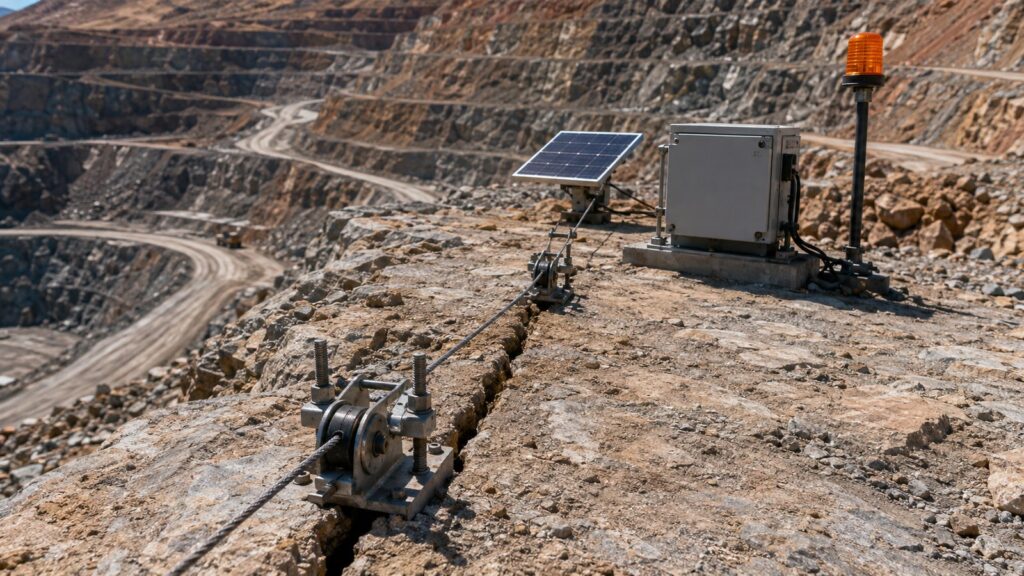
If you base your extensometer TARP thresholds solely on cumulative displacement, you are setting up your geotechnical team for failure. Setting off sirens just because a wire extended past 20 millimeters creates an operational nightmare. Alarms end up sounding repeatedly during the afternoon heat simply because the wire expands in the sun, while a genuine rock acceleration might slip by completely unnoticed.
In Indonesian open-pit operations, Kepmen ESDM Nomor 1827 K/30/MEM/2018 (Appendix II) mandates continuous slope monitoring. Kepdirjen Minerba Nomor 185.K/37.04/DJB/2019 backs this up with strict guidelines for the Safety Management System (SMKP). But compliance means nothing if your alarm logic is flawed. Distinguishing instrument noise from actual ground movement means you have to transition to deformation velocity analysis (mm/day or mm/hour). Total movement matters, but the rate of change tells you whether the slope is actually collapsing.
The Problem with Static Cumulative Thresholds
Setting an alarm to trigger at a fixed total displacement (like 20 mm) is a trap. Static thresholds trigger false alarms from wire thermal expansion. At the same time, they completely miss sudden brittle failures that happen before the wire extends that far.
Consider diurnal temperature swings. In tropical pits, intense solar radiation heats the extensometer wirelines. The wire expands. The sensor registers this expansion as movement, even though the rock mass has not budged an inch.
Heavy equipment and production blasting add another layer of mechanical noise. These events cause transient displacement spikes that require signal filtering algorithms before you even evaluate the alarm. If you do not filter these shocks, they accumulate in your data over several production cycles. Eventually, your static threshold gets breached by accumulated noise rather than actual slope movement.
The result? Alarm fatigue. Workers start ignoring evacuation sirens because they assume the wires just got too hot again. On the flip side, setting the threshold artificially high to avoid false alarms means you risk missing a sudden brittle failure, where a highwall collapses after barely moving at all.
The Three Creep Phases (And Why Velocity Matters)
Rock does not just fail instantly without warning. The kinematics of rock mass movement before a landslide generally follow three distinct creep phases: primary, secondary, and tertiary.
Primary creep is a regressive phase. The deformation rate slows down over time. The rock mass is simply seeking a new equilibrium after a mechanical disturbance like a blast or toe excavation. Internal shear stresses redistribute. The slope stabilizes.
Next comes secondary creep. The deformation rate flattens out and remains constant for an extended period. Joints slide uniformly. There is no immediate risk of collapse. You don’t need an emergency evacuation for constant velocity, though you definitely need to keep watching it.
Tertiary creep is where you lose the slope. This is progressive, unrestrained deformation acceleration. Shear strength along the slip surface is failing. Micro-fractures link up into a continuous shear plane, and the deformation velocity escalates exponentially.
The exact moment secondary creep transitions to tertiary is the Onset of Acceleration (OOA). You can spot the OOA by plotting the intersection of short-term and long-term moving averages of the sensor velocity. Once the slope breaches the OOA, you are out of time. Collapse is inevitable.
Forecasting Failure: The Inverse Velocity (1/v) Method
Confirming tertiary acceleration is only half the job. Mine operators need to know exactly when the slope will fail so they can pull out personnel and excavators.
Since acceleration during tertiary creep follows a power law, Fukuzono (1985) figured out that plotting the reciprocal of deformation velocity (1/v) against time straightens out that exponential curve into a linear trend. This is the inverse velocity method. When you extrapolate that straight line downward to where 1/v equals zero, you get the theoretical time of collapse.
Rose and Hungr (2007) proved this works remarkably well in large-scale open-pit mines. But it only works if your data is clean. You have to strip out the blasting and thermal noise first.
You also have to know your rock. Hard, brittle rock masses have notoriously short tertiary creep phases. A brittle highwall might transition from the OOA to total failure in a matter of hours. You need high-frequency data logging to catch that acceleration before it is too late.
The 4-Level Extensometer TARP Matrix
A functional TARP matrix cannot rely on a single number. It has to combine daily velocity rates, velocity ratio increases, and inverse velocity projections.
A standard response plan uses four operational levels. For context, studies on East Kalimantan coal mine disposal slopes suggest that movement rates above 3.3 mm/hour mean you should stop dumping immediately, while rates over 6.6 mm/hour indicate active slope failure.
| TARP Level | Extensometer Threshold Criteria (Illustrative) | Geomechanical State | Required Operational Actions |
|---|---|---|---|
| Green (Normal) | Movement rate below operational background baseline. Velocity Ratio (VR) $\le 1.0$. | Primary (regressive) or steady secondary creep. | Mining activities proceed normally under standard monitoring routines. |
| Yellow (Caution) | Velocity exceeds baseline. Velocity Ratio ($VR = v_t / v_{t-1}$) reaches 1.3 to 1.5. | Early indication of acceleration. Baseline trend disrupted. | Visual field inspection by geotechnical staff. Review blast patterns. Increase supervisor vigilance. |
| Orange (Critical) | Sustained acceleration confirmed (e.g., > 3.3 mm/hour). OOA transition verified. | Definite tertiary creep. Continuous shear plane coalescing. | Stop loading below the slope. Isolate access roads. Withdraw non-essential equipment. |
| Red (Danger) | Sharp velocity spike (e.g., > 6.6 mm/hour). Inverse velocity (1/v) projects imminent failure. | Advanced tertiary stage. Catastrophic highwall collapse imminent. | Total evacuation to designated muster points. Activate emergency sirens. |
When velocity climbs past the baseline, you hit Yellow. Once sustained acceleration confirms tertiary creep, escalate to Orange. When the 1/v trend points to imminent collapse, that is Red. Remember that in Indonesian mining operations, every threshold adjustment and TARP escalation must be documented in the Mining Logbook to pass SMKP Minerba audits.
Field Configuration and Edge Computing
None of this velocity-based logic works without proper field installation.
ISRM guidelines dictate that the extensometer dead anchor must be grouted into completely stable ground, far behind the anticipated slip surface. The wireline measures tension crack dilation by connecting that stable reference anchor to the instrument head sitting across the fracture zone. If you skip a proper monitoring site survey and put your anchor in moving rock, your data is useless.
Handling diurnal thermal noise and vibration at the hardware level changes everything. Modern, ruggedized edge dataloggers like the GEOVOS 1000 calculate velocity derivatives ($\Delta d / \Delta t$) on the device itself. They can trigger local sirens autonomously without waiting for a cloud server connection.
Writing deadband and delay filters directly into the datalogger firmware keeps blast vibrations from setting off the alarms, while still letting real kinematic acceleration trigger the siren. This is why Fortuna Argatech integrates solar-powered Extensometer V4.0 systems across Indonesian pits. You get automated thermal compensation, multi-level alarming, and telemetry that actually works from remote highwalls back to dispatch.
Baseline velocities are not static. As open pits deepen and monsoon season hits, the background noise floor shifts. Audit your TARP thresholds regularly. Relying on velocity and 1/v projections gives you the one thing that actually matters during a slope failure: enough lead time to get your people out alive.
Share this article
Share this insight with your team.
Related Articles
Similar topics from the same category.
Poor weather station placement can cause 50% data bias. Learn the WMO-No. 8 and Indonesian BMKG siting standards for AWS sensors in industrial and mining sites.
Explore a technical engineering comparison between solid-state ultrasonic anemometers and mechanical cup-and-vane sensors for industrial weather stations.

Technical guide to conductivity sensors: comparing toroidal (inductive), 2-electrode, and 4-electrode contacting probes for industrial water and wastewater.