Choosing Between Standpipe and Vibrating Wire Piezometers
A comprehensive technical guide comparing Standpipe Casagrande and Vibrating Wire Piezometers based on time lag, installation methods, and geotechnical telemetry.
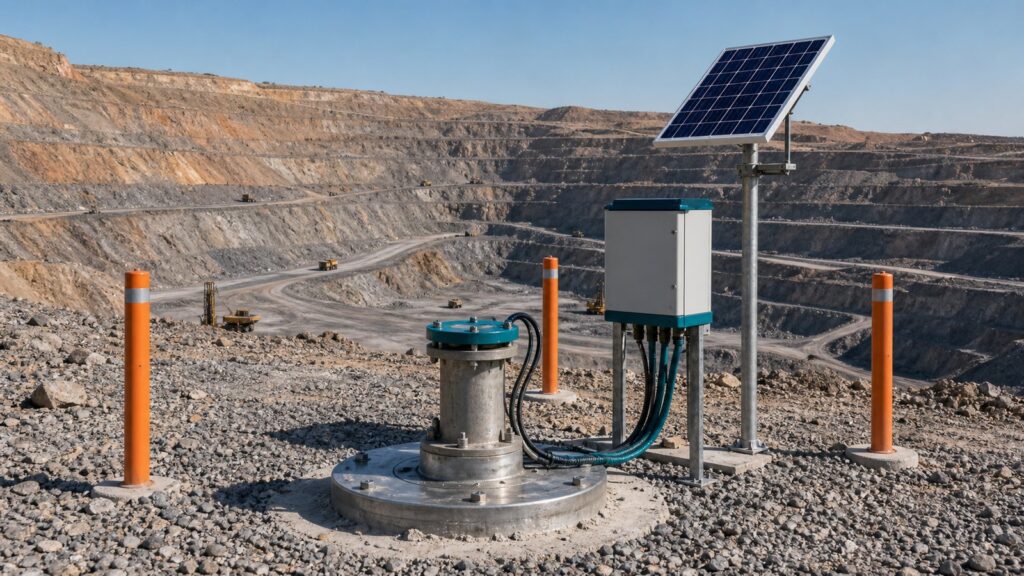
When heavy rainfall hits a mine site, groundwater pressure spikes long before the physical rock starts to deform. Monitoring these sub-surface hydraulic shifts gives you a head start on preventing a catastrophic highwall failure. But when it comes to picking the right instrument, engineers constantly debate the merits of a traditional standpipe vs vibrating wire piezometer.
This decision goes far beyond procurement costs. Drop the wrong sensor into dense clay, and your pressure readings could lag by weeks. By the time the data alerts you to a problem, the slope might already be gone.
The Mechanics of Pore Water Pressure
Karl Terzaghi figured this out decades ago with the Effective Stress Principle. When pore water pressure rises, it pushes soil particles apart. This directly reduces the effective stress and compromises the shear strength of the slope. Groundwater acts as both a lubricant and a hydrostatic battering ram.
In Indonesia, Kepmen ESDM 1827/2018 (Appendix II) specifically requires monitoring groundwater saturation to maintain required safety factors on mining slopes. Relying entirely on surface extensometers is a dangerous gamble if you are blind to the internal hydraulics. Piezometers give you the quantitative data to spot shear strength failure well before surface tension cracks ever appear.
Open Systems vs Closed Diaphragms
You have to understand the mechanical constraints of each instrument before drilling a borehole.
Standpipe Piezometer (Casagrande)
A standpipe is essentially an open tube sitting in the ground. It relies entirely on hydrostatic equilibrium. The water column inside the hollow PVC pipe rises until it matches the pore water pressure at the porous filter tip. It is an open system. A technician drops a manual water level indicator down the pipe to take a reading. You get a direct hydraulic pressure measurement without any need for electricity.
Vibrating Wire Piezometer (VWP)
A VWP is a sealed, electronic system. It uses a metal diaphragm that deflects against a tensioned steel wire when water pressure hits it. The hermetically sealed stainless steel body protects that wire from corrosion. As the water pressure pushes the diaphragm, the tension on the wire changes, which alters its resonant frequency. The datalogger reads that frequency and converts it into a precise pressure value.
Hydrodynamic Time Lag: The Silent Killer
The single most critical difference between these two instruments is hydrodynamic time lag. This is the delay it takes for water to physically flow from the surrounding soil into the instrument to register a change in pressure.
Standpipes demand physical water volume. In dense clay, water moves at a crawl. If a sudden storm floods the area, that 1-inch PVC pipe might take months to fill and reach equilibrium. The standpipe will eventually give you an accurate reading, but the slope will likely have collapsed weeks prior.
A VWP uses a rigid diaphragm. The volume of water required to deflect that metal plate is microscopic. This means the response time is almost instantaneous, regardless of the soil type. If you are drilling into low-permeability clay or silt (anything below $10^{-6}$ m/s), a VWP is the only viable option. Standpipes only make sense in highly porous gravel or coarse sand where water moves fast enough for regional observation.
Managing Barometric and Temperature Noise
Electronic sensors come with their own environmental headaches. Closed-type VWPs measure absolute pressure against the diaphragm. That means they capture both the pore water pressure and the weight of the atmosphere above ground. If a storm front moves in and barometric pressure drops, a non-vented VWP reading can skew by about 10 cm of water column per 10 mbar change.
You fix this by subtracting the surface atmospheric pressure using a reference barometer at the datalogger. Vented VWP models exist that run a hollow air tube up the cable to handle this automatically, but those tubes inevitably clog with condensation unless you obsessively swap out the desiccant packs.
Temperature is another variable. Deep underground, temperatures fluctuate and cause the steel vibrating wire to expand or contract, throwing off the frequency. A quality VWP includes an internal thermistor to track the in-situ temperature and calculate the thermal compensation in real time.
Installation: Sand Filters vs Fully Grouted
Drilling is expensive. Your installation method dictates how much value you get out of the hole.
The traditional method involves lowering the sensor, packing a filter sand pocket around the tip, and sealing it off with solid bentonite. It is a massive pain. If the bentonite seal fails, aquifers cross-contaminate. Trying to stack multiple sensors (nested piezometers) in one hole this way is a logistical nightmare.
The modern fully grouted method skips the sand completely. You lower the VWPs and pump a specialized cement-bentonite grout straight to the top. Because a VWP requires almost zero water volume to register pressure, the pore pressure propagates straight through the cured grout matrix perfectly. This method makes stacking multiple sensors in a single borehole fast, secure, and incredibly cost-efficient.
Telemetry and Remote Monitoring
A warning system is only useful if the data reaches the dispatch center in time.
Automating a standpipe requires retrofitting it with a hydrostatic pressure transducer, adding significant hardware costs. VWPs output an audio frequency (Hz) signal natively. Frequency signals do not degrade over long cable runs and they ignore electrical resistance. You can run hundreds of meters of cable across a heavy industrial mine site without losing signal integrity.
Fortuna Argatech integrates these geotechnical instruments with edge-computing dataloggers and telemetry. The raw frequencies are converted, compensated, and transmitted to a live dashboard. This lets geotechnical engineers set hard Trigger Action Response Plan (TARP) thresholds and get SMS alerts the second the pressure spikes.
The Decision Matrix
Standpipes still have a place. They are cheap, reliable, and perfectly fine for preliminary surveys or monitoring sandy aquifers. But when human lives and heavy machinery are sitting beneath a critical highwall, waiting on time lag is unacceptable.
| Decision Parameter | Standpipe (Casagrande) Piezometer | Vibrating Wire Piezometer (VWP) |
|---|---|---|
| Response Time (Time Lag) | Dangerously slow in clay/silt | Nearly instantaneous across all soils |
| Automated Signal Reliability | None (unless retrofitted) | Rock-solid (Frequency ignores cable resistance) |
| Impermeable Soil Accuracy | Low (Severe hydrodynamic bias) | Very high (Microscopic deflection volume) |
| Multi-Sensor (Nested) Drilling | Difficult; high risk of aquifer leaks | Simple and fast via the Fully Grouted method |
| Datalogger / EWS Integration | Requires expensive transducer retrofit | Natively compatible and recommended |
| Initial Acquisition Cost | Low | Higher upfront |
If you inherited an old standpipe network, you can drop transducers down them to modernize the array. But for any new critical monitoring installation, especially in tight operational areas or massive tailings dams, the VWP is the only choice. False alarms are annoying, but missing a failure entirely is catastrophic.
Share this article
Share this insight with your team.
Related Articles
Similar topics from the same category.
Poor weather station placement can cause 50% data bias. Learn the WMO-No. 8 and Indonesian BMKG siting standards for AWS sensors in industrial and mining sites.
Explore a technical engineering comparison between solid-state ultrasonic anemometers and mechanical cup-and-vane sensors for industrial weather stations.

Technical guide to conductivity sensors: comparing toroidal (inductive), 2-electrode, and 4-electrode contacting probes for industrial water and wastewater.