SPARING vs ONLIMO Difference: KLHK Water System Guide
Confused about the SPARING vs ONLIMO Difference? Discover what is SPARING KLHK and ONLIMO functions to ensure your industrial environmental compliance with Fortuna Argatech.
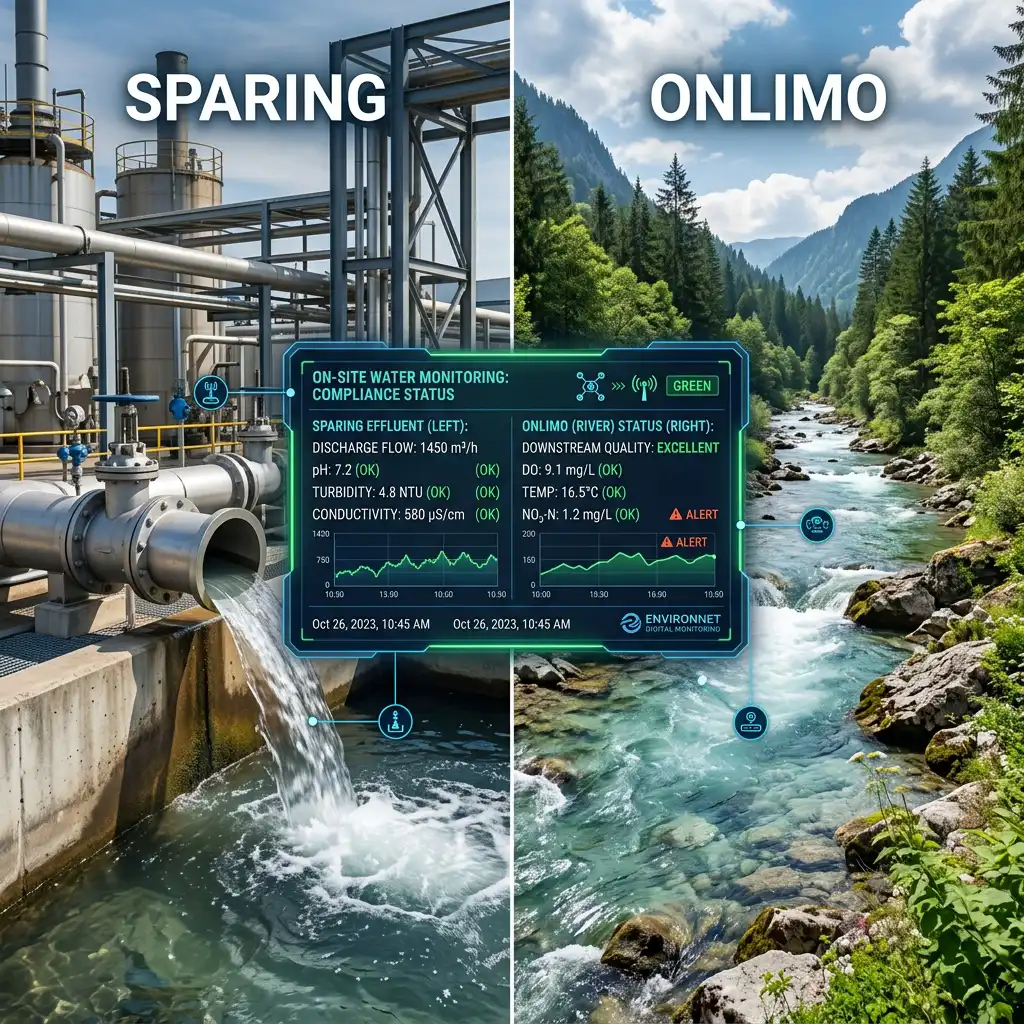
Don’t Install the Wrong System! Here is the SPARING vs ONLIMO Difference
For those of you working in the industrial sector, environmental regulations from the Ministry of Environment and Forestry (KLHK) are certainly nothing new. However, factory managers or Health, Safety, and Environment (HSE) divisions are frequently confused by two terms that sound remarkably similar in function: SPARING and ONLIMO.
Indeed, both are water quality monitoring technologies that utilize telemetry networks, and both must be reported to the KLHK servers. But did you know that the target water they measure is vastly different?
As an experienced Environmental Monitoring solutions provider, Fortuna Argatech often receives questions regarding this exact issue. So that your company doesn’t waste its budget buying the wrong system, let’s completely break down the SPARING vs ONLIMO Difference in simple, easy-to-understand terms.
1. SPARING: The Factory Gatekeeper (Wastewater)
SPARING stands for Continuous and Online Industrial Wastewater Quality Monitoring System (Sistem Pemantauan Kualitas Air Limbah Secara Terus-Menerus dan Dalam Jaringan).
From its name alone, it’s clear the key word here is Wastewater. This device is installed exactly at the compliance point (outlet) or the final discharge channel of your factory before the water spills out and mixes with natural water bodies (rivers or oceans).
The primary goal of SPARING is to monitor whether the liquid waste leftover from your factory’s production has been properly treated at the WWTP (Wastewater Treatment Plant). KLHK wants to ensure that the dirty water exiting your factory does not contain toxins or chemicals exceeding the safe quality standards.
The parameters typically measured by SPARING include:
- pH (Acidity Level)
- TSS (Total Suspended Solids)
- COD (Chemical Oxygen Demand)
- Ammonia, and Water Debit (Flow Rate)
If your factory’s COD numbers suddenly spike, SPARING will instantly send a real-time hazard alert straight to the KLHK server.
2. ONLIMO: The Nature Observer (Surface Water/Rivers)
Unlike SPARING, ONLIMO stands for Online Water Quality Monitoring (Pemantauan Kualitas Air Online).
If SPARING measures the factory’s leftover production water, ONLIMO instead measures natural water, often referred to as Surface Water (rivers, lakes, reservoirs, or the sea). These devices are usually installed directly in river bodies, either upstream (before passing through factories) or downstream (after passing factories and settlements).
The main goal of ONLIMO is not to penalize one specific factory, but rather to determine the overall “health status” of the river itself. The government uses ONLIMO data to evaluate how polluted a river is due to a combination of industrial waste, household waste, and agricultural runoff.
The parameters measured by ONLIMO are much more diverse than SPARING because its goal is to evaluate an entire ecosystem. Its parameters include:
- pH, Dissolved Oxygen (DO)
- BOD (Biochemical Oxygen Demand)
- Nitrates, Water Temperature, and Electrical Conductivity
Conclusion: The SPARING vs ONLIMO Difference for Your Industry
In short, the SPARING vs ONLIMO Difference lies in what is being measured. SPARING measures what exits your factory (Waste), whereas ONLIMO measures what flows freely in nature (Rivers/Lakes).
If you are the owner of a manufacturing, mining, or palm oil industry that holds a permit to dispose of liquid waste into a river, then the system you are obligated to install based on KLHK regulations is SPARING.
Meanwhile, ONLIMO is more commonly ordered and managed by government agencies (like the Environmental Agency) or massive-scale private companies mandated to protect the ecosystem areas surrounding their operational zones.
Whatever your industrial compliance needs may be, Fortuna Argatech has an engineering team ready to help—from physical installation and sensor integration (data logger) to registering the User ID (UID) directly to the KLHK servers. Ensure your monitoring equipment investment is accurate and keeps you free from legal sanctions!
FAQ
Are small factories also required to install SPARING?
The obligation to install SPARING is determined based on the type of industry and the volume of liquid waste generated every day, in accordance with the latest KLHK regulations.
At which exact point should SPARING be installed?
SPARING must be installed at the final outlet point of the factory’s WWTP drainage channel, right before the liquid waste mixes with the river/public waterways.
Can Fortuna Argatech handle the data registration to KLHK?
Absolutely. Fortuna Argatech’s services encompass equipment installation, calibration, and User ID (UID) registration to the central KLHK SPARING server until your data status is officially Live and valid.
If my company is in mining, what parameters are measured?
The parameters strictly required for the mining sector usually include pH, TSS (Turbidity), and Water Debit. However, the details will refer to your company’s specific environmental permit (AMDAL).
Can a single factory install both ONLIMO and SPARING at the same time?
Yes, and it is highly recommended for large companies that wish to definitively prove that their factory waste (SPARING) is not polluting or damaging the surrounding river water quality (ONLIMO).
Sources
- Ministry of Environment and Forestry (KLHK). (n.d.). Regulations for SPARING and ONLIMO Installation.
- Fortuna Argatech. (n.d.). Industrial Environmental Compliance Solutions. https://argatech.com
Share this article
Share this insight with your team.
Related Articles
Similar topics from the same category.

SPARING data completeness thresholds of 85% and 100% aren't in P.93 or P.80, they come from PROPER 2025. Here's what that means for your facility.

P.93/2018 doesn't set a minimum uptime for SPARING. The 85% daily rule and 100% reporting requirement actually come from PROPER. Learn the compliance impact.

Indonesia's SPARING mandates 2-minute sampling but ignores sensor T90. Learn the hidden risk of slow NH3-N sensors and using T90 as a fouling indicator.