Sensor Redundancy and Cross-Validation: When Is One Sensor Not Enough?
Three sensor cross-validation methods for monitoring stations: co-located redundancy, multivariate consistency, and neighbor checks across stations.
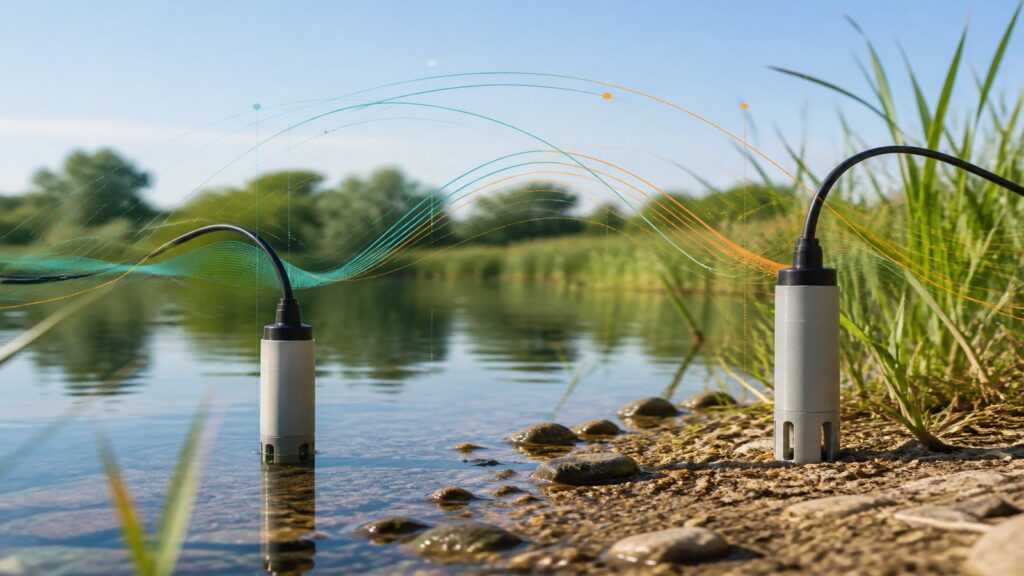
A single sensor gives a reading but no independent verification of that reading. The number on the dashboard could be accurate, drifted, or completely wrong, and until the next calibration visit or lab sample arrives, there is no way to tell. Sensor cross validation changes this. By comparing a sensor’s output against an independent reference (a second sensor, a correlated parameter, or a neighboring station), operators gain a basis for confidence or a reason to investigate.
Three cross-validation approaches apply to environmental monitoring stations: co-located redundancy, multivariate consistency, and neighbor checks. These methods draw on frameworks from QARTOD (the IOOS/NOAA quality assurance program originally designed for oceanographic data, adapted here for land-based environmental monitoring) and voting architecture concepts from IEC 61508 (a functional safety standard, adapted here for reliability rather than formal safety certification). Monitoring platforms such as ONLIMO and SPARING deploy multiple sensor types per station, making cross-validation between parameters practical.
Cross-validation supplements but does not replace scheduled calibration and maintenance. It adds a continuous check between calibration visits; it does not eliminate the need for them.
Three Cross-Validation Approaches
Before selecting a method, it helps to understand what each one requires and what it can detect.
Co-located redundancy deploys two or more sensors for the same parameter at the same location. If both sensors read 7.2 pH and then one jumps to 8.5 while the other stays at 7.2, the disagreement itself is the signal. This is the most direct form of cross-validation.
Multivariate consistency uses physically correlated parameters to flag anomalies. No additional hardware is needed. The method uses only the sensors already installed at the station. When temperature drops but dissolved oxygen does not rise as expected, something may be wrong with one of the sensors.
Neighbor checks compare the same parameter across nearby stations. If four stations along a river report conductivity between 280 and 310 µS/cm and a fifth reports 620, that station deserves investigation. This method requires a multi-station network.
Each method involves trade-offs: co-located redundancy adds hardware cost, multivariate consistency depends on well-understood physical relationships, and neighbor checks depend on spatial proximity and environmental similarity between stations.
Co-Located Redundancy: When to Add a Second Sensor
The decision to install a second sensor for the same parameter comes down to consequence. If an undetected pH drift leads to a compliance violation, a wrong management decision, or contaminated data in a regulatory submission, the cost of a second sensor is easier to justify than the cost of the failure.
IEC 61508, a functional safety standard for safety-instrumented systems, defines voting architectures that describe how redundant sensors interact. Environmental monitoring stations don’t typically require formal SIL certification, but the same voting concepts help design reliable sensor configurations:
- 1oo2 (one-out-of-two): Either sensor can trigger an alarm. This maximizes failure detection but may increase false alarms. If either sensor reads outside the expected range, the system flags the data. Good for parameters where missing a real exceedance is unacceptable.
- 2oo3 (two-out-of-three): Three sensors vote and the majority determines the accepted value. A single outlier is rejected. This architecture reduces false alarms and identifies which sensor has drifted, but the cost of a third sensor is significant. Usually justified only for high-consequence parameters or stations where site access is difficult.
Practically, adding a second sensor depends on whether the data logger has available channels. The GEOVOS 1000 data logger supports up to 12 sensor channels, with capacity for redundant sensor connections and no need to replace the logger.
Co-located redundancy works best when both sensors are independently calibrated. Installing two sensors from the same batch, calibrated at the same time, with the same reference standard, reduces the independence that makes cross-validation useful. Stagger calibration dates when possible.
Multivariate Consistency Without Extra Sensors
Not every station needs redundant hardware. When multiple parameters are already monitored, the physical relationships between them serve as a built-in consistency check. QARTOD multivariate checks (originally designed for oceanographic deployments) evaluate whether related parameters are physically consistent with each other. The same logic applies to land-based water quality and weather stations.
Three relationships are particularly useful:
DO and temperature. DO saturation depends on water temperature and barometric pressure. A sudden DO shift without a corresponding temperature change may indicate sensor malfunction. If temperature rises 5°C and DO stays flat, one of the readings is suspect.
Conductivity and TDS. Conductivity and TDS are related by a conversion factor. Disagreement between measured conductivity and expected TDS may indicate drift in one sensor. The conversion factor varies with ion composition, so site-specific baseline ratios perform better than textbook constants.
pH and temperature. pH measurement depends on temperature compensation. If the temperature sensor fails, pH readings may be unreliable, even if the pH sensor itself is functioning correctly. A temperature sensor failure can silently corrupt pH data.
These checks don’t require firmware changes. An operator reviewing data can apply them manually, or they can be implemented as post-processing rules during data quality review. ONLIMO monitors multiple correlated parameters (pH, DO, turbidity, conductivity, COD, TSS, and temperature), which makes multivariate consistency checks across the existing sensor set straightforward.
Neighbor Check Across Stations
When a monitoring network includes multiple stations, the QARTOD neighbor check adds a spatial consistency layer. It flags a reading when it deviates from nearby sensors beyond a configured threshold. QARTOD spatial checks evaluate whether a station’s readings are consistent with the surrounding monitoring network.
This method works well for parameters that vary gradually across space: water temperature in a lake, ambient air temperature across a valley, or conductivity along a river reach. It works poorly when stations are in different microenvironments (upstream vs. downstream of a discharge point, for example) or when the parameter has high natural spatial variability.
Thresholds must be configured per parameter, site, and expected spatial variability. A 2°C temperature difference between stations 500 meters apart on the same lake might be suspicious; the same difference between a shaded tributary and an open reservoir is normal. Generic thresholds produce either too many false alarms or too few real detections.
SPARING systems connect multiple monitoring points, and multi-station ONLIMO deployments create the network density that makes neighbor checks practical.
What to Do When Sensors Disagree
Cross-validation is only useful if disagreement triggers a defined response. Without a resolution path, flags accumulate and get ignored.
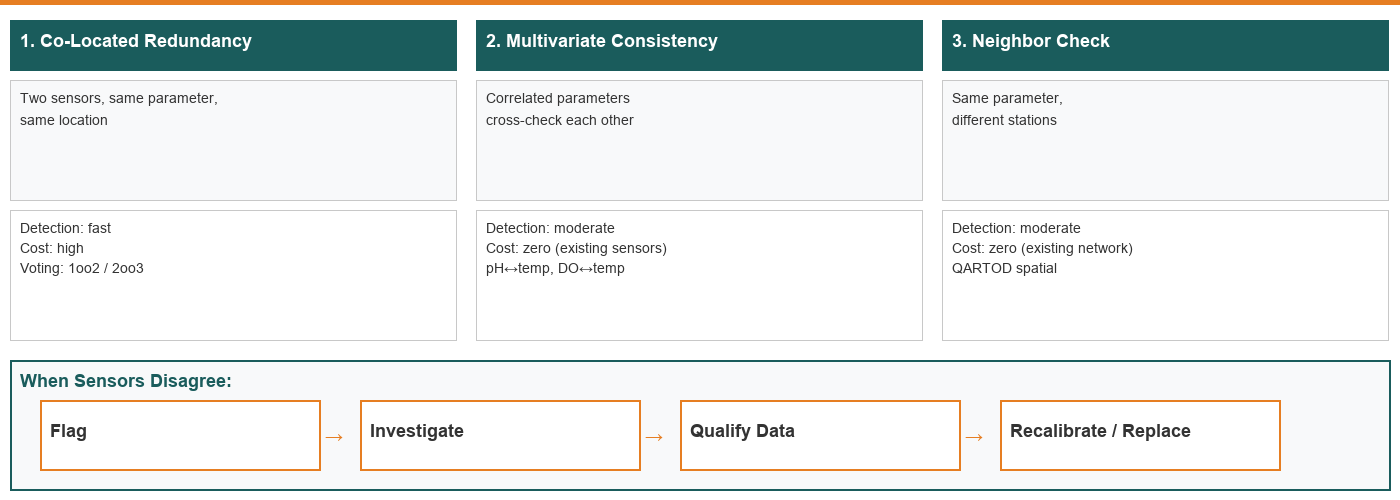
QARTOD defines quality flags that apply here: Pass, Not Evaluated, Suspect, Fail, and Missing. When sensors disagree, follow a defined path:
- Flag the data. Mark affected readings as Suspect. Do not delete them. Suspect data may still be usable if the investigation identifies which sensor was correct.
- Investigate the cause. Is the deviation sudden or gradual? Does it affect one parameter or several? A sudden jump in one sensor while others are stable suggests hardware failure. A gradual divergence suggests drift.
- Qualify affected records. Once the cause is identified, annotate the data with the investigation result. This preserves the record for future analysis and audit.
- Recalibrate or replace. The faulty sensor needs field verification, recalibration, or replacement. Offline sensor detection can catch total failures, but cross-validation catches the harder problem: a sensor that is still reporting but reporting wrong values.
Feeding cross-validation findings into preventive maintenance schedules turns data flags into action. If a specific sensor type drifts consistently after 90 days, the maintenance interval should reflect that pattern rather than a generic schedule.
Next Step
Review your monitoring station architecture against these three methods. For each critical parameter, ask: if this sensor drifts tomorrow, how would I know before the next calibration visit?
Start with multivariate consistency. It costs nothing beyond the analysis effort and uses sensors already in place. For parameters where undetected failure carries high consequences, evaluate whether the data logger has available channels for a second sensor. For networks with multiple stations, configure neighbor checks with site-specific thresholds.
Argatech monitoring systems (including ONLIMO and SPARING) support multi-sensor deployments and multi-station networks. The GEOVOS 1000 data logger supports up to 12 sensor channels, with capacity for redundant sensor connections. For station architecture review or sensor configuration questions, contact the Argatech team.
Share this article
Share this insight with your team.
Related Articles
Similar topics from the same category.

Poor weather station placement can cause 50% data bias. Learn the WMO-No. 8 and Indonesian BMKG siting standards for AWS sensors in industrial and mining sites.

Explore a technical engineering comparison between solid-state ultrasonic anemometers and mechanical cup-and-vane sensors for industrial weather stations.

Technical guide to conductivity sensors: comparing toroidal (inductive), 2-electrode, and 4-electrode contacting probes for industrial water and wastewater.