PM2.5 and PM10 Particulate Sensors: Beta Attenuation Monitor (BAM) vs Optical Particle Counter (OPC) for Industrial AQMS
A technical comparison of PM2.5 and PM10 particulate sensors between regulatory reference BAM and laser optical counters (OPC) for industrial AQMS stations.
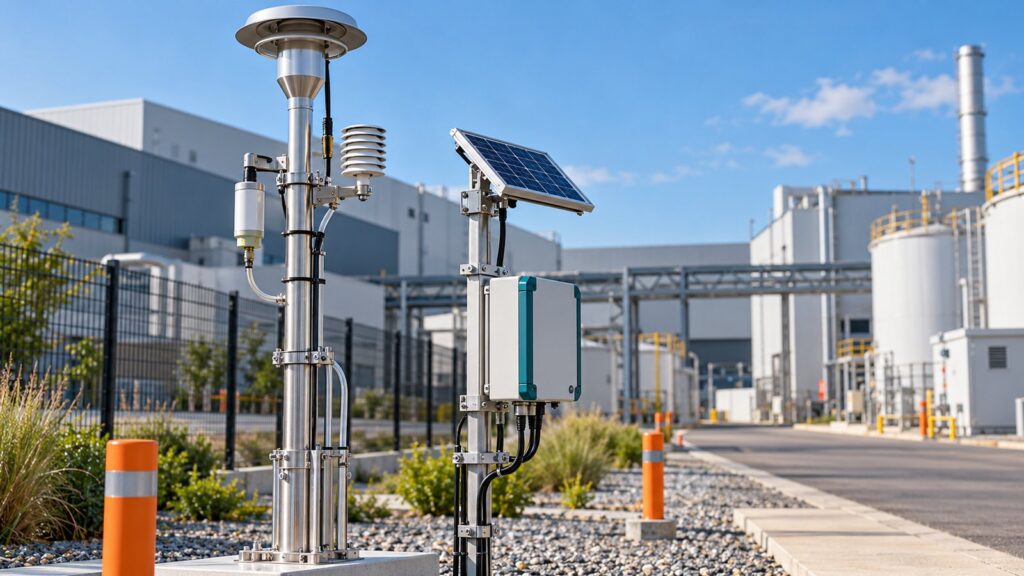
Picking the wrong PM2.5 sensor for an industrial plant burns through hundreds of thousands of dollars. Get it wrong, and you either waste massive capital on air-conditioned shelters or hand regulators biased dust data they will throw out during an audit.
Indonesian environmental rules leave zero wiggle room. PP No. 22/2021 (Annex VII) caps ambient PM2.5 at 55 µg/m³ for a 24-hour average and 15 µg/m³ annually. For PM10, the ceiling is 75 µg/m³ per 24 hours. Permen LHK No. 14/2020 then mandates converting those raw dust numbers into the official ISPU air quality index. Meeting these standards requires round-the-clock continuous monitoring. But plant managers face a sharp divide between two technologies: Beta Attenuation Monitors (BAM) and Optical Particle Counters (OPC).
A full BAM shelter setup easily clears IDR 600 million to 1.5 billion ($38,000 to $95,000). A compact optical sensor node costs a fraction of that, running IDR 40 million to 120 million ($2,500 to $7,500). Before signing off on a purchase order, engineering teams need to understand the physical mechanics behind both instruments, where optical units fail in tropical humidity, and how a hybrid network delivers legal compliance without blowing the capital budget.
Measurement Physics: Beta-Ray Attenuation vs Mie Light Scattering
A Beta Attenuation Monitor measures particulate mass directly. It operates on the Beer-Lambert law of radiation attenuation (I = I₀ · e^(−μ·x)). A low-activity Carbon-14 source shoots beta electrons through a glass-fiber filter tape. A vacuum pump pulls ambient air through a size-selective inlet head at a constant 16.67 L/min, depositing particulate matter onto the filter tape over a one-hour cycle.
The detector measures the drop in beta radiation transmitted through the tape before and after deposition. That absorption is directly proportional to physical mass. It does not care about particle color, shape, refractive index, or chemical composition. Carbon soot and mineral silica dust register strictly by their weight. This physical independence from optical properties makes BAM the reference standard for regulatory enforcement.
An Optical Particle Counter operates on a completely different premise: Mie light scattering. A focused laser beam cuts across a sample chamber. As particles stream through the beam, they scatter light pulses captured by photodetectors. The sensor counts these flashes and sorts them into size channels.
The catch lies in the math. An OPC counts particles; it does not weigh them. Firmware converts particle counts into mass concentration (µg/m³) by assuming all particles are spherical with a fixed density, typically ρ ≈ 1.65 g/cm³. When real-world aerosol characteristics drift (such as transitioning from reflective limestone dust to light-absorbing coal soot), that fixed density assumption slips. Raw optical readings drift with it.
10-Parameter Comparison Matrix: BAM vs Optical Particle Counter
The following matrix summarizes the critical engineering, regulatory, and financial differences between the two instrument classes. Use it as a procurement evaluation checklist.
| Parameter | Beta Attenuation Monitor (BAM) | Optical Particle Counter (OPC) |
|---|---|---|
| Detection principle | Beta-ray mass attenuation (Beer-Lambert law); direct gravimetric mass measurement | Mie laser light scattering; particle counting converted to estimated mass |
| Regulatory status | US EPA Federal Equivalent Method (FEM) Class III; legally binding for compliance reporting | Indicative instrument (non-FEM); effective for trend monitoring and early warning, requires reference calibration for regulatory submission |
| Mass measurement uncertainty | ±2 µg/m³ at 24-hour averaging (EN 16450 expanded uncertainty ≤ 25%) | Moderate; dependent on aerosol type, humidity, and density assumptions; co-located calibration achieves R² > 0.86-0.93 relative to BAM |
| Time resolution | 1-hour cycle per filter-spot accumulation period | Real-time continuous: 1-second to 1-minute intervals |
| Particle size fractions | Single fraction per instrument (PM2.5 or PM10 depending on size-selective inlet) | Simultaneous multi-fraction output: PM1, PM2.5, PM4, PM10, and TSP from a single sampling channel |
| Shelter and climate control | Enclosed air-conditioned shelter required; temperature and humidity-controlled environment | Open-air pole-mount installation; compact weatherproof enclosure |
| Power consumption | 500-1,500 W continuous (vacuum pump, tape motor, AC cooling) | 5-15 W (fully compatible with solar panel and battery systems) |
| Consumables and licensing | Continuous glass-fiber filter tape rolls; BAPETEN radioactive source (C-14) licensing and Radiation Protection Officer required under Indonesian nuclear safety regulations | No filter tape; no radioactive source; laser diode module with multi-year service life |
| Estimated CAPEX per station | IDR 600 million – 1.5 billion (~USD 38,000-95,000) including shelter infrastructure | IDR 40 million – 120 million (~USD 2,500-7,500) per compact node |
| Primary deployment scenario | Official regulatory compliance point; legal proof-of-attainment station; reference anchor for co-location calibration network | Fenceline perimeter monitoring; dense spatial coverage across industrial parks; operational dust early-warning; haul-road and stockpile surveillance at mines |
Operational Strengths and Field Limitations
Every sensor technology forces an operational compromise.
BAM strengths: Direct gravimetric mass measurement delivers unimpeachable data. BAM units hold US EPA Federal Equivalent Method (FEM) Class III designation under 40 CFR Part 53. Under Indonesian environmental law, a BAM station provides legally binding proof of attainment that regulators cannot dispute.
BAM limitations: The one-hour measurement cycle cannot track rapid dust spikes from pit blasting or haul-truck convoys. The station demands an enclosed shelter with continuous air conditioning pulling 500 to 1,500 Watts. Running that kind of power load on an off-grid mine perimeter without a utility grid hookup is an expensive headache. The Carbon-14 source requires radioactive material licensing from BAPETEN and a certified Radiation Protection Officer on site. Filter tape rolls require regular replacement, and upfront capital costs start above IDR 600 million.
OPC strengths: Real-time 1-minute resolution catches fugitive dust plumes the moment they blow off a stockpile, making alarm threshold configuration actionable for site dispatchers. A single intake channel outputs simultaneous multi-fraction readings (PM1, PM2.5, PM10, TSP) without multiple mechanical heads. Drawing only 5 to 15 Watts, a compact OPC node runs easily on a pole-mounted solar panel and LiFePO₄ battery.
OPC limitations: Tropical air will wreck an unprotected optical sensor. When ambient relative humidity climbs above 70%, hygroscopic particles absorb moisture and swell. The optical sensor sees these water-bloated droplets as massive dust particles, easily doubling apparent PM2.5 readings. Without empirical reference calibration, raw OPC numbers remain indicative and will not hold up in court as standalone compliance proof.
Eliminating Humidity Bias: The Heated Inlet Solution
In equatorial climates, humidity bias is the single biggest failure mode for optical dust counters. Tropical ambient RH routinely sits between 75% and 90% at dawn. Unconditioned optical sensors will falsely scream violations when the air is simply misty.
The fix is a heated sample inlet tube mounted directly upstream of the optical cell. It warms incoming air just enough to drop sample humidity below 50% RH. Condensed liquid evaporates before the particles cross the laser beam, while dry particulate matter passes through intact. Field studies (Dinh et al. 2023; Magi et al. 2019) confirm that heated-inlet OPCs achieve R² values between 0.86 and 0.93 against co-located BAM units, holding relative error under 10% even when ambient humidity exceeds 90%.
Without a heated inlet, deploying optical dust sensors in Southeast Asia is a waste of time. The data will be noisy, skewed, and practically useless for operational decisions.
Hybrid Network Architecture: One BAM Anchor with Distributed Compact OPC Stations
Instead of choosing between buying one expensive BAM or relying solely on unverified optical sensors, smart facilities deploy a hybrid network:
- The reference anchor station: Put a single BAM-class station at the primary legal compliance point, usually the boundary nearest sensitive community receptors identified during the monitoring site survey. This anchor satisfies official PP 22/2021 reporting.
- Distributed compact OPC cluster: Place 5 to 15 compact AQMS stations with heated inlets along perimeter fencelines, haul roads, crusher pads, and material stockpiles. Each node streams real-time dust readings at roughly 10% of a BAM station’s price tag.
- Co-location calibration: Before bolting optical nodes to perimeter fence poles, run them side-by-side with the BAM reference station for 2 to 4 weeks. This co-location run generates a site-specific regression formula that lines up optical output with actual gravimetric mass. Field data proves this calibration improves optical accuracy by 27% to 57% and holds seasonal deviation under 10% (Magi et al. 2019).
For the capital outlay of a single extra BAM shelter, a plant gets full spatial coverage across its entire boundary fence, catching dust leaks that a single isolated station would miss completely.
Telemetry Integration and Automated ISPU Reporting
Field sensors are only as reliable as the edge telemetry backing them up. An industrial datalogger like the GEOVOS 1000 handles data logging, math corrections, and telemetry transmission on site:
- Edge co-location corrections: The datalogger’s virtual channel executes site regression math (PM_corrected = β₀ + β₁·PM_raw + β₂·RH + β₃·T) locally before broadcasting. Every data packet leaving the mast is already adjusted for ambient temperature and moisture.
- Automated ISPU calculation: Permen LHK No. 14/2020 requires turning 24-hour particulate averages into the ISPU air quality index. The datalogger runs the official interpolation formula internally, cutting out clunky manual spreadsheets and slashing reporting delays.
- Cellular telemetry and instant alerts: Corrected data streams over 4G to plant dashboards, triggering automated SMS or WhatsApp alerts whenever dust levels cross pre-set alarm thresholds. Multi-parameter setups can also tie in electrochemical gas sensors for SO₂, NO₂, and CO, tracking criteria pollutants across the same node.
Matching the Instrument to the Regulatory and Operational Need
Selecting between BAM and OPC comes down to three clear use cases:
- Buy a BAM station when setting up an official compliance point under PP 22/2021, when submitting data for legal enforcement audits, or when establishing a baseline calibration anchor for a distributed network.
- Deploy compact OPC nodes for fenceline monitoring, haul-road dust control, operational early warnings, or dense spatial tracking across a large industrial complex, provided every node runs a heated inlet and undergoes co-location calibration.
- Build a hybrid network when the plant needs ironclad legal compliance at the property line while maintaining real-time operational eyes across 5 to 15 internal dust sources without blowing millions on shelters.
Before committing capital, verify site realities: power availability (grid shelter vs. off-grid solar), prevailing wind corridors, and regulatory reporting mandates. Fortuna Argatech engineers standalone solar-powered ambient air quality monitoring systems pairing heated-inlet particulate sensors with the GEOVOS 1000 datalogger, giving industrial plants dependable, legally sound air quality data built for tropical operating conditions.
Share this article
Share this insight with your team.
Related Articles
Similar topics from the same category.

Monitoring station OPEX budget planning guide covering five cost pillars, cross-station comparison, hidden costs, and a modular worksheet for annual budgeting.

8 mandatory monitoring criteria for PROPER Blue rating under PermenLH 7/2025: SPARING, AQMS, B3, waste, peatland, mining, and SIMPEL audit.

Compare TDR and FDR soil moisture sensor principles, dielectric calibration limits for tropical peat, and multi-depth telemetry integration via GEOVOS 1000.