Environmental Telemetry Systems: Real-Time Data Transmission Solutions
Learn how the Environmental Telemetry System from Fortuna Argatech wirelessly transmits industrial sensor data from remote areas straight to KLHK servers.
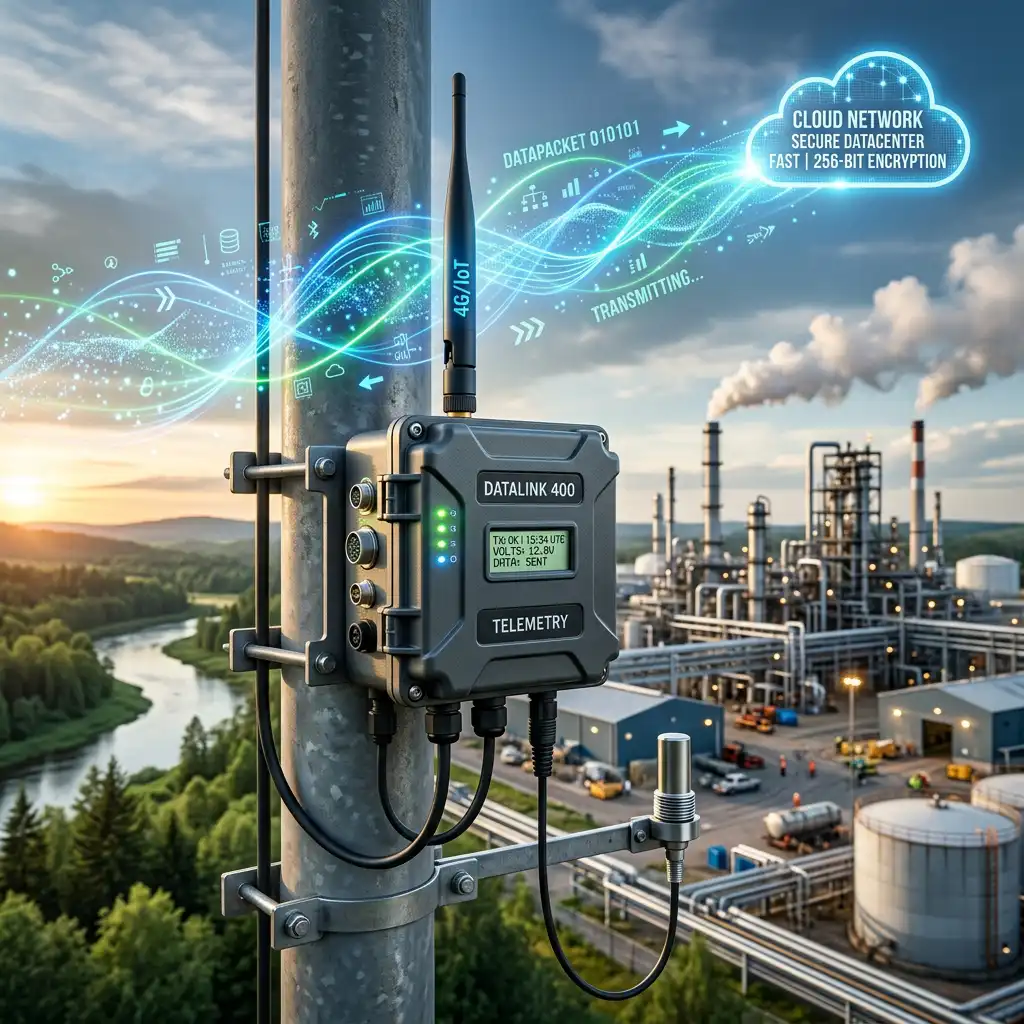
When you read a wastewater quality report from your factory, or notice an early flood warning on your computer dashboard, have you ever wondered how those numbers get there so instantly? Especially when those sensors are located in the middle of a remote river or an isolated mining area with poor cellular signals.
The answer lies within one crucial piece of technology known as the Environmental Telemetry System (Sistem Telemetri Lingkungan). As a leading provider of Industrial Internet of Things (IIoT) solutions, Fortuna Argatech heavily relies on this technology to bridge the vast physical distance between field measuring instruments and the command center (server).
Let’s unpack how this wireless data transmission system works to maintain your industry’s environmental compliance.
What Exactly is a Telemetry System?
Simply put, telemetry is the process of automated wireless communication. This equipment is tasked with taking data that has been measured by physical instruments (such as water pH sensors, dust sensors, or rain gauges) and sending it to another location that is geographically distant.
Without telemetry, you would have to send someone to the river or the smokestack every single day just to manually copy numbers off a sensor screen. Obviously, that is time-consuming, expensive, and prone to human error. With telemetry, this entire recording and reporting process happens automatically, instantly (real-time), and 24/7 without stopping.
The Anatomy of Fortuna Argatech’s Telemetry System
To ensure your sensor data arrives safely without anything getting lost or corrupted, Fortuna Argatech designs a telemetry architecture consisting of three main components:
1. The Data Logger (The Smart Recorder)
Out in the field, all the cables from the sensors run into a protective panel box containing the Data Logger. The software inside this box translates the analog or digital signals from the sensors into numerical data readable by a computer. Our data logger also functions as a local backup storage. So, if the signal suddenly drops, the data remains safely stored in the memory and won’t be lost.
2. The Wireless Communication Module (The Courier)
After the data is recorded, the next job is to send it through the air. Fortuna Argatech provides several “courier” options depending on where the equipment is installed:
- Cellular Networks (GSM/4G/5G): Perfect for factory or urban areas with stable mobile signals. Data is sent much like sending an instant message.
- Satellite Connection: If the device is installed deep in a forest or on a remote coastline (for instance, for Tsunami Early Warnings), the communication module beams the signal straight to orbiting satellites.
- LoRaWAN Radio: Utilized when there are many sensor points in a single large industrial complex that need to talk to each other without incurring mobile internet data costs.
3. Cloud Server and Dashboard (The End Point)
The airborne data is caught by cloud servers. This is where raw data is transformed into beautiful, easy-to-understand visual graphs. Through Fortuna Argatech’s web dashboard, clients and ministry officials (like KLHK) can directly monitor industrial compliance, view historical data, or receive hazardous alarm notifications.
Why is Telemetry Quality So Decisive?
When it comes to environmental law, disconnected data transmission can be fatal. The government (KLHK) strictly requires the connectivity of monitoring systems (like SPARING and ONLIMO) to remain active for a minimum percentage every month.
That is why telemetry modules from Fortuna Argatech are not only designed to be waterproof and resistant to extreme weather, but they are also powered by independent solar panels. Our commitment is to ensure that your operational data stream remains intact and compliant with regulations, regardless of the harsh conditions occurring in the field.
FAQ
What is a Telemetry System?
Telemetry is a technological system that allows the remote collection of data from physical measuring tools and transmits it to a receiving center without requiring human intermediaries.
What happens if the internet signal at the site dies?
Data Logger devices from Fortuna Argatech feature internal memory storage. When the signal comes back online, the data accumulated in the memory will automatically be sent sequentially (backfilled), so no data is lost.
How much data is transmitted every day?
It depends on the regulations. For KLHK environmental systems, data transmission intervals can be set from once every two minutes up to once an hour.
Is telemetry vulnerable to hacking?
Industrial data transmission is protected with strong end-to-end network encryption and dedicated API pathways so that data cannot leak or be altered by outside parties.
Can one data logger be connected to multiple sensors at once?
Yes. A single advanced data logger unit from Fortuna Argatech can simultaneously receive input from various types of sensors (e.g., water sensors, weather sensors, and gas sensors).
Sources
- Ministry of Environment and Forestry (KLHK). (n.d.). Environmental Monitoring Connectivity Regulations.
- Fortuna Argatech. (n.d.). Telemetry and IoT Solutions Portfolio. https://argatech.com
- IoT and Data Communication Journal Portal. Fundamentals of Industrial Telemetry Systems.
Share this article
Share this insight with your team.
Related Articles
Similar topics from the same category.
Environmental monitoring data retention guide: KLHK regulations, ANRI standards, a 3-layer storage model, and ALCOA+ principles for audit readiness.

Guard bands and decision rules for monitoring sensors: ILAC G8 4-zone model, SPARING pH example, documenting compliance decisions.
Three sensor cross-validation methods for monitoring stations: co-located redundancy, multivariate consistency, and neighbor checks across stations.