Thermopile vs Silicon Pyranometer: Choosing the Right Solar Radiation Sensor for Weather Stations and PV Plants
A technical guide to selecting thermopile vs silicon pyranometer sensors based on ISO 9060 spectral accuracy, IEC standards, and weather station budgets.
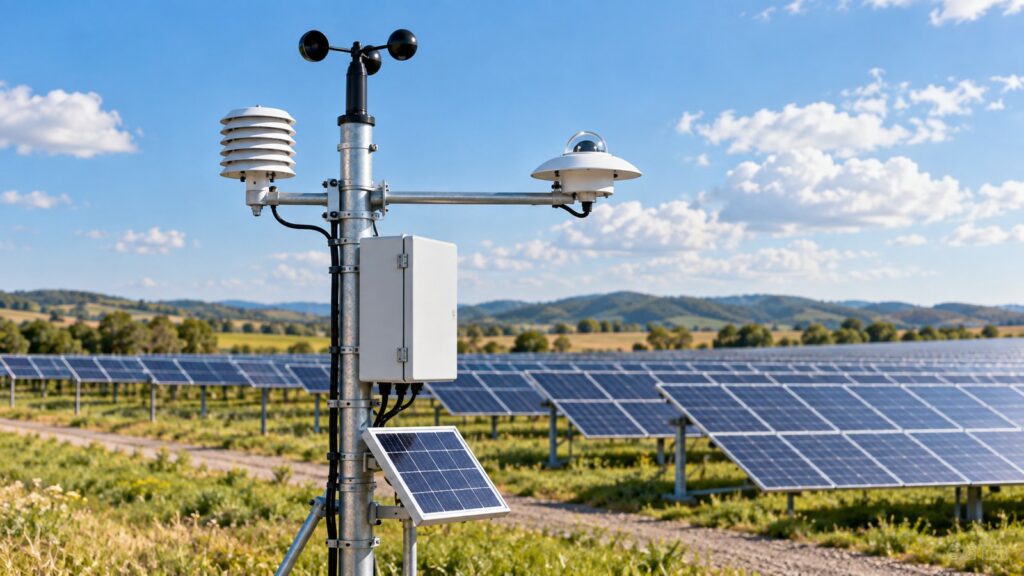
Instrumentation engineers and solar developers inevitably hit the same procurement wall when spec’ing a weather station: why the massive price gap? A silicon photodiode pyranometer costs anywhere from $200 to $500. A certified ISO 9060 Class A thermopile pyranometer commands five to eight times that, routinely clearing $3,000. Both output a clean Watt per square meter (W/m²) reading. Naturally, the procurement desk wants to know if the cheaper sensor is good enough.
A lot of EPC contractors guess wrong here. They assume an industrial 4–20 mA or Modbus output guarantees valid data. That bad guess ends up causing multi-million-dollar disputes during utility-scale PV performance audits. Before signing a purchase order, project managers need to understand the hard physical limits of optical absorption and the compliance rules that separate a thermopile from a piece of silicon.
The Physics of Spectral Absorption: Thermopile vs Silicon Photodiode
A pyranometer measures all the solar radiation falling on a flat surface from the entire sky. The problem is the sheer width of the solar spectrum. Shortwave radiation hitting the ground spans from roughly 285 nanometers (nm) out to 3000 nm. That covers ultraviolet light, the entire visible spectrum, and deep near-infrared heat.
A thermopile pyranometer handles this by using a blackbody absorber disk. This blackened surface acts like dark asphalt on a summer afternoon. It indiscriminately absorbs the entire spectrum—from 285 to 3000 nm—and turns that light into heat. That heat creates a temperature difference across a ring of thermocouples inside the housing. Thanks to the Seebeck effect, this temperature gradient generates a tiny voltage that directly matches the total W/m² hitting the sensor. Because it absorbs every color of light equally, a thermopile is considered “spectrally flat.”
A silicon sensor plays a totally different game. It uses a photodiode chip to convert photons directly into electricity. Because of the physical limits of the silicon bandgap, the chip only reacts to light between 350 nm and 1100 nm. Put simply, the silicon sensor is half-blind. It literally cannot see roughly 50% of the sun’s actual energy.
Why Cloudy Tropical Weather Amplifies Silicon Sensor Errors
Manufacturers hide this spectral blindness with factory calibration. They place the silicon sensor next to a reference thermopile under a perfect, cloudless midday sun (the AM1.5 spectrum) and dial in the math. If the sky stays perfectly clear, that calibrated silicon sensor will spit out a W/m² reading that matches a $3,000 thermopile almost perfectly.
But the real sky changes. When heavy clouds roll in, or when the sun drops low on the horizon, the color of the light piercing the atmosphere shifts. The spectral energy moves outside the silicon’s narrow viewing window. Because the silicon is only guessing the total energy based on a clear-sky baseline (sub-sampling), the factory math falls apart.
In the tropics, where convective clouds and high humidity scatter massive amounts of diffuse radiation, this gets ugly. NREL field data shows that silicon sensors can miss the actual irradiance mark by 10% to 15% under heavy cloud cover. In a tropical climate, being off by double digits every time it gets cloudy completely ruins an annual energy yield model.
ISO 9060:2018 Classification and IEC 61724-1 PV Monitoring Mandates
To stop manufacturers from making wild accuracy claims, the industry relies on ISO 9060. The 2018 revision simplified things into three tiers: Class A (formerly Secondary Standard), Class B (First Class), and Class C (Second Class). More importantly, the revision added a mandatory “spectrally flat” label for sensors that actually measure the whole spectrum evenly.
Because of its narrow vision, no silicon sensor will ever earn a spectrally flat label. The absolute best industrial silicon sensors tap out at Class C. Quality thermopiles own the Class A and Class B spectrally flat tiers.
This classification directly dictates what you can build. The latest PV monitoring standard, IEC 61724-1:2021, wiped out the Class C monitoring category entirely. If you are building a Class A utility-scale PV plant, the standard legally mandates a spectrally flat ISO 9060 Class A pyranometer as the primary sensor. Silicon photodiodes are strictly banned from acting as the primary irradiance reference.
For a solar farm operating under a strict Power Purchase Agreement (PPA), measuring irradiance a few percent too low destroys the Performance Ratio (PR) calculation. That math error is what triggers massive financial penalties between the EPC and the investors over guaranteed yield.
Agricultural and Hydrological Applications: Irradiance in FAO-56 Evapotranspiration
Solar developers aren’t the only ones who need clean data. Commercial palm oil and sugarcane plantations run on daily water balance calculations. The global gold standard for figuring out how much water a crop needs—the FAO-56 Penman-Monteith equation—runs primarily on net shortwave solar radiation.
If a silicon sensor drops the ball every time afternoon convective clouds roll in, the daily radiation total comes up short. That immediately skews the irrigation schedule and the crop water deficit index. A thermopile pyranometer ensures the evaporative energy data stays accurate, regardless of the cloud cover.
Technical Comparison Matrix and Procurement Decision Guide
If you are building a utility PV plant with a performance warranty, buy the Class A thermopile. If you just need a rough weather station for a residential roof or a local farm, save the money and buy silicon. This matrix breaks down the engineering differences so you can write a watertight Terms of Reference (ToR):
| Evaluation Parameter | ISO 9060 Thermopile Pyranometer | Silicon Photodiode Pyranometer |
|---|---|---|
| Detection & Absorption Principle | Black disk converts 285–3000 nm radiation energy into heat voltage | Semiconductor chip generates current from a narrow 350–1100 nm band |
| Spectral Response (Cloudy Accuracy) | Spectrally flat; holds steady regardless of cloud cover or sun angle | Spectral sub-sampling; accuracy drifts 10% to 15% under clouds |
| Response Time (t95) | Slow, 1 to 18 seconds; smooths out the data for daily energy totals | Ultra-fast, under 1 millisecond; instantly tracks passing cloud shadows |
| Thermal Zero Offset Phenomenon | Can output small negative numbers at night as the glass dome cools | Immune to nighttime thermal drift because it doesn’t use heat |
| IEC 61724-1 PV Regulatory Compliance | Mandatory for Class A/B monitoring; legally bankable for PR warranties | Banned for primary Class A/B monitoring; restricted to Class C |
| Estimated Procurement Cost (CAPEX) | Very expensive, $1,500 to $4,500 depending on class and Modbus options | Highly economical, $200 to $600; perfect for deploying dozens at once |
| Optical Maintenance Complexity | Requires wiping the glass dome, checking the level, and swapping silica gel | Low maintenance; Teflon domes shed rainwater easily |
| Primary Application Suitability | Utility PV audits, national weather grids, precision FAO-56 hydrology | Residential solar, rapid transient cloud research, low-cost farming |
Installation, Maintenance, and Weather Station Integration with Fortuna Argatech
Buying a $3,000 sensor is useless if you bolt it down crooked. High-end weather gear demands maintenance. A thermopile needs a technician to regularly wipe bird droppings off the glass dome, check the bubble level, and swap the internal silica gel so the glass doesn’t fog up from the inside. ISO 9847 also strongly recommends recalibrating the unit every two years against an instrument traced back to the World Radiometric Reference in Switzerland.
As an industrial integration firm, Fortuna Argatech builds turnkey automatic weather stations for open-pit mines, precision agriculture, and solar power plants. Regardless of which pyranometer you spec, the Fortuna Argatech GEOVOS 1000 datalogger reads it natively. It handles bare microvolt analog lines, standard 4–20 mA loops, and RS-485 Modbus RTU digital feeds.
If you are dropping a mast in the middle of nowhere, sensor power draw dictates whether the telemetry stays online. Fortuna Argatech engineers custom standalone solar panel and battery architectures matched to your site’s actual irradiance profile. Do not let a mismatched sensor void a PV performance warranty. Contact the instrumentation engineering team at Fortuna Argatech to lock in the right weather station topology for your budget.
Share this article
Share this insight with your team.
Related Articles
Similar topics from the same category.
Poor weather station placement can cause 50% data bias. Learn the WMO-No. 8 and Indonesian BMKG siting standards for AWS sensors in industrial and mining sites.
Explore a technical engineering comparison between solid-state ultrasonic anemometers and mechanical cup-and-vane sensors for industrial weather stations.

Technical guide to conductivity sensors: comparing toroidal (inductive), 2-electrode, and 4-electrode contacting probes for industrial water and wastewater.