The Role of an AQMS Smart City System for Clean Urban Air
Discover how an AQMS Smart City system helps local governments monitor deadly PM2.5 air pollution levels and establish healthier sustainable urban planning.
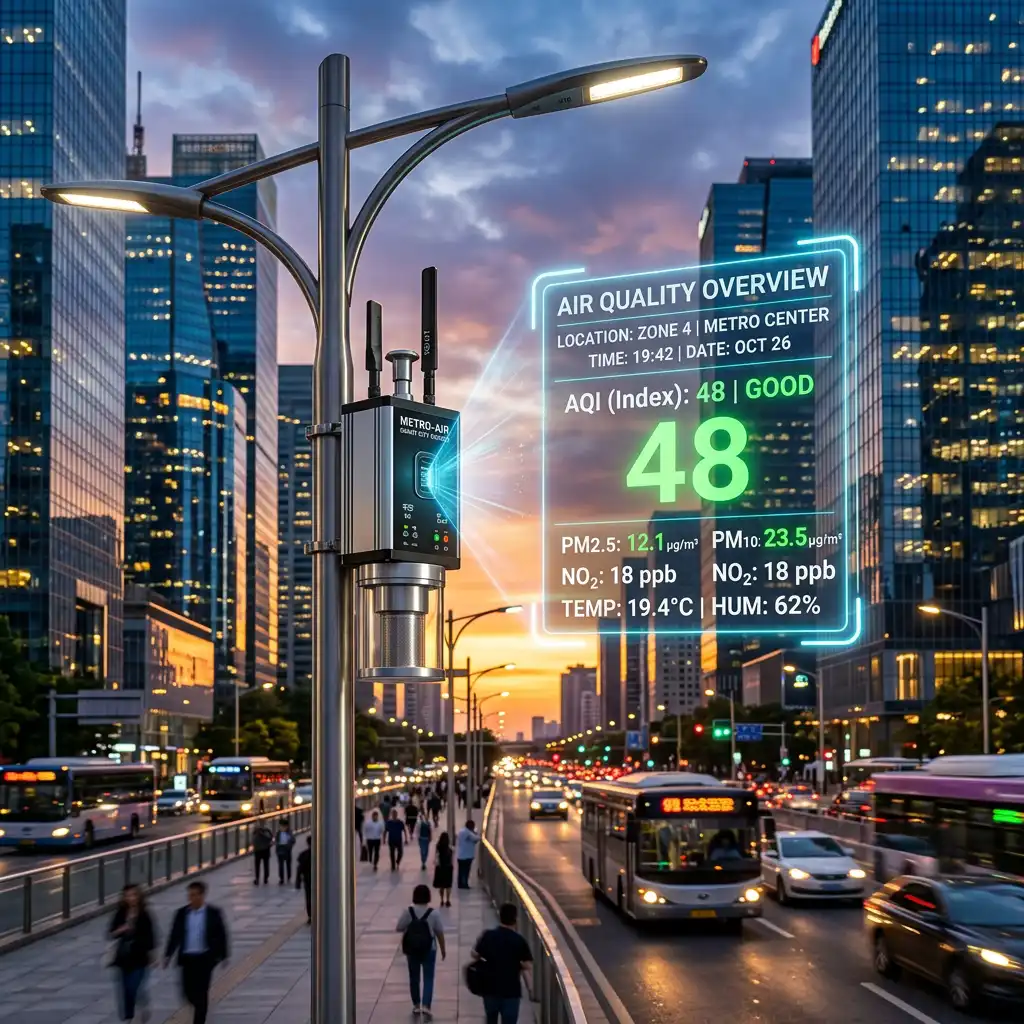
Within the grand concept of future urban planning, technology is not solely utilized to untangle traffic jams or illuminate grand highways. One of the most crucial pillars to make a city truly “smart” and livable is its absolute capability to protect its citizens’ health from the invisible threat of severe air pollution. This is precisely where the integration of an AQMS Smart City ecosystem becomes a technological leap that regional governments can no longer delay.
As metropolitan residents, we often fail to realize just how heavily polluted the air we inhale every morning truly is. Vehicle exhaust fumes, dense factory smoke, and rampant open waste burning generate microscopic, invisible poisons.
Fully committed to supporting the ambient air regulations set by the Ministry of Environment and Forestry (KLHK), Fortuna Argatech introduces brilliant innovations in urban air quality monitoring. Let’s delve into exactly how an AQMS Smart City system operates relentlessly to ensure the lungs of your city remain perfectly healthy.
What Exactly is an AQMS (Air Quality Monitoring System)?
In the simplest of terms, an AQMS is an integrated meteorological and pollutant monitoring station specifically engineered to precisely measure the quality level of ambient air in open public spaces.
Unlike cheap, portable measuring tools that are frequently wildly inaccurate, the industrial-grade instruments from Fortuna Argatech can accurately detect even the most lethal pollutant particles. The AQMS Smart City systems we develop are fully equipped with advanced sensors that read fine dust (PM2.5 and PM10), carbon monoxide (CO), sulfur dioxide (SO2), and nitrogen dioxide (NO2).
These robust devices are typically mounted elegantly onto street lampposts, government building rooftops, or heavily trafficked public city parks.
How Does AQMS Revolutionize Sustainable Urban Planning?
Adopting this cutting-edge monitoring technology is not merely about chasing the prestige of winning smart city awards; it delivers profound, direct impacts on the daily lives of millions:
1. Absolute Transparency of the Air Quality Index (AQI)
Have you ever noticed massive LED screens looming over major highways displaying bright green, yellow, or red colors alongside air quality scores? That critical data is supplied directly by an AQMS Smart City network. With real-time data updates executed every single minute, city residents can know with absolute certainty whether it is safe to jog outdoors today or if wearing medical masks is strictly mandatory.
2. Data-Driven Policy Making
When a specific highway is recorded consistently breaching the KLHK’s maximum threshold for PM2.5 air pollution for an entire month, the local government can take immediate, decisive action. For example: implementing odd-even license plate rationing, outright banning heavy trucks from passing during the day, or immediately planting carbon-absorbing trees aggressively within that specific red zone.
3. Early Warning for Fires and Factory Emissions
Beyond surveilling exhaust fumes, the SO2 and PM10 sensors on this device are hyper-sensitive to drastic air changes caused by massive land fires on the city outskirts or sudden toxic emission leaks from nearby industrial estates. An early warning alarm will instantly ping the government’s central Command Center dashboard.
Manifest Your Dream City with Fortuna Argatech
Building a genuinely smart city must begin from the most fundamental element of life: the air its citizens breathe. Governments simply cannot fight an enemy (pollution) that they cannot accurately measure.
Fortuna Argatech provides comprehensive AQMS Smart City solutions—spanning from the physical installation of rugged sensor hardware and seamless IoT cloud server connections to the creation of stunning visual dashboards (command centers) easily understood by both public officials and everyday society. Together, let us make your city flawlessly clean, remarkably smart, and breathing freely once again!
FAQ
Why is PM2.5 considered incredibly dangerous to human health?
PM2.5 constitutes fine dust particles measuring 30 times smaller than the diameter of a single human hair. Due to being microscopic, these particles cannot be filtered by nasal hairs and will slip directly into the lung’s bloodstream, directly triggering severe heart diseases and fatal asthma attacks.
Where are the best locations to install AQMS sensors in a metropolis?
To gather comprehensively accurate data, sensors must be strategically scattered across multiple diverse points: heavy traffic zones (for vehicle pollution), dense industrial zones, and pristine residential areas/parks (serving as clean air baseline data).
How can the general public view the data generated by Fortuna Argatech devices?
Our high-tech IoT system funnels data through a flawless API (Application Programming Interface). Local governments can effortlessly display this raw data on their proprietary Smart City applications or broadcast it live on towering highway videotrons.
Are these delicate instruments resistant to violent rainstorms?
Absolutely. The physical casing of a Fortuna Argatech AQMS station is rigorously designed with IP65/IP66 standards, rendering it utterly impenetrable to dust and heavy storms. It also features an internal ventilation ecosystem to stabilize the humidity shielding the electronic circuits.
Can this device track exactly where the pollution originated from?
By seamlessly integrating an additional weather station module (measuring wind speed and wind direction) onto the AQMS mast, environmental analysts can accurately trace the exact geographical direction from which the toxic gas clouds are blowing.
Sources
- Ministry of Environment and Forestry (KLHK). (n.d.). Air Quality Index (ISPU).
- Fortuna Argatech. (n.d.). Integrated AQMS Solutions. https://argatech.com
- World Health Organization (WHO). Air Quality Guidelines.
Share this article
Share this insight with your team.
Related Articles
Similar topics from the same category.

Environmental monitoring data retention guide: KLHK regulations, ANRI standards, a 3-layer storage model, and ALCOA+ principles for audit readiness.

Guard bands and decision rules for monitoring sensors: ILAC G8 4-zone model, SPARING pH example, documenting compliance decisions.

Three sensor cross-validation methods for monitoring stations: co-located redundancy, multivariate consistency, and neighbor checks across stations.