RTU vs Data Logger: Which Fits Environmental Monitoring Stations?
Technical comparison of RTU vs data logger for environmental monitoring stations covering power, storage, SCADA protocols, and selection criteria.
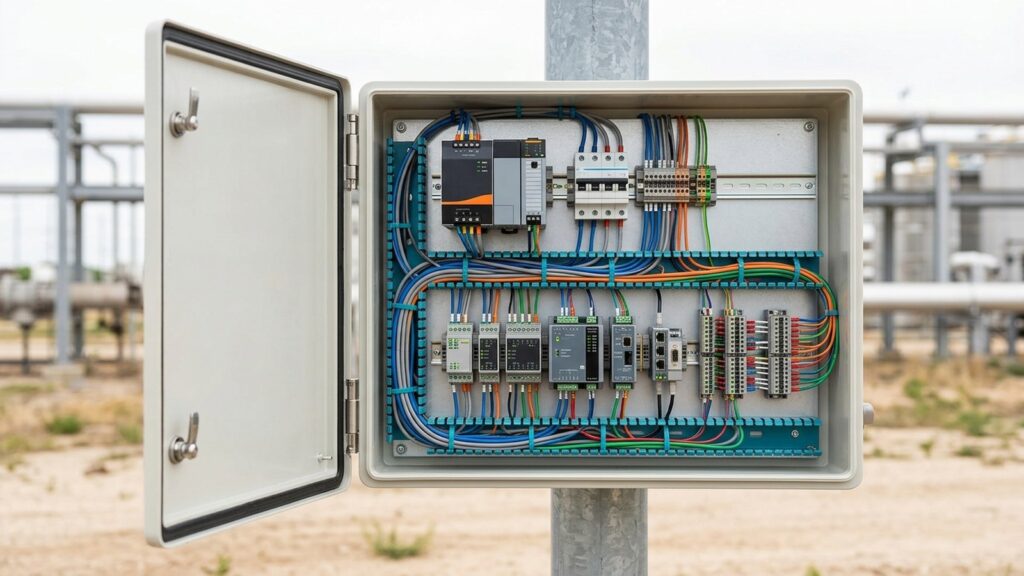
The RTU vs data logger question shows up early in every monitoring-station project. Usually right when someone starts writing the technical specification. Pick wrong, and you end up with a solar panel that can’t keep up or a station that can’t talk to the SCADA master running the rest of the network. But before comparing spec sheets, clear up one naming collision that trips people up constantly: “Modbus RTU” is a serial communication protocol, not hardware. It rides over RS485 wiring and shows up in both device types. A device that speaks Modbus RTU is not automatically a Remote Terminal Unit.
Once that’s sorted, the actual comparison gets straightforward.
Separating responsibilities: autonomous data acquisition vs centralized SCADA telemetry
NIST SP 800-82 Rev. 3 defines a Remote Terminal Unit as a microprocessor-based field device that connects physical objects (sensors, valves, pumps) to a supervisory system through telemetry. It also executes control commands from the SCADA master. The RTU’s job is two-way: report status upstream, carry instructions back down.
A data logger has a different center of gravity. USGS field-measurement standards and WMO guidance for automatic weather stations describe it as a programmable device that measures physical variables on a set schedule, stores time-stamped records locally, and transmits when connectivity allows. The logger’s first obligation is to the data. Not to a control room.
The South Florida Water Management District (SFWMD) SCADA audit shows what this separation looks like in the field. Across their canal and reservoir network, Campbell Scientific data loggers (CR-10, CR1000) handled hydrology, weather, and water-quality recording. Motorola MOSCAD RTUs controlled gate structures and pumps. Two different device classes, each doing the job it was built for.
Four field-critical factors: power, storage, communication, and control
Station planners evaluate four dimensions when choosing between an RTU and a data logger. Each one determines whether the station survives its first dry season or its first network outage.
| Factor | Data logger | RTU |
|---|---|---|
| Power profile | Ultra-low-power architecture with sleep duty cycling; runs on small solar panels and batteries for months or years | Higher sustained draw to maintain real-time communication, I/O scanning, and actuator readiness; needs larger power budgets or mains supply |
| Offline storage | Core function: logs time-stamped records locally and forwards them when the link returns (store-and-forward) | Some buffer capability, but offline autonomy is secondary to real-time SCADA reporting |
| Communication model | Scheduled push or pull over MQTT, HTTP, or cellular; can also respond to Modbus polling | Master-slave polling or event-driven Sequence of Events (SOE) via DNP3, Modbus, or IEC 60870-5-104 |
| Control capability | Reads sensors, processes data, triggers alerts. Does not execute actuator commands | Receives and executes commands from SCADA master: open valve, start pump, adjust set point |
The table simplifies a range of products, but the directional differences hold. Power draw alone knocks out most conventional RTUs from solar-powered remote sites where a 20 W panel and a 12 V battery are all you’ve got.
Why environmental stations pick data loggers
Most environmental monitoring stations (weather, hydrology, water quality, geotechnical) are observation platforms. They measure, record, and report. Nobody’s opening gates or starting pumps from them.
That observation-only mission lines up perfectly with data-logger architecture. A logger draws microamps to low milliamps in sleep mode, wakes on schedule to scan sensors, writes records to local storage, and transmits at whatever interval the power budget can handle. Cellular coverage drops for hours? Days? The store-and-forward buffer keeps the dataset intact. No records lost to a missed polling cycle.
The SFWMD audit backs this up. Their environmental data-collection stations ran on loggers. RTUs showed up only where mechanical control existed: gates, pumps, structures needing commands from central dispatch.
For remote sites on solar, the power math is the deciding factor. An RTU that stays awake to answer SCADA polls on millisecond notice pulls sustained current. A data logger that sleeps between measurement intervals runs the same station on a fraction of the energy. In procurement terms, a logger-based station often carries lower total cost of ownership when no actuator control is required.
When an RTU becomes a hard requirement
If the station must execute commands (open a sluice gate, run a dosing pump, adjust a valve position), you need an RTU. Full stop. This is the single clearest dividing line.
An RTU connects to the SCADA master through protocols built for control: DNP3 with event-class reporting, IEC 60870-5-104 for TCP/IP networks, or Modbus function codes that write to output registers. The master polls, or the RTU reports on exception. Either way, the control room operator can issue commands that the RTU carries out at the field level.
Water utilities, flood-management agencies, and industrial process plants put RTUs wherever physical assets need to move. NIST SP 800-82 Rev. 3 positions the RTU as a standard SCADA field-layer component for exactly this reason. If a station has no actuators and data flows only from field to server, an RTU adds cost and complexity without delivering anything the station actually needs.
Convergence: smart RTUs and modern data loggers
The boundary between RTU and data logger is less rigid than it was ten years ago. Campbell Scientific documents cases where data loggers serve as RTU nodes in SCADA systems by supporting DNP3 and Modbus TCP. On the other side, smart RTUs from manufacturers like Schneider Electric now include onboard data logging, low-power modes, and cellular connectivity.
This convergence matters most for stations sitting between pure observation and light control, where a logger handles the bulk of the work but one or two digital outputs need to respond to a remote command.
The GEOVOS Datalogger 1000 from Fortuna Argatech sits on the data-logger side of this spectrum: 4G connectivity, RS485 sensor interface, 8 GB onboard storage, cloud monitoring dashboard, and WhatsApp/email alert notifications. It doesn’t claim RTU control functions. But it represents the kind of modern logger that handles telemetry, edge data validation, and remote visibility without the power overhead of a traditional RTU.
For projects that genuinely require SCADA integration with existing RTU or PLC infrastructure, Fortuna Argatech also provides industrial solution engineering through protocols such as OPC-UA. This is a system-integration capability, not a feature of the GEOVOS unit itself.

Six questions before procurement
Before writing a specification or RFP, run through these:
- What is the power source? If the station runs on solar and battery with no mains connection, calculate whether the candidate device can sustain its duty cycle on the available energy. Data loggers with sleep modes will survive. Most conventional RTUs won’t.
- Does the station need to control anything? If yes (valves, pumps, gates, dosing systems), an RTU or smart RTU belongs in the architecture. If no, a data logger covers the requirement at lower cost and lower power.
- What happens when the network goes down? Figure out how many hours or days of data must be retained locally and resynchronized. A logger with store-and-forward handles this by design. Verify the specific buffer depth against your station’s sampling rate.
- Which system receives the data? A SCADA master expecting DNP3 polling requires a device that speaks that protocol. A cloud dashboard expecting MQTT or HTTP works fine with a cellular data logger. Match the device to the receiving architecture.
- How many sensors and what interfaces? List every sensor, its signal type (RS485 Modbus, analog 4-20 mA, SDI-12, pulse), and the required scan interval. That gives you channel count and protocol compatibility.
- What is the maintenance and lifecycle budget? RTU-based stations with actuators need periodic valve and pump servicing, SCADA software licensing, and cybersecurity patching. Logger-based observation stations have simpler maintenance profiles: sensor calibration, battery replacement, SIM management.
These six questions narrow the decision faster than a feature-by-feature datasheet comparison. For data loggers vs PLCs in control-oriented applications, see: Data Logger vs PLC: Which Fits Monitoring or Control?
Matching the device to the station’s job
The RTU vs data logger decision comes down to one question: does the station observe, or does it also act? Observation stations (weather, hydrology, water quality, structural monitoring) run efficiently on data loggers that sleep between measurements and store records through outages. Stations that must execute control commands from a central dispatch need an RTU in the field layer.
Where the line blurs, hybrid devices and system-integration approaches bridge the gap. Fortuna Argatech’s engineering team can help map sensor requirements, power budgets, and SCADA interoperability to an architecture that fits the station’s operating conditions, whether it centers on a GEOVOS data logger, an RTU, or both.
Technical references
- National Institute of Standards and Technology, Guide to Operational Technology (OT) Security, NIST SP 800-82 Rev. 3, September 2023.
- Campbell Scientific, Understanding the Roles of Data Loggers, RTUs, PLCs, and PACs, February 2018.
- Campbell Scientific, Why Should You Use a Data Logger as an RTU in Your SCADA System?, October 2024.
- South Florida Water Management District, Audit of SCADA Implementation and Operations, Report No. 10-06, March 2010.
Share this article
Share this insight with your team.
Related Articles
Similar topics from the same category.
Monitoring station OPEX budget planning guide covering five cost pillars, cross-station comparison, hidden costs, and a modular worksheet for annual budgeting.

8 mandatory monitoring criteria for PROPER Blue rating under PermenLH 7/2025: SPARING, AQMS, B3, waste, peatland, mining, and SIMPEL audit.

Compare TDR and FDR soil moisture sensor principles, dielectric calibration limits for tropical peat, and multi-depth telemetry integration via GEOVOS 1000.