Why ISE Nitrate Probes Fail in Rivers and When to Switch to Reagent-Free UV Spectrophotometry
A technical guide comparing UV absorption spectrophotometry and ISE probes for online nitrate monitoring in rivers, ONLIMO stations, and industrial wastewater.
Monthly grab sampling misses the acute stormflow nutrient pulses that flush through river catchments. After heavy rainfall upstream, fertilizer runoff surges into waterways within hours, then washes downstream before a field technician shows up weeks later. A continuous online nitrate sensor is the only reliable way to catch those rapid loads. Once nitrate concentrations exceed 10 mg/L as nitrate-nitrogen (NO3-N), eutrophication fuels algal blooms that strip dissolved oxygen and trigger fish kills.
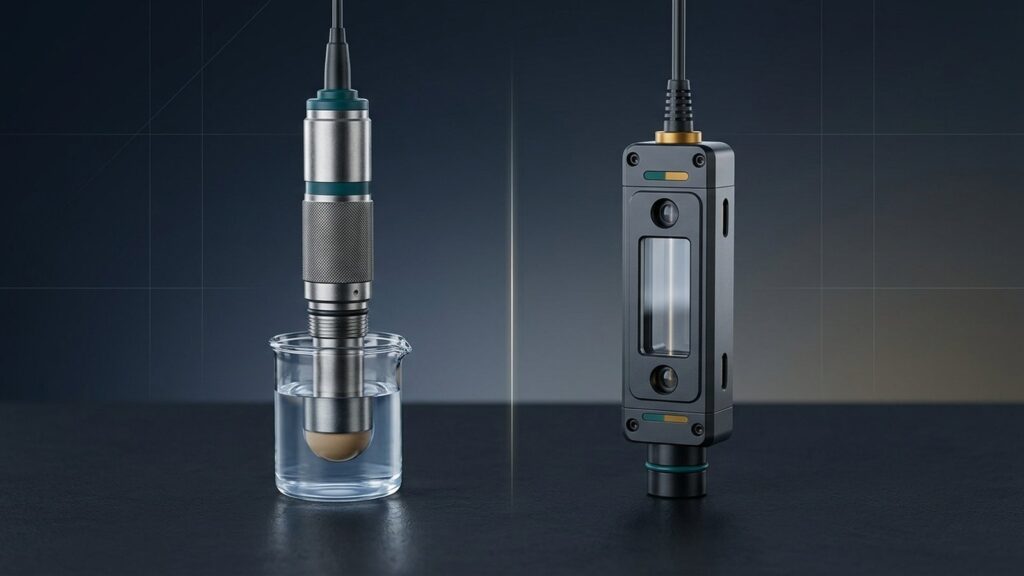
Two field instruments compete for continuous nitrate duty: potentiometric Ion Selective Electrode (ISE) probes and reagent-free ultraviolet (UV) absorption spectrophotometers. ISE probes cost less upfront. But chronic calibration drift and ionic cross-sensitivity undermine their field reliability in actual deployments.
Indonesian Regulatory Limits and the NO₃⁻ vs NO₃-N Conversion Trap
In Indonesian jurisdiction, Government Regulation (PP) No. 22 of 2021 (Appendix VI) caps nitrate at 10 mg/L NO3-N for Class 1 (drinking water intake) and Class 2 (recreation and fisheries), and 20 mg/L for Class 3 and Class 4 waters. In municipal networks, Ministry of Health Regulation (Permenkes) No. 2 of 2023 enforces a 10 mg/L NO3-N ceiling (equivalent to ~44.3 to 50 mg/L as total nitrate ion, NO3−) to prevent infant methemoglobinemia (blue baby syndrome) and carcinogenic nitrosamine risks.
Continuous compliance is mandated under Directorate General PPKL Regulation No. P.8/2019 for online water monitoring (ONLIMO) stations across 15 national priority river basins. Permen LHK No. 5 of 2014 sets separate effluent limits for fertilizer, petrochemical, and inorganic chemical industries.
Field teams often confuse nitrate-nitrogen (NO3-N, atomic mass 14.007 g/mol) with the intact nitrate ion (NO3−, molecular mass 62.004 g/mol). They relate via a 4.427 stoichiometric factor:
Mix these up and you get a 442% compliance error. A legal discharge of 10 mg/L NO3-N reported as 44.3 mg/L NO3− will trigger unwarranted regulatory violation notices and plant audit disputes.
Why Chloride Interference and Calibration Drift Wreck ISE Probes
Nitrate ISE probes measure potentiometrically using a plasticized PVC membrane containing a lipophilic quaternary ammonium ionophore paired with an Ag/AgCl reference electrode. At 25°C, the Nernstian response yields a theoretical slope of -59.16 mV per decade change in nitrate activity:
Real surface waters, though, contain interfering anions governed by the Nikolsky-Eisenman relationship. Bicarbonate (HCO3−), nitrite (NO2−), and especially chloride (Cl−) cross the membrane. Standard nitrate membranes exhibit a chloride selectivity coefficient (KNO3,Cl) between 10−2 and 10−3. In brackish reaches, estuaries, or industrial outfalls where chloride levels hit 100 to 500 mg/L, chloride displaces nitrate and generates large false-positive spikes.
ISE probes also experience baseline drift of 5 to 10 mV weekly in open waters. The causes: ionophore leaching, reference junction clogging, biofilm buildup. A 59 mV shift represents a tenfold concentration change, so a 6 mV weekly drift creates an error exceeding 20% in just seven days. Leave a probe unattended beyond 14 days and data divergence gets bad. Membrane cartridges degrade within 3 to 9 months and need recurring replacement.
UV Absorption Spectrophotometry: Direct, Reagent-Free Measurement
Optical sensors skip membranes entirely. They measure natural photon absorption instead. Nitrate ions (NO3−) absorb strongly in the deep ultraviolet spectrum (200 to 240 nm), with a characteristic peak at 210 to 220 nm driven by n→π∗ molecular orbital transitions. The measurement follows the Beer-Lambert law:
Absorbance (A) scales directly with path length (b) and concentration (c), so optical sensors measure nitrate without chemical reagents. No cadmium. No hazardous waste. That alone eliminates the carcinogenic copperized cadmium powder required by standard laboratory reduction tests (APHA 4500-NO3− E).
Pulsed Xenon flash lamps rated for >108 pulses give industrial UV sensors a working life of 5 to 10 years without lamp replacement. Readings come back in 1 to 10 seconds, and typical drift stays below 0.1 mg/L NO3-N over several months. Field maintenance drops to almost nothing.
Spectral Compensation: Handling Turbidity, Organics, and Biofouling
In raw water, dissolved organic matter (NOM, DOC, humic acids) absorbs broadly across 200 to 400 nm, overlapping the nitrate peak. Suspended sediment causes optical scattering on top of that. A single-wavelength sensor (such as a 254 nm COD probe) cannot isolate nitrate without compensation.
Dual-wavelength instruments (USGS TM 1-D5, APHA 4500-NO3− B) measure absorbance at 220 nm and a reference channel at 275 nm (where nitrate does not absorb), then apply the standard correction:
Full-spectrum spectrophotometers (200 to 390 nm diode arrays) use Partial Least Squares (PLS) chemometrics to deconvolve nitrate, nitrite, and organics while subtracting turbidity scattering.
Path length selection matters just as much:
- 10 mm to 35 mm: Suits clear, low-nutrient natural streams (0.01 to 5 mg/L NO3-N), where you need enough optical absorbance to get a clean signal.
- 1 mm to 2 mm: Required for turbid rivers and industrial outfalls to prevent complete light extinction (absorbance blackout).
Tropical biofilm and silt coat optics within 3 to 7 days. Sensors handle this with motorized wiper blades or compressed air-blast nozzles fired before each measurement.
10-Parameter Decision Matrix: ISE vs UV Spectrophotometry
| Parameter | Potentiometric ISE Probe | UV Spectrophotometry |
|---|---|---|
| 1. Principle | Potentiometry via PVC ionophore membrane | Molecular UV absorbance (Beer-Lambert law) |
| 2. Reagents | None in testing; uses calibration standards | Zero reagents (reagent-free physical method) |
| 3. Chloride Sensitivity | High ($K_{NO_3,Cl} \approx 10^{-2}\text{–}10^{-3}$); false spikes | Immune to chloride and dissolved salts |
| 4. Turbidity & Organics | Vulnerable to membrane surface fouling | Corrected via dual-wavelength or PLS |
| 5. Calibration Interval | Every 7 to 14 days (5–10 mV weekly drift) | Every 6 to 12 months (<0.1 mg/L drift) |
| 6. Sensor Lifespan | 3 to 9 months per membrane cartridge | 5 to 10 years (Xenon flash >10^8 pulses) |
| 7. Power Consumption | <0.5 W continuous potentiometry | 2 to 8 W during pulsed flash measurement |
| 8. Capital Cost (CAPEX) | Low (30% to 40% of optical sensor cost) | Moderate to high initial investment |
| 9. Maintenance (OPEX) | High (frequent membranes, lab standards, visits) | Low (periodic wiper checks, zero chemicals) |
| 10. 3-Year TCO & Fit | Higher TCO; portable or attended batch testing | Lower TCO; unattended ONLIMO and SPARING |
An ISE probe costs less to buy. But recurring membrane replacements, calibration reagents, and bi-weekly field visits push its 3-year Total Cost of Ownership past that of an optical sensor within 18 to 24 months. ISE still makes sense for portable spot-testing or attended tanks. For continuous, unattended telemetry stations, optical UV spectrophotometry is the better engineering choice.
Fortuna Argatech integrates industrial UV nitrate spectrophotometers into turnkey ONLIMO river stations and industrial SPARING wastewater packages. Sensors connect via RS-485 Modbus RTU to the GEOVOS 1000 Datalogger, which automates compressor air-blast relays or wiper sweeps before sampling, runs edge data validation, and transmits telemetry data via 4G/satellite to KLHK servers. This setup safeguards regulatory SPARING data completeness alongside complementary optical DO sensors and in-situ chlorophyll-a and phycocyanin sensors.
Share this article
Share this insight with your team.
Related Articles
Similar topics from the same category.

Monitoring station OPEX budget planning guide covering five cost pillars, cross-station comparison, hidden costs, and a modular worksheet for annual budgeting.

8 mandatory monitoring criteria for PROPER Blue rating under PermenLH 7/2025: SPARING, AQMS, B3, waste, peatland, mining, and SIMPEL audit.

Compare TDR and FDR soil moisture sensor principles, dielectric calibration limits for tropical peat, and multi-depth telemetry integration via GEOVOS 1000.