In-Situ Chlorophyll-a and Phycocyanin Fluorometry for Algal Bloom Early Warning in Reservoirs and Raw Water Intakes
An engineering guide to in-situ optical fluorometry: deploying chlorophyll-a and phycocyanin sensors for real-time harmful algal bloom early warning.
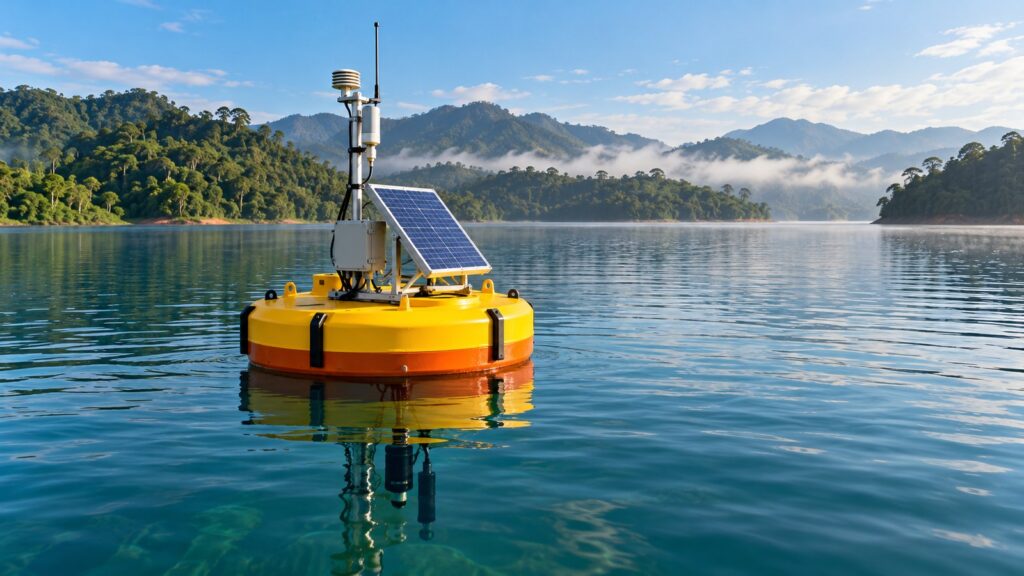
Algal blooms kill fish, poison drinking water, and wreck reservoir economics overnight. In-situ chlorophyll-a and phycocyanin sensors are the engineering backbone of any automated Harmful Algal Bloom (HAB) Early Warning System on tropical reservoirs and raw water intakes. When excess nutrient loading hits a freshwater lake or hydropower impoundment, cultural eutrophication kicks off fast. Dissolved oxygen crashes. Commercial fish stocks die in the thousands. And cyanotoxins (hepatotoxic microcystin, specifically) start rolling toward your municipal water treatment plant intake pipe.
Here is the problem with traditional reservoir management: you are stuck waiting on grab samples and lab extraction. ISO 10260:1992 and SNI 06-6989.17-2009 protocols demand cell filtration, ultrasonic lysis, then solvent extraction with acetone or ethanol. That eats 24 to 48 hours. By the time your lab certificate lands on someone’s desk, the bloom has peaked. Toxic scum coats the surface. Intracellular cyanotoxins have already infiltrated downstream intakes. If you want to catch exponential algal population spikes days before you can see scum from a patrol boat, you need autonomous in-situ optical fluorometry running around the clock.
Operating Principles of Optical Chlorophyll-a and Phycocyanin Sensors
These instruments work on in vivo fluorescence, the physics of living cells re-emitting light. USGS Techniques and Methods 1-D10 lays it out: photosynthetic pigment molecules inside live algal cells absorb light at specific excitation wavelengths, then re-emit a fraction of that energy as fluorescence at longer wavelengths. That is the Stokes shift. You measure the emitted intensity in real time. No reagents. No cell destruction. Continuous tracking of relative pigment biomass, 24/7.
The real power shows up with dual-channel sensors that separate harmless phytoplankton from toxic cyanobacteria. Chlorophyll-a (Chl-a) appears in every algal taxon, so it works as a universal proxy for total phytoplankton biomass. The Chl-a channel fires a blue excitation LED at around 470 nm and picks up red fluorescence emissions at 685 nm through a filtered photodiode. Phycocyanin (PC) is a different beast entirely: a phycobiliprotein accessory pigment that only freshwater cyanobacteria (blue-green algae) produce, including toxigenic genera like Microcystis and Anabaena. The PC channel runs an orange excitation LED near 590 nm and reads far-red emissions between 650 and 685 nm.
What does this dual-channel data actually tell a plant operator? Simple. If the Chl-a signal climbs while PC stays flat, you have a benign bloom of green algae or diatoms. Annoying, but not dangerous. If both channels spike together, that is your toxigenic cyanobacteria red flag. Submersible fluorometers pick up this subsurface exponential growth 3 to 7 days before any surface scum shows up on patrol boat rounds.
The Midday Data Artifact: Mitigating Non-Photochemical Quenching (NPQ)
This one catches a lot of field techs off guard. Non-Photochemical Quenching (NPQ) is a real headache. Under strong midday sun, phytoplankton in the upper photic zone (0 to 2 meters depth) switch on a photoprotective mechanism. Instead of converting excess light to photosynthesis or fluorescence, the cells dump absorbed photon energy as heat. Raw fluorescence output drops 40% to 80% around solar noon, even though the actual cell count has not changed at all.
That midday dip is dangerous. It creates false negatives that trick operators into thinking water quality is improving during an active bloom. Three proven engineering approaches deal with it. First, pull your baseline thresholds from nighttime or pre-dawn readings when NPQ is fully relaxed. Second, mount probes below the photic suppression zone, deeper than 1.5 to 2.0 meters. Third, run irradiance-driven correction algorithms in the datalogger firmware, calibrated against co-located solar radiation sensors.
Engineering Defenses: Turbidity, Thermal Drift, and Biofouling
Tropical reservoir water is rough on optical gear. Suspended sediment (turbidity) eats your excitation beam going in and scatters background light back into the receiver optics. Industrial fluorometer probes solve this with a dedicated near-infrared backscatter channel at roughly 850 nm that applies mathematical turbidity compensation across sediment loads up to 200 to 500 FNU. Without it, your readings drift with every rain event.
Then there is thermal quenching. Chlorophyll fluorescence efficiency drops in an inverse linear relationship with water temperature, roughly 1.0% to 1.5% per degree Celsius. Good submersible probes carry integral fast-response thermistors and normalize raw fluorescence to a 20°C or 25°C reference. Biofouling is the other fight you never stop fighting. Nutrient-rich eutrophic water grows biological slime on optical lenses within days. Skip the wiper blade and your sensor goes blind. Continuous in-situ deployments need motorized mechanical wiper blades that sweep the optical window clean before every measurement cycle. No exceptions.
Regulatory Frameworks: Trophic Status Standards and WHO Alert Levels
Raw in-situ fluorometry logs in Relative Fluorescence Units (RFU). Converting that to equivalent mass concentrations (µg/L) lets you compare directly against statutory water quality benchmarks. In Indonesia, Government Regulation PP No. 22/2021 Appendix VI sets lake and reservoir trophic status by Chlorophyll-a boundaries:
- Oligotrophic (High Quality): Chlorophyll-a $\le 2\ \mu\text{g/L}$ (clear, low nutrient baseline).
- Mesotrophic (Moderate Quality): Chlorophyll-a $>2$ to $\le 5\ \mu\text{g/L}$ (moderate biological fertility).
- Eutrophic (Light to Moderately Impaired): Chlorophyll-a $>5$ to $\le 20\ \mu\text{g/L}$ (elevated algal biomass, dissolved oxygen stress).
- Hypereutrophic (Severely Impaired): Chlorophyll-a $> 20\ \mu\text{g/L}$ (chronic algal scums, high cyanotoxin risk).
For municipal drinking water plants, the World Health Organization (WHO) Cyanobacteria Alert Framework triggers Alert Level 2 when Chlorophyll-a exceeds 12 µg/L with phycocyanin dominance. That is the threshold where intake operators must start powdered activated carbon (PAC) dosing or advanced ozonation to break down cyanotoxins. Finished water has to meet Permenkes No. 2/2023, which caps Microcystin-LR at $1\ \mu\text{g/L}$ maximum. No negotiation on that number.
Evaluation Matrix: In-Situ Fluorometry vs Laboratory Testing vs Satellite Imagery
Picking a monitoring approach means weighing three things: how fast you get data, whether it holds up in court, and how much ground it covers. This matrix lines up the three main algal surveillance methods side by side:
| Evaluation Parameter | Automated In-Situ Optical Fluorometry | Laboratory Spectrophotometric Assay | Satellite Remote Sensing (Sentinel-2) |
|---|---|---|---|
| Temporal Frequency | Continuous real-time (every 5 to 15 minutes, 24/7) | Discrete periodic (weekly or monthly grab samples) | Periodic (every 3 to 5 days per orbital overpass) |
| Data Turnaround Latency | Instantaneous (seconds to minutes via IoT telemetry) | Delayed (24 to 48 hours for extraction and analysis) | Moderate (several hours to days after post-pass processing) |
| Early Warning Capability | Very High: catches subsurface bloom 3 to 7 days early | Low: only a snapshot concentration at time of sampling | Moderate: mainly captures surface scum after accumulation |
| Cyanobacteria Differentiation | High: discrete dual-channel phycocyanin pigment optics | High: microscopic taxonomic cell counting | Limited: semi-empirical spectral color index estimation |
| Weather & Cloud Resilience | Immune: operates continuously beneath water surface | Immune: samples processed inside laboratory benches | Vulnerable: heavy tropical cloud cover blinds satellite passes |
| Field Maintenance Demands | Motorized wiper upkeep and routine cross-checks | Continuous manual sampling labor plus solvents | Zero physical hardware maintenance at reservoir sites |
| Primary Management Role | Automated alarm triggers, intake protection, EWS | Formal statutory compliance and legal verification | Macro-scale spatial bloom mapping across broad lakes |
Integrated Early Warning System Architectures with Fortuna Argatech
Stopping reservoir catastrophes takes field telemetry built to survive unattended open-water deployment. Fortuna Argatech engineers build complete ONLIMO surface water monitoring systems and limnological telemetry buoys designed for tropical freshwater impoundments. These rigs pair digital dual-channel Chlorophyll-a and Phycocyanin optical probes with optical dissolved oxygen (DO), turbidity, pH, and water temperature sensors on a single platform.
Every sensor talks to the GEOVOS 1000 industrial datalogger over RS-485 Modbus RTU or SDI-12. The datalogger runs edge filtering to strip out midday NPQ artifacts and checks observations against PP 22/2021 trophic thresholds automatically. Power draw sits under 1.5 Watts average, so the whole station runs on autonomous solar power packs moored in remote reservoir zones. No shore power needed.
Telemetry packets push over 4G cellular IoT to cloud supervisory dashboards. The moment phycocyanin trends cross safety thresholds, emergency SMS and WhatsApp alerts fire. Pairing water quality telemetry with Automatic Water Level Recorder (AWLR) networks gives dam operators a window into stratification shifts and nutrient retention patterns at different reservoir levels. If you need a compliant algal bloom early warning network for your reservoir or intake facility, talk to the instrumentation engineering team at Fortuna Argatech.
Share this article
Share this insight with your team.
Related Articles
Similar topics from the same category.

Monitoring station OPEX budget planning guide covering five cost pillars, cross-station comparison, hidden costs, and a modular worksheet for annual budgeting.

8 mandatory monitoring criteria for PROPER Blue rating under PermenLH 7/2025: SPARING, AQMS, B3, waste, peatland, mining, and SIMPEL audit.

Compare TDR and FDR soil moisture sensor principles, dielectric calibration limits for tropical peat, and multi-depth telemetry integration via GEOVOS 1000.