Vibrating Wire Anchor Load Cell vs Hydraulic Load Cell for Ground Anchor and Rock Bolt Monitoring
Master the engineering selection between vibrating wire and hydraulic anchor load cells to eliminate eccentric loading errors and prevent slope failure.
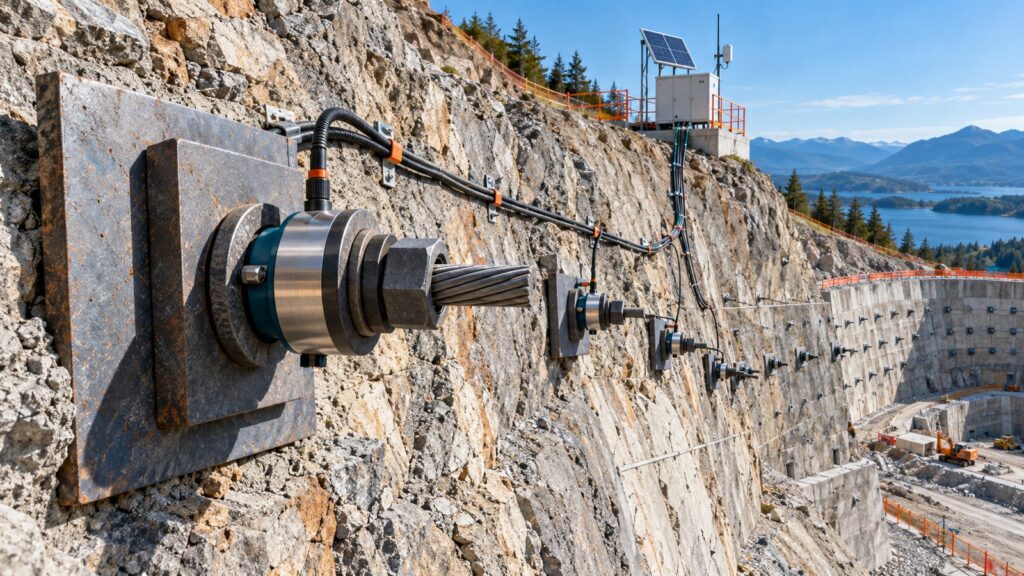
When you lock off a ground anchor on an open-pit highwall or a deep excavation retaining wall, the tension in that tendon never stays constant. Steel relaxes. Grout creeps. Worse, a developing slip plane behind the face can ramp up tendon loads until the strands snap without warning. If you cannot track those force shifts accurately, your reinforcement is a blind guess.
Choosing between a vibrating wire anchor load cell vs hydraulic gauge comes down to a simple question: do you want actual load data, or an illusion distorted by bent plates and the midday sun? Center-hole load cells sit right at the anchor head to measure axial force. But pick the wrong sensor technology, and you will chase false alarms or miss a catastrophic failure entirely.
Anatomy and Working Principles: Multi-Gauge Vibrating Wire vs Hydraulic vs Strain Gauge Load Cells
Three main sensor types show up in geotechnical specifications: multi-gauge vibrating wire, hydraulic capsules, and bonded foil strain gauges.
A vibrating wire (VW) anchor load cell uses a hollow, high-strength alloy steel cylinder. Inside that steel body, engineers mount three to six vibrating wire strain sensors parallel to the tendon axis, spaced evenly around the ring. When post-tensioned tendon loads compress the cylinder, microscopic elastic strain changes the wire tension. Plucking the wire produces an audio frequency signal where applied load is proportional to the square of frequency ($L \propto f^2$). Because the output is a frequency (1200 to 2800 Hz) rather than a fragile millivolt voltage, the signal cuts straight through electrical noise and travels down hundreds of meters of cable without signal degradation.
A hydraulic anchor load cell takes a crude mechanical route. It sandwiches a sealed, fluid-filled stainless steel pad under the anchor head. Compressive load squeezes the fluid, forcing a needle to move on a Bourdon dial or pushing an electric pressure transducer. It sounds simple. In clean laboratory conditions, it works. On an active highwall, it quickly falls apart.
The third contender, electrical resistance strain gauge load cells, glues foil patterns in a Wheatstone bridge onto a steel spool. While they react fast to rapid dynamic loads, they drift over time. In humid, rainy environments, insulation breakdown eventually corrupts the zero point. That makes them a poor choice for permanent slope monitoring.
The Challenge of Eccentric Loading: Why Multi-Gauge VW Wins
Anchor holes in rock are never dead straight. Tendons leave the face at slight angles. Jacks pull unevenly during lock-off. This angular misalignment creates severe eccentric loading, pushing down hard on one side of the load cell while lifting the other.
If you mount a single-sensor load cell or a hydraulic capsule under an uneven load, the readings skew violently. Bending moments can easily introduce 20% to 30% measurement error. A single sensor only sees whatever side it sits on. A hydraulic pad tries to average pressure through fluid displacement, but uneven mechanical pinching along its thin edges creates massive internal stress concentrations that wreck gauge calibration.
A multi-gauge vibrating wire load cell solves this through geometry and math. By placing three to six independent gauges around the cylinder ring, it measures the tilt directly. The side bearing the brunt of the angle reports higher frequency. The relieved side reports lower frequency. The datalogger averages all individual sensors ($L_{total} = \sum L_i / n$). That arithmetic cancels out bending moments and spits out the true axial force.
Critical Flaws of Hydraulic Load Cells in Tropical Heat
Contractors love hydraulic load cells because they are cheap up front. But on a tropical bench exposed to baking equatorial sun, that cost savings evaporates.
Sealed hydraulic oil expands aggressively with heat. When sunshine bakes a dark steel anchor head, daily temperature shifts of 20°C can artificially inflate hydraulic dial readings by 1.0% to 1.2% of full-scale capacity. On a 1000 kN anchor, that is a fake 12 kN surge every single afternoon. Site engineers end up panicking over daytime spikes that mysteriously vanish once the sun goes down.
Even worse is the single-point failure problem. Hydraulic cells rely on thin welded seams, hoses, and mechanical fittings. Add acidic mine runoff or blast vibrations, and micro-leaks develop. Once the fluid seeps out, the cell dies completely. You cannot refill it on a live, post-tensioned tendon without setting up an expensive destressing rig.
Vibrating wire cells contain zero fluids. Each unit includes a built-in 3 kOhm thermistor, allowing the datalogger to calculate and strip out steel thermal expansion automatically.
Critical Installation Procedures: Distribution Plates and Spherical Seating
Even the best load cell gives garbage numbers if the mechanical stack at the anchor head is sloppy. You cannot just bolt a load cell against raw rock or rough shotcrete.
Follow this stacking order to protect the instrument:
- Bearing Plate: Set flat against sound concrete or rock using non-shrink grout to establish a true perpendicular foundation.
- Bottom Load Distribution Plate: A thick, precision-machined steel plate that spreads load evenly across the bottom rim of the cell.
- Center-Hole Load Cell: Centered squarely over the tendon bundle.
- Top Load Distribution Plate: Prevents the anchor head from digging into the upper rim of the sensor cylinder.
- Spherical Seating Washer: A matched pair of concave and convex washers that rotate slightly to absorb residual tendon angular misalignment.
- Wedge Plate or Anchor Nut: Grips the prestressed strands or bar after tensioning.
Skimping on distribution plate thickness is a classic rookie mistake. Under several hundred kilonewtons, thin plates bend like potato chips. That dishing effect pinches the load cell rim and destroys calibration accuracy immediately.
Replacing Manual Lift-Off Tests with Continuous Telemetry
The old-school way to verify anchor tension is the manual lift-off test. A crew hauls a heavy hollow-ram jack up the bench, rigs pull rods to the anchor head, and pumps hydraulic pressure until the wedges lift off the plate.
It is expensive, slow, and dangerous. Technicians have to stand directly in line with tendons loaded to hundreds of tons. Mobilizing cranes and equipment disrupts haul roads. Repeated re-stressing fatigues the steel strands. Most critically, running lift-off checks every three to six months leaves huge temporal blind spots. If a heavy rainstorm triggers slope creep two weeks after your test, you will not know until tension cracks split the crest.
Permanently installed vibrating wire cells wired into automated telemetry log load dynamics every 15 minutes. No crews in the blast zone. No production shutdowns. Just clean, continuous load data.
Comparative Decision Matrix
Here is how the three main anchor monitoring technologies stack up in the field:
| Evaluation Parameter | Center-Hole VW Load Cell | Hydraulic Load Cell (Manometer) | Electrical Strain Gauge |
|---|---|---|---|
| Operating Principle | Resonant wire frequency ($L \propto f^2$) | Hydrostatic fluid pressure | Wheatstone bridge resistance |
| Eccentric Load Compensation | Excellent (averages 3 to 6 gauges) | Poor (edge pinching distorts volume) | Moderate (only with full-bridge arrays) |
| Long Cable Signal Immunity | Very High (audio frequency output) | None (requires physical dial inspection) | Low (signal drops over long copper runs) |
| Temperature Sensitivity | Very Low (compensated by thermistor) | High (fluid expands 1.2% per 20°C) | Moderate |
| Long-Term Zero Stability | Outstanding (zero drift across decades) | Vulnerable to fluid leakage | Vulnerable to moisture and adhesive drift |
| Physical Durability | Rugged, IP68 hermetically sealed | Fragile (single weld failure kills cell) | Sensitive to humidity and lightning |
| Field Labor Requirement | Zero (automated wireless logging) | High (manual visual clipboard checks) | Low (automated via datalogger) |
| TARP Early Warning Integration | Direct real-time compatibility | Cannot trigger automated alarms | Compatible, but needs line loss correction |
| Total Cost of Ownership | Lowest over multi-year monitoring | High (relies on continuous site visits) | Moderate (frequent calibration checks) |
Fortuna Argatech Anchor Telemetry Architecture: GEOVOS 1000
Collecting load data is pointless if numbers sit unread on a flash card. Fortuna Argatech delivers integrated geotechnical monitoring solutions by pairing multi-gauge Center-Hole Vibrating Wire Load Cells directly with the GEOVOS 1000 Industrial Datalogger.
The GEOVOS 1000 features dedicated vibrating wire excitation channels using plucked-coil spectral analysis alongside simultaneous 3 kOhm thermistor reading. An onboard edge computing engine averages the multi-gauge readings in real time, applies polynomial calibration factors, and broadcasts engineering values (kN) over 4G LTE, LoRaWAN, or industrial solar radio links.
Configured with your site-specific geotechnical TARP alarm thresholds, the dashboard pushes multi-tier notifications to dispatch:
- Alert Level: Prestress load drops 10% to 15% from relaxation, or creeps 10% above lock-off.
- Action Level: Load accelerates faster than 20 kN per day, flagging active ground movement behind the retaining wall.
- Alarm Level: Tendon tension approaches 80% to 85% of ultimate yield strength, requiring an immediate shutdown and bench evacuation below.
From initial anchor monitoring site surveys to live cloud dashboards, Fortuna Argatech’s engineering team helps you build an anchor monitoring network that actually protects lives and assets on high-risk slopes.
Share this article
Share this insight with your team.
Related Articles
Similar topics from the same category.
Monitoring station OPEX budget planning guide covering five cost pillars, cross-station comparison, hidden costs, and a modular worksheet for annual budgeting.

8 mandatory monitoring criteria for PROPER Blue rating under PermenLH 7/2025: SPARING, AQMS, B3, waste, peatland, mining, and SIMPEL audit.

Compare TDR and FDR soil moisture sensor principles, dielectric calibration limits for tropical peat, and multi-depth telemetry integration via GEOVOS 1000.