Preventing Secondary Disasters: Cold Lava Early Warning System
Discover how the Cold Lava Early Warning System technology engineered by Fortuna Argatech flawlessly detects deadly volcanic debris flows to save local communities.
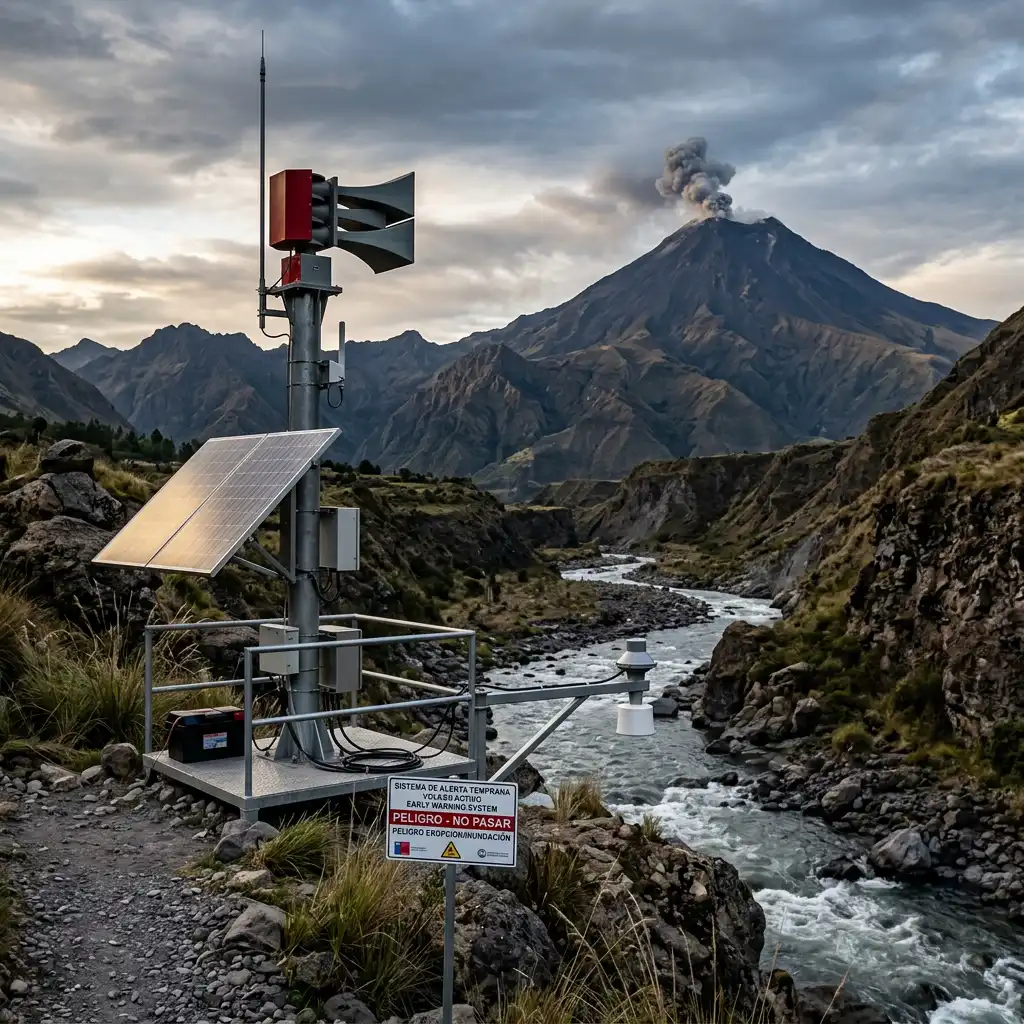
For the millions of people residing on the slopes of active volcanoes across Indonesia, the immediate threat of the main eruption or scorching pyroclastic clouds is frequently not the only lethal danger. There is a terrifying secondary disaster that creeps silently and is fully capable of violently wiping out entire downstream villages. This devastating phenomenon is widely known by the local population as cold lava (or rain-triggered lahar).
To aggressively protect the lives of residents living along these volcanic riverbanks, the Center for Volcanology and Geological Hazard Mitigation (PVMBG) alongside regional governments are rapidly deploying automated telemetry networks. As a premier provider of safety infrastructure solutions, Fortuna Argatech is incredibly proud to design and manufacture the Cold Lava Early Warning System (EWS) that grants vital golden evacuation time for villagers.
Let us explore exactly how this sophisticated technology operates to conquer the violent fury of nature.
Understanding the Terrifying Power of Volcanic Debris Flows
Countless people dangerously underestimate the brutal force of a rain-triggered lahar. After a volcano erupts and violently spews millions of cubic meters of sand and boulder materials, those deposits typically accumulate heavily near the summit or on extremely steep slopes.
When torrential tropical rains pound the mountain summit, the rainwater rapidly mixes with these massive deposits of ash and gigantic rocks. This thick, cement-like mud mixture will then violently plunge down through the river valleys at astonishing speeds. Vastly different from a regular water flood, the destructive crushing power of this flow is horrifyingly absolute, easily capable of snapping concrete bridges, obliterating houses, and instantly burying fertile agricultural lands.
To mitigate this terrifying risk, installing a Cold Lava Early Warning System at critical chokepoints along the river is a strict necessity that cannot be delayed.
The Triple-Layer Detection Engineered by Fortuna Argatech
An industrial-grade telemetry system from Fortuna Argatech never relies on a single fragile measurement device. To create a highly accurate Cold Lava Early Warning System that is entirely free from dangerous false alarms, we seamlessly integrate three primary communicating sensors:
- Rainfall Sensors (ARR): This automatic rain gauge is deliberately installed high up on the mountain slopes. Its primary duty is to detect extreme rainfall intensity. If a massive volume of rain falls within a very short timeframe, the system fires a preliminary alert signal to the control room.
- Vibration Sensors (Geophone): A massive torrent of giant boulders crashing violently against the riverbed creates a very distinct ground vibration signature. The sensor buried deeply on the riverbank will intelligently distinguish the vibration of a mudflow from the rumbling of passing trucks.
- Radar-Based Water Level Sensors (AWLR): This advanced non-contact radar sensor is suspended high above a bridge or a steel pole. It continuously measures the rising elevation of the debris flowing rapidly beneath it. If the thick mud level violently breaches the critical boundary, our data logger module will instantly execute the final warning.
Evacuating Through Solar-Powered Automated Sirens
When all the critical danger parameters align, the Fortuna Argatech data logger machine will automatically trigger giant TOA siren horns. The deafening roar of this siren can easily reach a three-kilometer radius, violently piercing through the torrential rain to wake up deeply sleeping villagers in the middle of the night.
Fully realizing that violent volcanic mudflows frequently destroy municipal electrical poles in the villages, our entire EWS stations are engineered to operate fully independently (off-grid). Our robust devices are powered exclusively by premium-grade solar panels and heavy-duty backup batteries, ensuring the warning system remains fully operational even in the most extreme catastrophic weather conditions.
Fiercely protect your local communities and valuable infrastructural assets in disaster-prone volcanic regions with cutting-edge safety telemetry technology from Fortuna Argatech today!
FAQ
Who legally possesses the authority to press the emergency siren button?
In a fully automated system configuration, our data logger will autonomously trigger the loud siren without any human intervention. However, in a semi-automated setup, the system will only blast warning notifications to the BPBD or PVMBG monitoring command post, and the commander on duty holds the exclusive right to press the trigger button remotely.
Why don’t you simply use a standard floating water sensor?
A violent volcanic mudflow aggressively carries massive boulders the size of cars and gigantic uprooted tree trunks. If we utilized a floating sensor or any device physically submerged in the water, it would be instantly crushed and destroyed within the very first second of the disaster. A non-contact radar sensor is the absolute only viable and safe solution.
What happens if the cellular signal on the isolated mountain slopes suddenly disappears?
Fortuna Argatech systems are comprehensively equipped with Radio Frequency (RF LoRa) modules or Satellite communication dishes. The crucial sensor data will continue to be flawlessly transmitted without ever needing to rely on standard commercial cellular (GSM) operator signals.
Is this outdoor station truly resistant to highly corrosive volcanic ash?
Yes, we meticulously coat the entire data logger panel box with a specialized anti-rust protective paint and utilize an IP66 certified enclosure that is fully impenetrable to fine volcanic ash and highly corrosive sulfur gases.
Can these emergency alerts be broadcasted directly to the villagers’ mobile phones?
Absolutely. Our advanced devices are deeply integrated with automated messaging modules (WhatsApp API or SMS Gateways) capable of instantly blasting emergency texts to the mobile numbers of village chiefs, neighborhood leaders, and the local Search and Rescue (SAR) teams.
Sources
- Center for Volcanology and Geological Hazard Mitigation (PVMBG). (n.d.). Volcano and Cold Lava Disaster Mitigation Guidelines.
- Fortuna Argatech. (n.d.). Telemetry and EWS Disaster Solutions. https://argatech.com
- National Disaster Management Agency (BNPB). Standard Operating Procedures for Flash Flood Evacuations.
Share this article
Share this insight with your team.
Related Articles
Similar topics from the same category.
An operational guide to developing extensometer TARP thresholds based on deformation velocity and the inverse velocity method to prevent false alarms.
Compare multiparameter sensor probes and single-parameter sensors on flexibility, maintenance, cabling, replacement cost, and regulatory fit.
Guide to choosing submersible, flow cell, or bypass installation for online water quality sensors based on sensor type and site conditions.