Liquid Level Transmitter: How Hydrostatic Level Measurement Works
Liquid Level Transmitter measures liquid level using hydrostatic pressure. Learn how it works, what Argatech publishes, and where to use it.
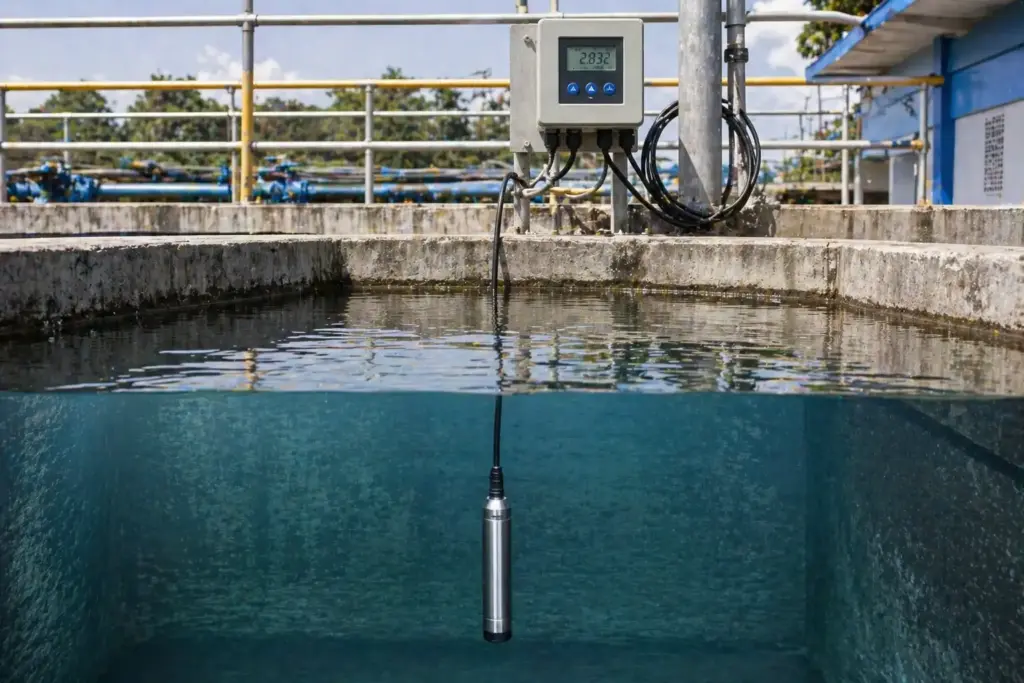
Liquid Level Transmitter is an industrial sensor used to measure liquid level continuously and in real time. On Fortuna Argatech’s official website, it is described as a hydrostatic liquid level transmitter with 4-20mA and RS485 output, plus IP68 submersible design.
This type of sensor is useful when you need stable level readings for water, tanks, wells, reservoirs, or rivers.
What is a Liquid Level Transmitter?
A Liquid Level Transmitter measures the pressure created by a liquid column and converts it into a level value.
Because it works on hydrostatic pressure, it is a good fit for continuous level monitoring where stable readings matter.
How a Liquid Level Transmitter works
The sensor measures liquid pressure
The pressure element reads the static pressure from the liquid.
Pressure is converted into level
Because pressure increases with depth, the system can calculate the water level from that pressure value.
Data goes to the control system
The measurement is sent as a standard signal that PLC, SCADA, or DCS can read.
Monitoring becomes easier
The data can support dashboards, alarms, and historical recording.
Key specs published by Argatech
Argatech’s product page, published on March 2, 2026, lists hydrostatic pressure as the measurement principle, 4-20mA DC and RS485 Modbus output, 12-36VDC power supply, IP68 submersible protection, and use in tanks, rivers, wells, sumps, and reservoirs. (Fortuna Argatech, Liquid Level Transmitter, March 2, 2026, https://argatech.com/sensor/liquid-level-transmitter/)
Main details include:
- measurement principle: hydrostatic pressure
- output: 4-20mA DC, RS485 Modbus
- power supply: typically 12-36VDC
- accuracy: +/-0.1% / +/-0.25% / +/-0.5%
- protective rating: IP68 submersible
- cable length: up to 75 m
- operating temperature: -20 to +80 C
- medium compatibility: water, compatible liquids
- output interfaces: PLC, SCADA, DCS compatible
When should you choose it?
This sensor is a good choice when you need stable readings and do not want to rely on a non-contact sensor.
Typical use cases:
- water storage tanks
- wells and reservoirs
- rivers and channels
- sumps or collecting pits
- environmental and industrial monitoring systems
Liquid Level Transmitter vs Radar Level Meter
Compared with radar, a hydrostatic transmitter measures level from liquid pressure rather than wave reflection.
Radar is better for non-contact measurement. A Liquid Level Transmitter is a better fit when submersible installation and pressure-based measurement are more practical.
For comparison, Argatech also offers Radar Level Meter for non-contact level measurement.
Main benefits
- continuous real-time readings
- suitable for submersible applications
- easy industrial integration
- multiple accuracy options
- useful across many water monitoring points
Conclusion
A Liquid Level Transmitter is a practical choice for hydrostatic liquid level measurement. For tanks, rivers, and reservoirs, it provides stable data that can be connected to control systems.
FAQ
What is a Liquid Level Transmitter?
An industrial sensor used to measure liquid level continuously.
What is its working principle?
Hydrostatic pressure.
What outputs are available?
4-20mA DC and RS485 Modbus.
What can it be used for?
Tanks, wells, rivers, reservoirs, and sumps.
Can it connect to PLC or SCADA?
Yes, Argatech says it is compatible with PLC, SCADA, and DCS.
Sources
- Fortuna Argatech. (March 2, 2026). Liquid Level Transmitter – Fortuna Argatech. https://argatech.com/sensor/liquid-level-transmitter/
- Fortuna Argatech. (no date). Radar Level Meter – Fortuna Argatech. https://argatech.com/sensor/radar-level-meter/
Share this article
Share this insight with your team.
Related Articles
Similar topics from the same category.

Poor weather station placement can cause 50% data bias. Learn the WMO-No. 8 and Indonesian BMKG siting standards for AWS sensors in industrial and mining sites.
Explore a technical engineering comparison between solid-state ultrasonic anemometers and mechanical cup-and-vane sensors for industrial weather stations.

Technical guide to conductivity sensors: comparing toroidal (inductive), 2-electrode, and 4-electrode contacting probes for industrial water and wastewater.