Radar Level Meter: How Non-Contact Level Measurement Works
Radar Level Meter measures liquid level without direct contact. Learn how radar works, what Argatech publishes, and when to use it.
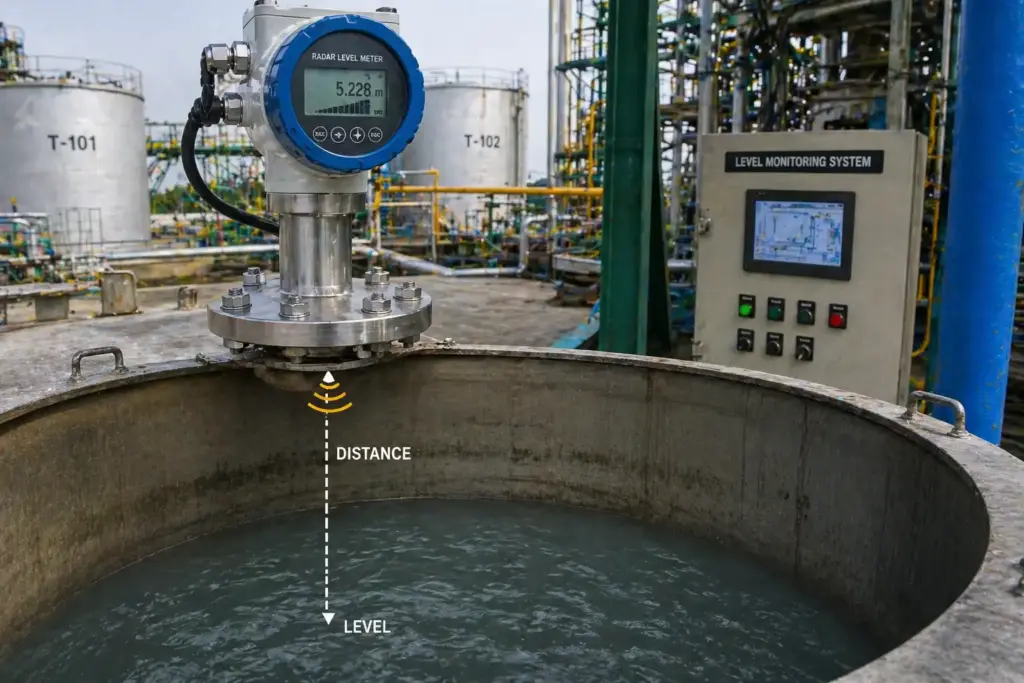
Radar Level Meter is a sensor used to measure liquid level without touching the medium. On Fortuna Argatech’s official website, the product is positioned for tanks, water, petroleum, sewage, and mildly corrosive liquids.
At a general level, radar level measurement is continuous level measurement using free-space radar sensors mounted above the medium. The sensor sends a signal, receives the reflection, and calculates distance from the signal’s time of flight. The method is non-contact and well suited to applications that need low maintenance. (Endress+Hauser, Radar level measurement, n.d., https://www.endress.com/en/field-instruments-overview/level-measurement/Radar-level-measurement)
What is a Radar Level Meter?
A Radar Level Meter is a liquid level instrument that works with radar waves. Unlike contact sensors, it reads the surface from a distance.
Because it does not touch the liquid, the sensor can be used across a wider range of media, especially when surface conditions are not always stable.
How a Radar Level Meter works
The sensor emits radar waves
The sensor sends a microwave signal toward the liquid surface from above.
The signal reflects back
The returning reflection is captured by the sensor.
The system calculates distance
The signal’s travel time is used to calculate the distance to the surface, then the level is derived from that distance.
The reading goes to the monitoring system
The measured value is sent to industrial outputs or a dashboard so operators can review it easily.
Key specs published by Argatech
Argatech’s product page, published on March 2, 2026, lists a 26 GHz frequency, a 0-30 m measuring range, +/-1-3 mm accuracy, 4-20 mA and RS485 Modbus output, and IP68 transducer protection. (Fortuna Argatech, Radar Level Meter, March 2, 2026, https://argatech.com/sensor/radar-level-meter/)
Published product details include:
- operating frequency: 26 GHz
- measuring range: 0-30 m
- accuracy: +/-1-3 mm
- output: 4-20 mA, RS485 Modbus
- display: backlit LCD
- protection: display IP65, transducer IP68
- medium: water, petroleum, sewage, mildly corrosive liquids
When should you choose it?
This sensor is a strong fit when you want stable level measurement without direct contact.
Typical use cases:
- water tanks
- oil or fuel tanks
- wastewater systems
- mildly corrosive industrial liquids
- remote level monitoring applications
Radar vs hydrostatic level transmitter
If you compare the two approaches, radar is better for non-contact measurement, while a hydrostatic transmitter measures level from liquid pressure.
As a reference, Argatech also offers Liquid Level Transmitter, which uses hydrostatic pressure.
Main benefits
- no direct contact with the liquid
- flexible across multiple media types
- suitable for continuous monitoring
- helps reduce maintenance in some applications
- easy to integrate into industrial monitoring systems
Conclusion
A Radar Level Meter is a clean way to read liquid level from above without direct contact. For tanks and industrial liquids, this approach is practical because measurement can continue even when media conditions change.
FAQ
What is a Radar Level Meter?
It is a sensor that measures liquid level without direct contact.
Does it touch the liquid?
No. It is mounted above the medium and reads reflected waves.
What media can it measure?
Argatech lists water, petroleum, sewage, and mildly corrosive liquids.
What outputs are available?
4-20 mA and RS485 Modbus.
What is the difference from a Liquid Level Transmitter?
Radar is non-contact, while a Liquid Level Transmitter uses hydrostatic pressure.
Is it suitable for monitoring systems?
Yes, especially for tank monitoring and industrial dashboards.
Sources
- Fortuna Argatech. (March 2, 2026). Radar Level Meter – Fortuna Argatech. https://argatech.com/sensor/radar-level-meter/
- Endress+Hauser. (n.d.). Radar level measurement. https://www.endress.com/en/field-instruments-overview/level-measurement/Radar-level-measurement
- Fortuna Argatech. (no date). Liquid Level Transmitter – Fortuna Argatech. https://argatech.com/sensor/liquid-level-transmitter/
Share this article
Share this insight with your team.
Related Articles
Similar topics from the same category.
Poor weather station placement can cause 50% data bias. Learn the WMO-No. 8 and Indonesian BMKG siting standards for AWS sensors in industrial and mining sites.
Explore a technical engineering comparison between solid-state ultrasonic anemometers and mechanical cup-and-vane sensors for industrial weather stations.

Technical guide to conductivity sensors: comparing toroidal (inductive), 2-electrode, and 4-electrode contacting probes for industrial water and wastewater.