Flood EWS: 5 Essential Components for Resilient Cities
Floods caused 51% of Indonesia's 2025 disasters. Discover the 5 essential Flood EWS components that transform any city into a resilient urban center.
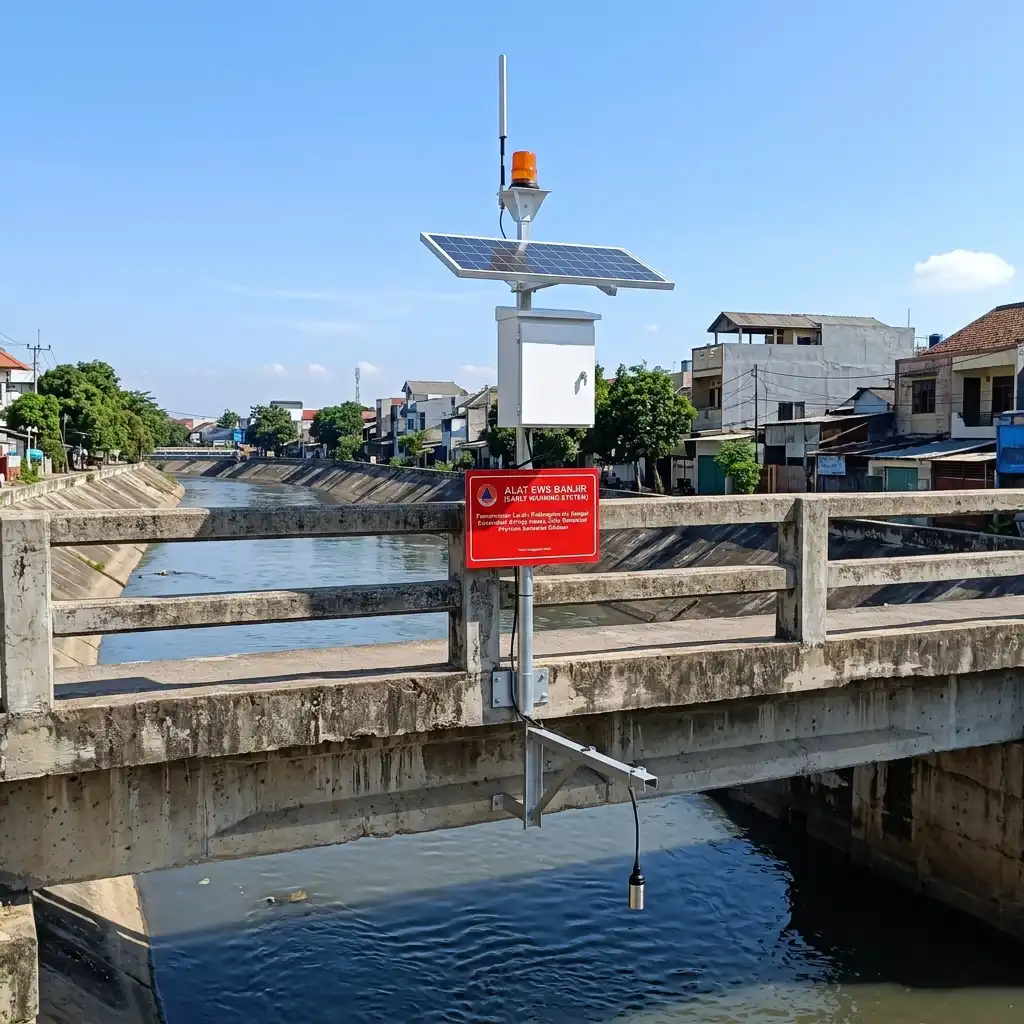
A total of 1,652 flood events struck Indonesia throughout 2025. That figure represents 51.1% of all disasters nationwide, according to BNPB data. Over 10 million people suffered displacement or direct impact. Yet many cities still lack an adequate Flood EWS. The following five technical components can transform any urban center into a genuinely resilient city.
This article examines each component in detail. Every element connects to form one complete and reliable early warning chain.
1. Water Level Sensors: The Core of Every Flood EWS
Without a water level sensor, an early warning system remains an empty concept. These sensors measure water height with precision every second. The readings form the foundation for every evacuation and mitigation decision.
Choosing the Right Sensor for Urban Environments
Three sensor types dominate Flood EWS deployments in cities:
- Ultrasonic sensors: Emit sound waves toward the water surface and measure reflection time. Ideal for urban drainage channels.
- Radar sensors: Use microwave signals, offering superior resistance to vapor and fog. Best suited for wide rivers.
- Pressure transducers: Measure hydrostatic pressure below the water surface. Extremely accurate for culverts and underground channels.
Fortuna Argatech provides both ultrasonic and pressure transducer sensors with high accuracy. Each sensor withstands the harsh conditions found in urban river environments.
Strategic Sensor Placement Across the City
Sensor placement determines the overall effectiveness of a Flood EWS. Optimal locations include:
- Bridges spanning primary rivers
- Floodgates and pump stations
- Primary drainage outfalls
- Confluence points where two waterways meet
Jakarta, as a reference, deploys sensors across 178 pump stations and floodgates. According to BMKG, integrating rainfall data with water level readings produces significantly more accurate flood predictions.
2. Dataloggers with Real-Time Connectivity
A sensor without a datalogger produces only raw signals with no actionable value. The datalogger translates sensor signals into digital information. It then transmits that data to a central server automatically.
Datalogger Specifications for Urban Flood EWS
A reliable datalogger for a Flood EWS must meet these criteria:
- 4G/LTE connectivity as the primary communication channel
- Satellite or LoRa backup for areas with weak cellular signals
- Local storage of at least 30 days of data as a failsafe
- Auto-reconnect capability when connections drop
Fortuna Argatech deploys the GEOVOS 1000 datalogger in every Flood EWS installation. This device supports 4G connectivity with automatic auto-reconnect. Data transmits every 1 to 5 minutes, depending on configuration.
3. Independent Power: Solar Panels and Batteries
Flooding frequently disrupts city electrical grids. Therefore, a reliable Flood EWS must operate independently. Solar panels serve as the primary power source for monitoring stations in exposed locations.
Power Capacity Requirements
A standard Flood EWS requires approximately 10 to 20 watts of continuous power. A 50 to 100 watt solar panel, combined with a 12V deep cycle battery, supplies energy for 3 to 5 days without sunlight.
Fortuna Argatech engineers every Flood EWS station with an independent power system. Solar panels and batteries integrate within a weatherproof enclosure. The entire system operates without reliance on city electrical infrastructure.
4. Multi-Channel Notification Systems for Flood EWS
Water level data serves no purpose without a warning delivery mechanism. Multi-channel notification systems ensure information reaches all stakeholders promptly.
Effective Notification Channels
A modern Flood EWS leverages multiple notification channels simultaneously:
- Local sirens: Automatic audible warnings when water levels exceed thresholds
- SMS Gateway: Mass alerts to mobile devices within a defined radius
- WhatsApp and Telegram Bots: Real-time notifications to community groups
- Web dashboard: Visual displays for BPBD command centers and relevant agencies
Each channel serves a different audience. Sirens reach residents without smartphones. Meanwhile, the web dashboard provides comprehensive data visualization for decision-makers.
Tiered Warning Thresholds
A mature Flood EWS implements three warning levels:
- Alert (Yellow): Water level begins rising significantly. Notifications reach the BPBD response team.
- Warning (Orange): Water level approaches the critical threshold. Notifications reach all affected residents.
- Danger (Red): Water level exceeds the safe limit. Automatic evacuation orders activate.
Fortuna Argatech configures these thresholds based on each location’s specific characteristics. Initial calibration involves analysis of historical flood data and local drainage channel capacity.
5. Centralized Monitoring Dashboard
The final yet most critical component: a centralized monitoring dashboard. All data from every sensor station flows into one visual interface. BPBD teams, public works agencies, and decision-makers monitor the entire city from a single screen.
Essential Flood EWS Dashboard Features
An effective Flood EWS monitoring dashboard must include:
- Real-time map displaying all sensor locations and water level status
- Trend graphs showing water height changes over the past 24 hours
- Automatic pop-up alerts when water levels exceed thresholds
- Data history covering at least 12 months for seasonal flood pattern analysis
- Report export in PDF or CSV format for official documentation
Fortuna Argatech provides a web-based telemetry dashboard accessible from any device. All data resides on cloud servers with enterprise-grade security.
Why All 5 Components Must Work Together
Each Flood EWS component functions optimally only when fully integrated. Sensors without dataloggers produce no data. Dataloggers without connectivity send no warnings. Notifications without accurate data create unnecessary panic.
Fortuna Argatech designs the entire Flood EWS ecosystem as an integrated solution. From water level sensors and the GEOVOS 1000 datalogger to solar panels and monitoring dashboards, every component comes pre-validated for seamless interoperability.
The 2025 flood recovery cost for Sumatra alone reached IDR 51.82 trillion, according to BNPB. Investing in a complete Flood EWS costs a fraction of that figure. Every missing component weakens the entire early warning chain.
FAQ
What are the main components of a Flood EWS system?
Five core components form a complete system: water level sensors, dataloggers with real-time connectivity, independent power (solar panels and batteries), multi-channel notification systems, and a centralized monitoring dashboard. All five must integrate for accurate early warnings.
Which type of water level sensor works best for urban rivers?
Ultrasonic sensors suit urban drainage channels due to easy installation. Radar sensors resist fog and vapor better for wide rivers. Pressure transducers deliver the highest accuracy for culverts and underground channels.
How long can a Flood EWS operate without city electricity?
With a 50-100 watt solar panel and a 12V deep cycle battery, a Flood EWS station operates for 3 to 5 days without sunlight. This design ensures monitoring continues even when flooding disrupts electrical grids.
How frequently does a Flood EWS sensor transmit data to the server?
The GEOVOS 1000 datalogger from Fortuna Argatech transmits data every 1 to 5 minutes, depending on configuration. Transmission frequency increases automatically as water levels approach critical thresholds.
Can a Flood EWS integrate with BPBD and BMKG platforms?
The Flood EWS system from Fortuna Argatech supports data integration with BPBD and BMKG platforms. The web-based dashboard enables access from any device for centralized monitoring and decision-making.
Sources
- Badan Nasional Penanggulangan Bencana (BNPB) — 2025 Disaster Data
- Badan Meteorologi, Klimatologi, dan Geofisika (BMKG) — https://www.bmkg.go.id/
- Jakarta Smart City — Flood Monitoring System (178 pump stations and floodgates)
- Fortuna Argatech — https://argatech.com
Share this article
Share this insight with your team.
Related Articles
Similar topics from the same category.

An operational guide to developing extensometer TARP thresholds based on deformation velocity and the inverse velocity method to prevent false alarms.
An Ultrasonic Flow Sensor is crucial for measuring open water channels precisely. Discover its 5 essential features from Fortuna Argatech.
A Mining TSS Sensor must be installed in settling ponds to avoid severe penalties. Discover the 5 critical reasons here.