Calibration Standard Shelf Life: When Do Sensor Buffer Solutions Expire After Opening?
Calibration standard solution shelf life in field: discard opened pH buffers, danger CO2 absorption, USGS handling guidelines.
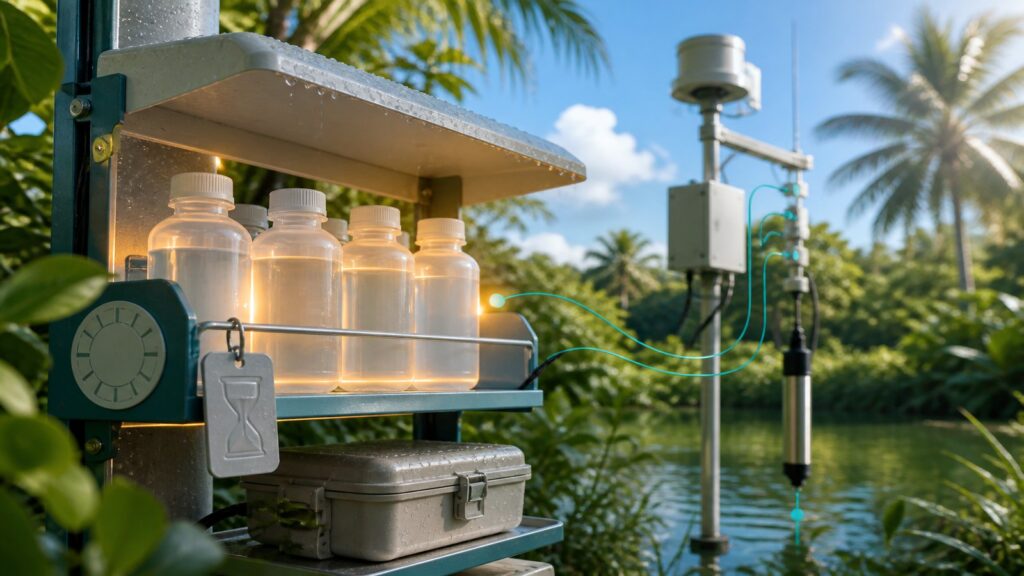
A water quality sensor is only as accurate as the calibration standard solution used to calibrate it. The USGS National Field Manual (NFM A6.4) states this directly: “Measurements of pH are only as accurate as the buffers used to calibrate the meter and electrodes.”
Think about what that means. If you calibrate with a pH 10 buffer that has been sitting open for two months, quietly absorbing CO2 from the atmosphere, your sensor is not just inaccurate. You are actively miscalibrating it against a standard that has already drifted away from its certified value.
In a SPARING continuous monitoring deployment, this creates a dangerous blind spot. Your sensor reports pH values that look perfectly normal on the dashboard. Compliance data flows into the regulatory portal without triggering a single alarm. But every reading above pH 7 carries a systematic offset. That error can go completely undetected for weeks until an audit or manual cross-check finally catches it.
This problem is entirely preventable. You just need to understand when calibration standard solutions actually degrade and how to handle them under real field conditions.
Degradation Mechanisms: Why Do Standards Go Bad?
Calibration standard solutions are not permanent reagents. The second you break a bottle seal, three distinct degradation mechanisms start attacking the liquid.
CO2 absorption in alkaline pH buffers. Buffers at pH 9.18 and pH 10.01 are the most vulnerable. Atmospheric CO2 dissolves into the alkaline solution and forms carbonic acid (H2CO3). That acid progressively lowers the buffer’s pH value. Every time you open the cap, fresh CO2 enters. Acidic and neutral buffers (pH 4 and pH 7) are far more resistant to this because their chemistry just doesn’t react with CO2 the same way. If your pH 10 buffer stock has been opened for several weeks, stop trusting the label. It is almost certainly no longer 10.01.
Evaporation in conductivity standards. Leave a conductivity standard bottle open, and the pure water evaporates faster than the dissolved ions. The result is simple math: the ion concentration rises, and the conductivity reading drifts upward beyond the certificate value. On top of that, atmospheric CO2 also dissolves into the solution to form carbonic acid, adding entirely new ions to the mix. Both mechanisms work at the same time, and both force the conductivity standard to read higher than it should.
Settling and instability in dilute formazin turbidity standards. Lab-prepared dilute formazin suspensions are notoriously fragile. They can lose stability just one hour after preparation. The polymer particles settle or clump together, changing the turbidity value wildly. Hach StablCal uses a stabilized formulation that lasts much longer, but even StablCal has a hard expiration date the moment the bottle is opened.
Shelf Life: Unopened vs. Open-Bottle
This is the data field teams desperately need but rarely find in one place. The table below compiles open-bottle shelf life specifications from five major manufacturers: Yokogawa, Hach, Hamilton, YSI, and Mesa Labs.
| Calibration Standard | Sealed Shelf Life | Open-Bottle Shelf Life | OEM Source |
|---|---|---|---|
| pH 4.01 Buffer | 48 months (Hach); 18 months (typical) | 6 months (Hach); 6–12 months (Instrument Choice); 90 days (Mesa Labs) | Hach, Instrument Choice, Mesa Labs |
| pH 7.00 Buffer | 12–18 months (typical) | 6–12 months (Instrument Choice); 90 days (Mesa Labs); 1 month (Yokogawa) | Yokogawa, Instrument Choice, Mesa Labs |
| pH 10.01 Buffer | 12 months (Hach/Yokogawa) | 2 weeks–1 month (Yokogawa); 3–6 months (Instrument Choice); “impossible to determine” (Hach) | Yokogawa, Hach, Instrument Choice |
| Conductivity Standard | 12–36 months (Hamilton); 18 months (Mesa Labs) | Max. 1 month (YSI); 30 days (Mesa Labs); total air exposure <1 hour (Hamilton) | Hamilton, YSI, Mesa Labs |
| Turbidity – StablCal (Hach) | 24 months (720 days) | 30 days after opening | Hach |
| Turbidity – Dilute Formazin | Use immediately after preparation | As short as 1 hour | Hach, Campbell Scientific |
Look at the massive spread for pH 10 buffer. Yokogawa gives it 2 weeks. Instrument Choice claims 3–6 months. Hach refuses to give a number at all, calling the open-bottle shelf life “impossible to determine” because it depends entirely on your local environment. If you operate in a tropical deployment where heat and humidity accelerate CO2 absorption, use the conservative figure. Throw it out after 2 to 4 weeks.
There is one premium exception: Hamilton DuraCal buffers. Hamilton claims these maintain their published accuracy (±0.01–0.02 pH) for 2 to 5 years from manufacture, even after you open them. They use a proprietary CalPak bottle with a one-way valve that locks air out. But this is a highly specialized product. Do not assume your conventional field buffers share that kind of resilience.
Field Handling Best Practices
The USGS NFM A6.4 lays out a field handling framework that translates perfectly to SPARING and ONLIMO station operations.
Never pour used buffer back into the bottle. This is the single most violated rule in the field. Buffer that has touched a calibration cup, a sensor, dust, or residual sample water is dead. Discard it. Pouring it back into the bottle introduces contaminants that will slowly poison your entire remaining stock.
Use secondary field bottles. The USGS recommends pouring your buffer from the bulk container into a clean, dedicated polyethylene bottle. Label it with the pH value, lot number, and expiration date. Carry the small bottle into the field. This protects your main supply from being exposed to the air every single time you calibrate.
Seal bottles immediately. Keep standards in tightly sealed polyethylene or borosilicate glass bottles. Do not leave a bottle uncapped while you wait for the sensor reading to stabilize. Pour what you need, and cap it immediately.
Control your storage temperature. OEMs want you to store buffers at 10–25°C, away from direct sunlight. In a tropical deployment, ambient temperatures easily break 35°C. Use an insulated storage case or keep your standards inside an air-conditioned shelter. Remember that the pH value of the buffer changes with temperature. You must calibrate with buffers that are within ±10°C of your actual sample temperature.
Write the open date on every bottle. This sounds trivial, but it saves you from guessing. YSI explicitly recommends writing the exact date you broke the seal directly on the label. Without that Sharpie mark, the next technician has zero way of knowing whether that conductivity standard is fresh or six months old.
How Bad Standards Break Your Data
Let’s trace the failure path. Your pH 10 buffer has absorbed CO2, and its true value has dropped to 9.85. But the label still says 10.01, so you punch 10.01 into the controller. The sensor accepts the calibration point, but the resulting slope is now mathematically wrong. Every single pH reading above 7 will now carry a systematic offset.
A healthy pH electrode should generate a slope between 95–101% of the theoretical Nernstian value (roughly 56–60 mV/pH at 25°C). When you see a slope fall outside this range during calibration, do not immediately throw the sensor away. The first corrective action in the USGS troubleshooting guide is to replace the buffers with fresh, NIST-traceable standards. Academic research from Gadjah Mada University (2016) proved this: expired buffers force measurable deviations onto pH meter calibration results.
This cascading failure makes degraded standards incredibly dangerous. The field technician sees a “successful” calibration message. The sensor pushes data to the dashboard. The numbers enter the regulatory portal as official compliance data. But the entire chain of trust was broken by a single bottle of buffer left open too long. Most pH sensor troubleshooting ends exactly here: the sensor was perfectly fine, but the solution was garbage.
Next Steps
Review your field team’s calibration SOPs today. Put it in writing: when to discard opened buffers, how to store them in the truck, and who is responsible for writing the open date on a new bottle.
If you run high-frequency calibrations, consider moving to single-use sachets. Hamilton CalPak and Hach sealed vials completely eliminate open-bottle degradation. Every single calibration uses a guaranteed fresh solution.
For a complete breakdown of field calibration procedures, check the field calibration verification guide. If your sensor drifts after a successful calibration, start diagnosing with pH sensor troubleshooting. To ensure your entire monitoring chain stays accurate – from the sensor cleaning schedule to the dashboard explore the ONLIMO water quality monitoring solution by Fortuna Argatech.
Share this article
Share this insight with your team.
Related Articles
Similar topics from the same category.

Poor weather station placement can cause 50% data bias. Learn the WMO-No. 8 and Indonesian BMKG siting standards for AWS sensors in industrial and mining sites.

Explore a technical engineering comparison between solid-state ultrasonic anemometers and mechanical cup-and-vane sensors for industrial weather stations.

Technical guide to conductivity sensors: comparing toroidal (inductive), 2-electrode, and 4-electrode contacting probes for industrial water and wastewater.