Corrosive Wastewater Sensor Materials: Guide to PTFE, Hastelloy, and Titanium Selection
Selection guide for wetted sensor materials in corrosive industrial wastewater: comparing PTFE, PVDF, Hastelloy C-276, Tantalum, and Titanium.
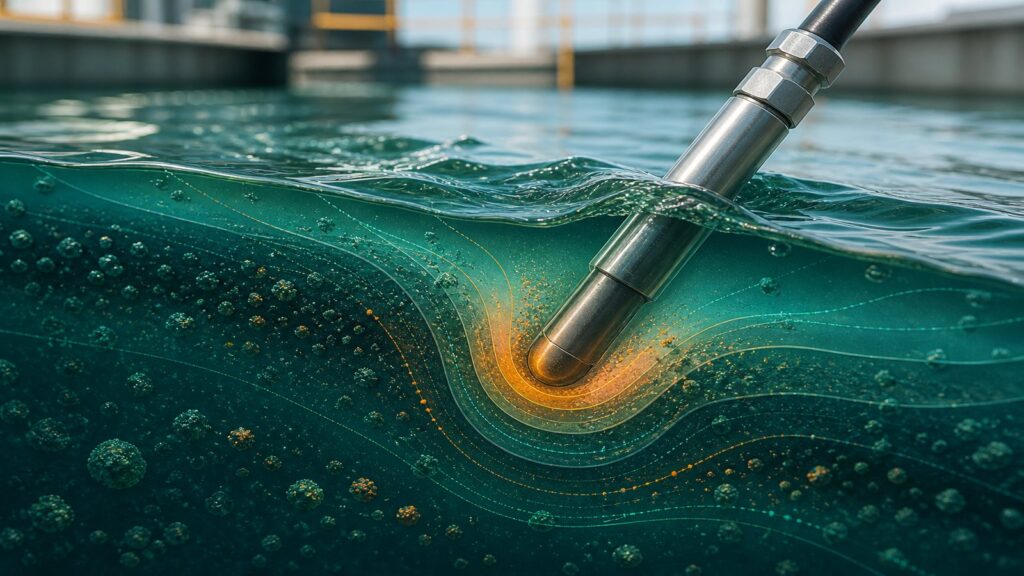
Drop a standard 316L stainless steel pH sensor into high-chloride mining effluent, and you will be pulling it back out in pieces a few weeks later. The housing pits through. The reference junction clogs. The readings drift until someone finally notices the flat line on the dashboard.
According to a 2025 Materials Performance Journal study, corrosion kills roughly 38% of all water quality sensors in the field. When you are buying sensors for corrosive wastewater, material selection is the single largest factor in whether your probe lasts one month or one year. It all comes down to the wetted material stack: the body housing, the electrode, the junction, and the seals that actually touch the acid.
If your facility operates under SPARING continuous monitoring rules, every dead sensor leaves a permanent hole in your data log. Picking the wrong material does not just burn your equipment budget—it creates a massive compliance blind spot.
Why 316L Stainless Steel Dies in Corrosive Effluent
316L is the default material for industrial pH and conductivity probes. In mild acids and neutral process water, it works perfectly. But it falls apart under two specific conditions: high chlorides and strong reducing acids.
In chloride-heavy effluent (anything above 200 ppm Cl⁻), the passive chromium oxide layer that protects 316L simply breaks down. This triggers pitting corrosion. Small, deep cavities drill straight through the housing wall from the outside in. Add high temperatures and low pH—standard conditions in mining and chemical plant discharge—and the attack accelerates.
In strong reducing acids like concentrated hydrochloric acid (HCl) or sulfuric acid (H₂SO₄), the situation is worse. 316L just dissolves. It has no passive layer to protect it here.
Look at a real-world failure. At an HPAL (high-pressure acid leach) nickel mine in Indonesia, standard pH sensors were dropped into effluent carrying 15,000 mg/L of chlorides. They lasted an average of 45 days before dying. The operators switched to probes built with tantalum electrodes and PTFE housings. The new sensors lasted 180 days (BOQU Instrument data, 2025). That is a four-fold jump in lifespan. They did not change the electronics; they just changed the metal touching the water.
High-Performance Plastics for Sensor Bodies
When 316L is off the table, you move to a polymer housing. Three plastics dominate the corrosive sensor market.
PTFE (polytetrafluoroethylene) is the heavy hitter. It shrugs off virtually every industrial chemical—concentrated acids, strong bases, organic solvents, oxidizers—and survives up to 260°C. The only things that beat it are alkali metals and some rare fluorinating agents. If you want universal chemical resistance, PTFE is the answer. Its only real flaw is mechanical: PTFE is soft, so threaded fittings can lose their torque over time under high pressure.
PVDF (polyvinylidene fluoride / Kynar) handles strong acids, chlorides, and oxidizers beautifully. It beats PVC hands-down when dealing with concentrated sodium hypochlorite and hydrogen peroxide. But PVDF has an Achilles heel: amines, ketones, and polar organic solvents will attack the polymer chain, causing it to swell or crack. If your effluent is just inorganic acids and chloride salts, PVDF gives you better mechanical strength than PTFE at a lower cost.
CPVC (chlorinated polyvinyl chloride) is the budget option. It maxes out around 93°C, and its chemical resistance is much narrower than PTFE or PVDF. However, CPVC is one of the only cheap polymers rated for hydrofluoric acid (HF) at moderate temperatures. AST Sensor uses CPVC bodies on their Model 6413 HF-resistant pH probes for exactly this reason. If you handle HF but don’t run it hot, CPVC protects the sensor for a fraction of the price of PTFE.
Exotic Metals: Hastelloy, Titanium, and Tantalum
Plastics work for the body, but electrodes and high-stress parts need metal. You have three main alloy options, and you have to pick carefully.
Hastelloy C-276 (nickel-molybdenum-chromium-tungsten) is the go-to for mixed-acid nightmares. It has a rare superpower: it survives both oxidizing and reducing conditions. That makes it the default choice for chemical plants, flue-gas scrubbers, and hot, dirty process streams where multiple aggressive chemicals mix together. But it has a massive blind spot. Hastelloy C-276 is rated “Poor” against hydrofluoric acid (HF). If your effluent contains HF, Hastelloy will fail.
Titanium dominates in high-chloride zones. Seawater, brine, and salty mine effluent are no problem. It also handles oxidizing acids like nitric acid perfectly. But engineers screw this up constantly because they forget titanium’s fatal flaw: it cannot handle reducing acids. Concentrated HCl and H₂SO₄ will eat it alive. People buy titanium because their effluent has high chlorides, completely ignoring the hydrochloric acid in the same pipe, and then wonder why the sensor dies.
Tantalum offers the most extreme acid resistance available. It survives concentrated HCl and H₂SO₄ at temperatures that destroy both Hastelloy and titanium. In the HPAL nickel mine case mentioned earlier, tantalum electrodes were the exact reason the sensors survived 180 days. The catch? Tantalum is outrageously expensive and carries massive lead times. You only pay for tantalum when nothing else works.
The Worst-Case Scenarios: Hydrofluoric Acid (HF) and Sour Gas (H₂S)
These two environments break all the normal rules.
Hydrofluoric acid (HF) eats glass. That includes the glass bulb on a standard pH sensor. To measure pH in HF, you need a specialized HF-resistant glass formulation, which usually restricts your measurement range to pH 0–11 instead of the standard 0–14. For the electrode metal, Monel (nickel-copper) is one of the only alloys rated “Excellent” for HF. For the sensor body, manufacturers use CPVC, Ryton (PPS), or PEEK. Emerson’s Rosemount 372 uses an Ultem/Kynar body rated for up to 10,000 ppm of HF. Bottom line: true HF-rated sensors are rare. Check the datasheet before you buy.
Sour gas (H₂S) triggers sulphide stress cracking (SSC). If your wetted parts touch H₂S at a partial pressure of 0.3 kPA or higher, you must comply with the NACE MR0175/ISO 15156 standard. That standard caps carbon steel hardness at 22 HRC. For corrosion-resistant alloys like Duplex 2205 or Inconel 625, the rules get incredibly complex based on exact temperatures, pressures, and chloride levels. If your gas stream contains H₂S, do not just look at a basic chemical compatibility chart. You have to specify NACE compliance on the purchase order.
Sensor Material Compatibility Matrix
Here is how the standard materials stack up against six brutal effluent types. These ratings assume normal operating temperatures. Extreme heat changes the math completely.
| Effluent Type | 316L SS | Hastelloy C-276 | Titanium | Tantalum | PTFE | Monel |
|---|---|---|---|---|---|---|
| HCl (hydrochloric acid) | Poor | Good | Poor | Good | Good | Limited |
| H₂SO₄ (sulfuric acid) | Poor | Good | Poor | Good | Good | Limited |
| High chloride / seawater | Poor | Good | Good | Good | Good | Good |
| HF (hydrofluoric acid) | Poor | Poor | Poor | Limited | Good | Good |
| Sour gas (H₂S) | Limited* | Good | Good | Good | Good | Limited |
| NaOH (caustic soda) | Good | Good | Limited | Poor | Good | Good |
*316L in H₂S requires NACE MR0175/ISO 15156 compliance (max 22 HRC).
Good = Works across most concentrations/temperatures. Limited = Works only if cold or diluted. Poor = Do not use it.
Stop Guessing. Review Your Effluent Chemistry.
You cannot order a sensor for corrosive wastewater by pointing at a catalog. Follow these three steps:
Step 1 — Get a real water analysis. You need hard numbers on pH, chlorides, exact acid types (HCl, H₂SO₄, HF), H₂S, temperature, and organic solvents. Pull the lab report from your discharge permit. Without this, you are just guessing.
Step 2 — Run the matrix. Use the table above. If your water mixes high chlorides with reducing acids, titanium is out. You are immediately pushed toward Hastelloy C-276 or tantalum for the metal parts, wrapped in a PTFE body.
Step 3 — Specify every single part. A sensor is a stack of materials: body, electrode, junction, and O-rings. A PTFE body with a tantalum electrode is useless if the O-ring dissolves. Make sure you specify the seal material (Viton, EPDM, Kalrez) on the PO.
Argatech does not manufacture these exotic sensors. But as an integrator building SPARING and ONLIMO systems, we evaluate effluent chemistry and pair it with the right hardware. If your sensors keep dying, pull a fresh water sample and review your material stack. You should also look at proper installation practices to minimize exposure, pH troubleshooting, and anti-fouling strategies to keep the new probes alive.
Share this article
Share this insight with your team.
Related Articles
Similar topics from the same category.

Poor weather station placement can cause 50% data bias. Learn the WMO-No. 8 and Indonesian BMKG siting standards for AWS sensors in industrial and mining sites.

Explore a technical engineering comparison between solid-state ultrasonic anemometers and mechanical cup-and-vane sensors for industrial weather stations.

Technical guide to conductivity sensors: comparing toroidal (inductive), 2-electrode, and 4-electrode contacting probes for industrial water and wastewater.