Tipping Bucket, Weighing, or Disdrometer: Choosing the Right Rain Gauge for Tropical Mining and Hydrology
A comparative guide to automatic rain gauges: overcome tipping bucket heavy rain errors, explore weighing gauges, and solid-state disdrometers.
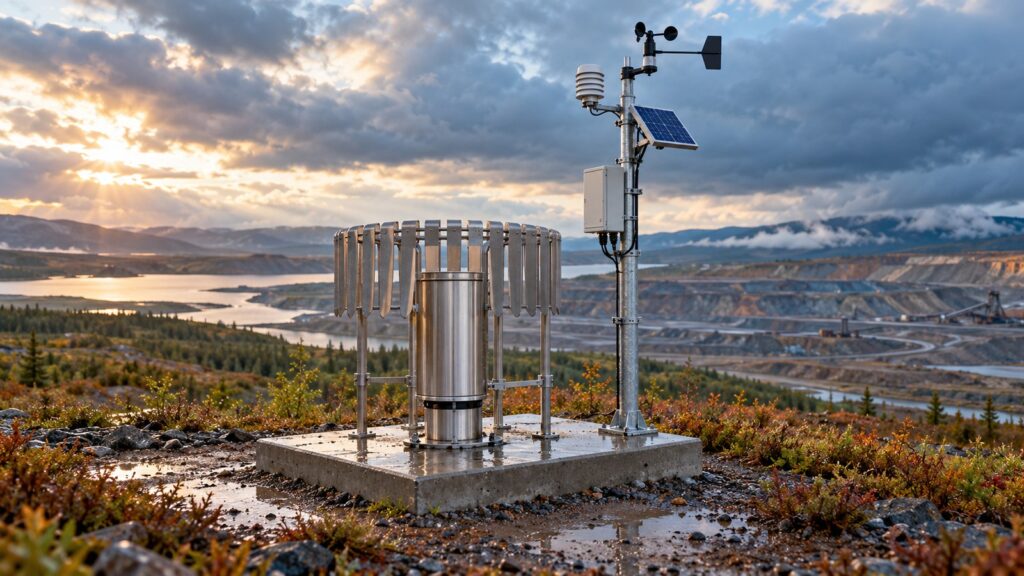
Pick the wrong automatic rain gauge and your entire hydrometry network goes blind in the field. Convective thunderstorms in tropical regions like Indonesia regularly dump 50 to 100 millimeters per hour (mm/hr). That extreme rainfall pushes instrument accuracy past the physical breaking point. I have seen project managers find out the hard way. Their conventional rain gauges drop massive amounts of data. They underreport rainfall by 15% to 25% exactly when geotechnical teams need those numbers to trigger evacuation alarms.
Bad precipitation data at open-pit mines delays slope stability alarms in the Trigger Action Response Plan (TARP). Bad data in the dam sector ruins the hydrograph models used for flash flood warnings. You have to understand the physical limits of your precipitation sensors to stop disasters before they happen. Let us look at the real differences between mechanical tipping buckets and weighing gauges. We will also cover solid-state disdrometers.
The Tipping Bucket: Mechanical Principles and Tipping Time Loss
Tipping bucket rain gauges sit on almost every site because they are cheap and stupidly simple. Rainwater drops through a funnel into one of two mechanically balanced compartments. The incoming water hits a set calibration threshold (usually 0.2 millimeters). That weight forces the bucket to tip. The action dumps the water and swings the empty second compartment under the funnel.
Each tip sweeps a magnet past a reed switch to send a digital pulse to the datalogger. That mechanical setup carries a fatal flaw in tropical storms. The bucket needs physical time to swing down and dump the water. The transition takes between 0.2 and 0.75 seconds. Rainwater keeps pouring out of the funnel during that fraction of a second. It spills completely outside the bucket. Sometimes it falls into the wrong side. The switch never triggers.
We call this spilled volume tipping time loss or kinematic error. The World Meteorological Organization (WMO IOM Report No. 99) field reports prove it. A standard tipping bucket without algorithmic correction carries a 5% to 15% systematic undercatch bias in heavy rain. The laws of hydrodynamics dictate that this water loss scales directly with rainfall intensity. Tropical storms pushing past 100 mm/hr will drive your unrecorded spilled water well over 20%.
Moving parts also demand dead-on installation precision. A mounting pole tilted more than 0.5° causes an asymmetrical bucket swing. That destroys your volume calibration by 5% to 10%. The wide collection funnel clogs fast in the field. Abrasive pit dust or a few dead leaves will plug the intake. Your remote precipitation recording system goes completely blind.
Weighing Gauges: Mass Precision Without Swing Delays
Field metrologists deploy weighing precipitation gauges to bypass mechanical water loss entirely. This instrument dumps the tipping mechanism. It sits a sealed water collection bucket on a high-precision load cell using strain gauge or vibrating wire tech. The setup directly measures the continuous accumulation of fluid mass over time.
The main advantage here is the total elimination of tipping time loss. A weighing gauge measures fluid mass continuously without mechanical dumping motions. The instrument holds deviations below 1% to 2% across the whole intensity spectrum. It tracks a light drizzle perfectly. It handles violent 2,000 mm/hr torrential storms just as well. The resolution detects precipitation accumulations as fine as 0.001 millimeters. The WMO treats stable weighing gauges as the best field reference instruments on the market.
High accuracy always brings maintenance trade-offs. The collection bucket has a hard physical limit (usually 250 mm to 1,000 mm). You need an automatic siphon pump or a drain valve to empty the fluid. Those parts wear out. Some older setups demand periodic manual draining. You also need heavy digital filtering algorithms on the datalogger. Strong wind gusts hit the bucket and cause mechanical shocks on the sensitive load cell.
Solid-State Disdrometers: Measuring Raindrops Without Funnels
Solid-state disdrometers represent the newer hardware in industrial hydrometeorological monitoring. These non-contact precipitation sensors abandon the collection funnel. They store zero water. The instrument just measures the characteristics of individual raindrops in real time. The water falls freely through an open detection zone.
You will see two dominant disdrometer designs out in the field. Acoustic models use a solid metal diaphragm to register the kinetic impact energy of falling drops. The processor translates that collision frequency and amplitude into a precipitation volume. Optical disdrometers shoot an infrared light beam across an open air gap. Raindrops slice through the beam. The resulting light attenuation calculates the Drop Size Distribution (DSD) and terminal fall velocity.
A zero-moving-parts design solves a lot of headaches. Skipping the funnel makes the disdrometer immune to clogging from leaves or dense mineral dust. I specify these for remote weather stations where routine maintenance access is impossible. You still have to watch out for severe wind shear turbulence or splash-in interference. Those forces distort the falling angle of the water drops and throw off the mass calculations.
Engineering Evaluation Matrix: Comparing 8 Parameters
Hydrology engineers have to evaluate their specific infrastructure risk profiles before drafting procurement Terms of Reference (ToR). The table below breaks down the hard engineering differences between the three main rain gauge technologies.
| Evaluation Parameter | Tipping Bucket | Weighing Gauge | Disdrometer |
|---|---|---|---|
| Metrological Detection Principle | Discrete mechanical; water triggers a dual-swinging bucket | Mass tensometric; continuous fluid weighing via load cell | Analyzes piezoelectric impact energy or laser beam attenuation |
| Storm Accuracy (>100 mm/hr) | Low; systematic 10% to 25% undercatch due to tipping time water loss | High; error <1% to 2%, standard WMO field reference instrument | Moderate; vulnerable to wind shear and raindrop splashing distortion |
| Minimum Sensitivity Resolution | Coarse (typically 0.2 mm); must collect full volume to yield 1 pulse | Extremely fine (0.001 to 0.01 mm); instantaneous precipitation detection | Variable; detects drop size spectrum and instantaneous mm/hr rate |
| Foliage/Dust Clogging Risk | High; open funnel traps debris and bird droppings | High; relies on the identical traditional collection funnel architecture | Zero; the funnel-less, basin-free design entirely eliminates clogging |
| Capacity & Water Emptying | Unlimited; automatically discards water instantly with every tip | Limited; requires automatic siphon valve or manual draining | Unlimited; does not collect or store water whatsoever |
| Active Power Consumption | Passive/Zero Watts; operates purely via a dry magnetic reed switch | Low (0.5 to 1.5 Watts); powers ADC circuitry and automatic drain motors | Moderate to High (1 to 5 Watts); powers laser emitters and DSP processors |
| Estimated Capital Expenditure (CAPEX) | Low; ranges from USD 300 to USD 1,200 for industrial materials | High; USD 3,000 to USD 8,000+ for WMO research-caliber sensors | Medium; USD 800 to USD 2,500 for maintenance-free commercial modules |
| Recommended Industrial Application | Low-cost agrometeorological AWS networks, secondary backup rain posts | Primary basin hydrometry stations and critical dams (plus WMO climate research) | Remote dusty mining masts, isolated posts lacking routine maintenance |
Integrating Precipitation Sensors in Mine TARP and Flood Early Warning
Precipitation measurement reliability directly dictates the safety of your personnel and your operational assets. National regulations for open-pit mining like Kepmen ESDM No. 1827 K/30/MEM/2018 Appendix II mandate continuous rainfall monitoring. You need this data to run geotechnical slope stability evaluations. You need it to engineer your settling pond capacities.
Hourly rainfall intensity (mm/hr) and daily accumulation (mm/24hr) act as the primary triggers in your geotechnical TARP escalation matrix. Imagine a station running a conventional tipping bucket with a 20% undercatch during a massive storm. The telemetry system fails to breach the evacuation alarm threshold on time. That delay gets people killed. The geotechnical team cannot withdraw heavy dump trucks and excavators before the saturated slope walls collapse. Watershed management faces the exact same risk. Upstream Automatic Rainfall Recorder (ARR) stations must deliver accurate instantaneous precipitation data. You have to trust those numbers before merging them with downstream Automatic Water Level Recorder (AWLR) dam data to calculate flash flood travel times.
Engineering Autonomous Weather and ARR Telemetry with Fortuna Argatech
Sensor accuracy means nothing if your data acquisition and telemetry system dies in extreme weather. Fortuna Argatech builds integrated automatic weather stations and Automatic Rainfall Recorders (ARR) explicitly hardened for wet tropical conditions in Indonesia. We integrate whatever sensor technology you require. You can spec a tipping bucket or a weighing gauge. We also deploy solid-state disdrometers. It depends entirely on your risk profile and Capex budget.
The industrial GEOVOS 1000 datalogger serves as the brain for our remote monitoring stations. This telemetry module packs a high-speed digital pulse counter. We use hardware debouncing filters to strip noise and guarantee clean signal integrity from tipping buckets. The unit provides high-impedance analog interfaces to capture sensitive load cell signals. It includes standard RS-485 Modbus RTU and SDI-12 digital ports to interface with disdrometers. The internal power management architecture enables full autonomous operation using solar panels. Your real-time IoT 4G GSM data transmission stays online.
Never let the safety of your personnel depend on a rain gauge that drops data right when a storm hits. Contact the instrumentation engineering team at Fortuna Argatech today. We will help you plan an accurate and strictly compliant meteorological and hydrological station network for your facility.
Share this article
Share this insight with your team.
Related Articles
Similar topics from the same category.
Monitoring station OPEX budget planning guide covering five cost pillars, cross-station comparison, hidden costs, and a modular worksheet for annual budgeting.

8 mandatory monitoring criteria for PROPER Blue rating under PermenLH 7/2025: SPARING, AQMS, B3, waste, peatland, mining, and SIMPEL audit.

Compare TDR and FDR soil moisture sensor principles, dielectric calibration limits for tropical peat, and multi-depth telemetry integration via GEOVOS 1000.