Electric Field Mills vs RF Lightning Detectors: Selecting an Early Warning System for Mining and Industrial Safety
Compare Electric Field Mill (EFM) and RF lightning detectors to engineer robust thunderstorm early warning systems complying with IEC 62793 standards.
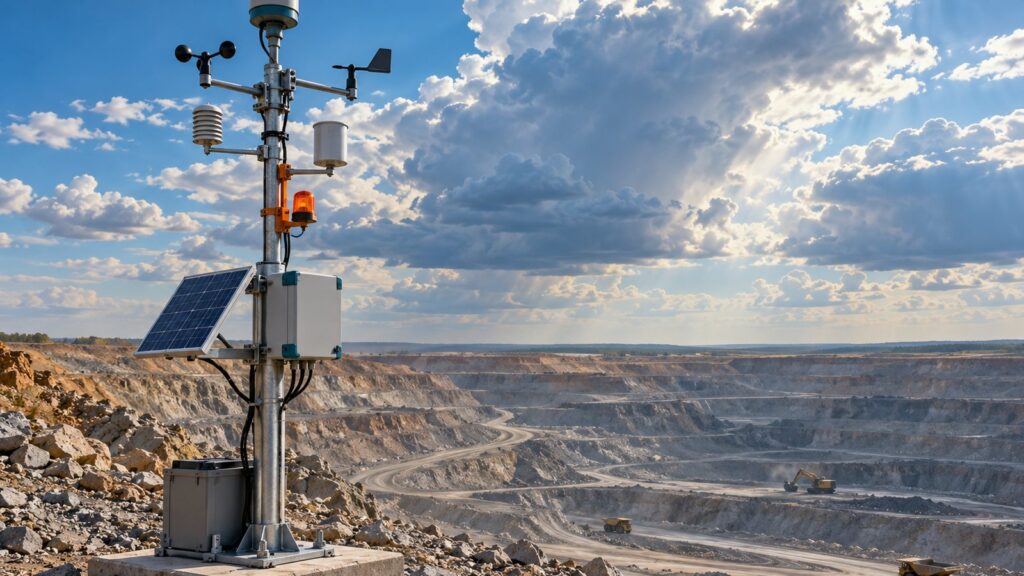
Indonesia sits on the equator. We get some of the highest lightning flash densities on the planet. For crews working in open-pit mines and wide-open industrial yards, that is a lethal problem. Passive structural protection is not enough. You need an early warning system. But not all detectors work the same way. The very first lightning bolt can form directly over your site and strike without any prior warning. If you rely on electromagnetic detectors, you are flying blind. They only trigger after the lightning already fired.
Look at any serious electric field mills vs rf lightning detectors comparison. You will see that Electric Field Mill (EFM) sensors measure the actual buildup of atmospheric electrostatic charge. They read the field in real-time. That gives your site a 10 to 30-minute head start to clear the area before the first strike hits. We are going to break down how EFM and RF detectors actually work in the field. We will cover IEC 62793 standard ratings and point out specific blind spots. Then we will show you how to tie these sensors into automated weather stations to build a complete safety protocol.
The 4 Thunderstorm Phases Under IEC 62793
The IEC 62793:2020 standard breaks a thunderstorm’s life cycle into four phases. Phase 1 is cloud electrification. Phase 2 covers storm growth and initial strikes. Phase 3 is the mature storm. Phase 4 is dissipation.
Phase 1 is where the real work happens. Aggressive charge separation inside the developing cloud distorts the ground-level electrostatic field. On a clear day, the baseline hovers around a few hundred volts per meter. As the storm builds, that field spikes to several kilovolts per meter. This happens long before anyone sees a flash. If you want to get your guys out of the pit alive, Phase 1 is exactly when you pull the alarm.
The IEC 62793 standard splits detectors into four classes. Class A handles all phases, including Phase 1. Class B picks up cloud and ground strikes. Class C only registers ground strikes, and Class D has limited use. The Electric Field Mill is a Class A detector. It spots that Phase 1 electrification. You get 10 to 30 minutes of lead time before lightning hits the dirt.
The Physics of Detection: Capacitive Modulation vs RF Transients
An Electric Field Mill relies on basic mechanics and capacitance. A grounded metallic rotor spins directly above a stationary stator plate. As the rotor turns, it changes how much of the stator is exposed to the atmospheric electric field. This mechanical rotation creates an alternating induced current. That current perfectly matches the strength of the electrostatic field outside. The math is simple: $i(t) = \varepsilon_0 \cdot E \cdot (dA/dt)$. A good industrial EFM reads up to $\pm 20\text{ kV/m}$. It catches shifts down to tens of volts per meter and samples the air at least once every second.
RF lightning detectors take a completely different approach. They just sit and listen. They pick up the transient electromagnetic wave pulses radiated into the atmosphere. But they only hear those pulses after a lightning bolt actually discharges. By using crossed-loop antennas, an RF detector can track the direction and distance of active strikes out to a 30 to 50 km radius. It does a great job at tracking moving storms. However, it is strictly a Class B device. It completely misses the initial electrification phase. It cannot tell you a storm is forming directly above your head until a bolt drops.
Blind Spot Evaluation and Environmental Reliability
EFM sensors have a major blind spot. Their range is strictly local. They only see out to about 8 or 15 km. They are also incredibly sensitive to space charge interference. Heavy particulate dust from a haul road or thick diesel exhaust from heavy equipment will mess with the readings. Because of this, you have to mount EFM sensors on low grounded masts in flat open spaces. Keep them away from tall structures and trees that distort the electric field. You must maintain a safe setback distance during your monitoring site survey.
RF detectors have their own fatal flaw. If a storm develops right above your site, an RF unit gives you zero warning before the first strike. Heavy industrial radio frequency noise can also drown out the signal. The smartest engineering fix is a hybrid setup. Pair an EFM electrostatic sensor with an RF detector. The EFM watches the sky directly above the pit for immediate threats. The RF unit tracks incoming regional storm fronts from miles away.
Engineering Evaluation Matrix: EFM vs RF
Here is the direct technical comparison between Electric Field Mill sensors and RF Detectors.
| Performance Parameter | Electric Field Mill (EFM) | Electromagnetic RF Detector |
|---|---|---|
| IEC 62793 Classification | Class A | Class B |
| Initial Detection Phase | Phase 1 (Cloud Electrification) | Phase 2 & 3 (Post-strike radiation) |
| Warning Lead Time | 10 – 30 minutes before first strike | 0 minutes for overhead first strike |
| Effective Radius | 8 – 15 km (Localized monitoring) | 30 – 50+ km (Long-range tracking) |
| Moving Components | Yes (Motorized rotating shutter) | None (Solid-state passive antenna) |
| Operational Weakness | Vulnerable to heavy mining dust | Blind to overhead first strikes |
| Optimal Application | Pit worker evacuation triggers | Regional storm tracking & trending |
Formulating Mine Safety TARP and the 30-Minute Rule
Indonesian mining rules pull no punches here. Kepmen ESDM 1827/2018 requires strict lightning hazard procedures. You have to suspend blasting. You have to get your crews out of the open. A standard mining Trigger Action Response Plan (TARP) breaks safety status into tiered zones. These zones rely on electrostatic field strength alongside active strike distance. For example, hitting $>2.5\text{ kV/m}$ triggers an Alert. If strikes get within 3 km, you run a total evacuation.
| TARP Status | Electrostatic Field (E-Field) | RF Detection Distance | Operational Safety Action |
|---|---|---|---|
| Normal (Green) | $E < 1.0\text{ kV/m}$ | $> 20\text{ km}$ | Normal operations proceed. |
| Advisory (Yellow) | $E \ge 1.5\text{ kV/m}$ | 15 – 20 km | Radio warning issued to personnel at height. |
| Alert (Orange) | $E \ge 2.5\text{ kV/m}$ | 8 – 15 km | Suspend blasting operations and fueling. |
| Danger (Red) | $E \ge 4.0\text{ kV/m}$ | $< 8\text{ km}$ | Total evacuation to protective lightning shelters. |
When the storm finally passes, you cannot send guys straight back to work. The “all-clear” protocol demands a hard 30-minute waiting period. You need zero lightning strikes within the safe radius for a full half hour. The electrostatic field also has to drop back to normal fair-weather levels. To keep the site moving without sacrificing safety, your monitoring sensor alarm threshold configuration must be custom-calibrated. Otherwise, you end up dealing with endless false alarms.
Hybrid System Integration with Argatech Weather Stations
Do not rely on lightning data alone. Tie those detectors into your main weather station. Tracking a sudden drop in barometric pressure or a shift in wind speed helps validate the path of a convective storm. It also drives down your false alarm rate. Fortuna Argatech provides integrated Automatic Weather Station (AWS) solutions. These packages run on the GEOVOS 1000 Datalogger. They include wireless telemetry and standalone solar power. We also wire them straight into your automated emergency sirens.
Installing expensive detectors in the field comes with an obvious risk. You have to back them up with coordinated passive lightning protection and SPD systems. If you skip the surge protection, a nearby strike will fry your sensor circuitry. We see the same requirement at maritime ports. Rigging this safety architecture is the only way to maintain heavy crane operational security. The bottom line is simple. Build an active detection system that fuses both EFM and RF technologies. It gives you the best defense on the market and keeps your crews safe from sudden lightning strikes.
Share this article
Share this insight with your team.
Related Articles
Similar topics from the same category.

Monitoring station OPEX budget planning guide covering five cost pillars, cross-station comparison, hidden costs, and a modular worksheet for annual budgeting.

8 mandatory monitoring criteria for PROPER Blue rating under PermenLH 7/2025: SPARING, AQMS, B3, waste, peatland, mining, and SIMPEL audit.

Compare TDR and FDR soil moisture sensor principles, dielectric calibration limits for tropical peat, and multi-depth telemetry integration via GEOVOS 1000.