Settlement Plate vs Magnetic Extensometer vs Vibrating Wire Settlement Cell: Embankment Monitoring Guide
A comparative guide for embankment monitoring instruments: evaluating mechanical settlement plates, magnetic extensometers, and telemetry VW settlement cells.
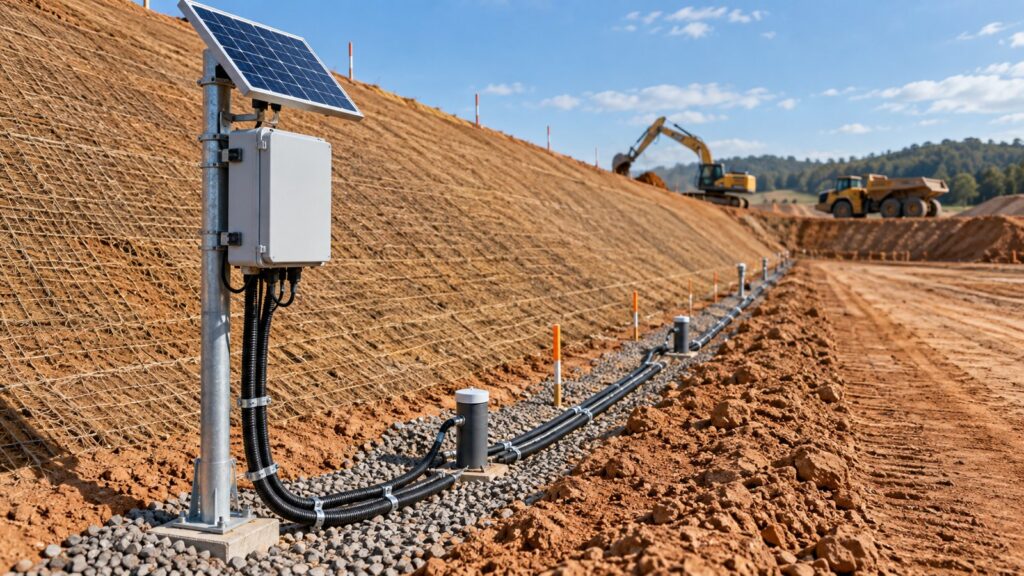
Picking between a settlement plate, a magnetic extensometer, or a hydraulic cell usually starts an argument on site. Settlement plates look great on the initial budget. The reality hits when their vertical riser pipes force heavy equipment to swerve, brake, and eventually snap the pipes in half. Hydraulic and multipoint instruments fix the traffic jam and offer better resolution. The catch is they require serious installation engineering. This guide breaks down the operational trade-offs. We look at exactly when earthworks, mining, or dam projects should bite the bullet and install a Vibrating Wire (VW) Settlement Cell to keep the dump trucks moving.
Why Vertical Settlement Monitoring Determines Embankment and Dam Integrity
Terzaghi’s consolidation theory spells it out: pile dirt over saturated soil, and pore water pressure spikes. As that water squeezes out, the pore volume shrinks and the ground sinks. The total settlement you measure at the surface is actually two things happening at once. The supporting foundation drops, and the internal fill material compresses. You have to separate those two numbers to know if the design is holding up or if the slope is about to fail.
Kepmen ESDM No. 1827/2018 makes deformation monitoring mandatory for mine waste dumps and tailings embankments. If the settlement rate suddenly jumps to 5 or 10 mm per day, it is a hard warning. The foundation bearing capacity is failing, and the site needs to trigger its TARP protocol immediately. But getting that continuous data means keeping instruments alive in the field. That directly clashes with 100-ton compactors that cannot stop for delicate survey points.
The Conventional Settlement Plate: Mechanics, Single-Point Data Limits, and Equipment Conflicts
A standard settlement plate is basic hardware. You drop a 600 mm or 1000 mm steel plate on the subgrade and bolt a vertical threaded riser pipe to it. As the fill gets higher, you screw on more pipe. The settling dirt will grip the pipe and drag it down, so you have to wrap it in a PVC sleeve pipe with enough clearance for the inner rod to slide free. A surveyor walks out, puts an optical level on the top of the riser, and checks the drop against a stable benchmark off site.
That vertical pipe is a nightmare for operators. Graders, dump trucks, and vibratory compactors have to steer around it. Statistics show 20% to 40% of these pipes end up bent or crushed by equipment. Since a roller cannot get close to the pipe, a guy with a hand tamper has to compact the soil around it. That creates a soft spot of low-density dirt right through the core of the dam, practically inviting water seepage and piping failures.
The data output is also barebones. You only get one number: the settlement at the base plate. It tells you nothing about how the internal fill layers are compressing above it. Because surveyors only read them daily or weekly, the data comes with blind spots. If the ground accelerates and shifts overnight, nobody knows until the morning survey.
Magnetic Extensometer: Multi-Layer Settlement Profiling and 2D Inclinometer Integration
A magnetic extensometer takes a different route. It uses a string of magnetic targets, usually spring-loaded spider magnets for soft dirt or plate magnets for fill, stacked at specific depths along a PVC access pipe. A technician drops a reed switch probe down the hole on a graduated tape. When the probe hits the magnetic field, the circuit closes. The reel beeps, and the tech logs the exact depth.
Stacking these magnets gives you a multipoint settlement profile. You can see exactly which soil layer is crushing and by how much. For the math to work, the bottom reference magnet has to sit dead still. Drillers push the bottom datum magnet 3 to 5 meters into hard bedrock to give the whole string a fixed zero point.
Contractors often slip these magnetic rings over the outside of an inclinometer casing. That turns one borehole into a dual instrument reading both lateral shear and vertical settlement. It is highly accurate, but someone still has to walk out and dip the hole by hand. If you need hourly data feeds for an automated safety system, manual reads will not cut it.
Vibrating Wire Settlement Cell: Hydrostatic Principles Without Riser Obstacles
Vibrating Wire Settlement Cells drop the mechanical pipes entirely. They work on hydrostatic pressure. You bury a vibrating wire pressure transducer in the dirt and run a fluid-filled tube out to a reference reservoir sitting on stable ground. If the cell sinks with the soil, the hydrostatic pressure in the line changes. The math converts that pressure drop directly into millimeters of vertical displacement.
Here is the real advantage: everything runs flat. The signal cables and fluid tubes sit in a sand-filled trench running horizontally to the edge of the site. There is no vertical pipe sticking up. Compactors drive right over the top. Engineers spec hydraulic cells when the schedule is tight and stopping a fleet of scrapers for a surveyor is out of the question.
Hydraulic Cell Engineering: Fluid Density, Barometric Compensation, and De-Airing
Hydrostatic systems are not without headaches. Their precision lives and dies on fluid density and a flawless, bubble-free installation. You cannot just use tap water. The circuit requires de-aired water mixed with ethylene glycol to stop it from freezing, kill algae, and keep dissolved gases from bubbling out of solution.
One trapped air bubble will compress under ground pressure and ruin the reading by tens of millimeters. Temperature swings in the trench also mess with the fluid density. The internal thermistor inside the sensor has to track the temperature so the datalogger can correct the density math on the fly. If you run a non-vented cell, a surface barometric sensor has to strip out atmospheric pressure changes to keep the elevation data clean.
Comparative Matrix: Settlement Plate vs Magnetic Extensometer vs VW Settlement Cell
Know what you are buying before you drill. It is always a trade-off between the data resolution you want and the construction delays you can tolerate.
| Parameter | Settlement Plate | Magnetic Extensometer | VW Settlement Cell |
|---|---|---|---|
| Elevation Principle | Optical level survey | Magnetic flux detection | Hydrostatic pressure differential |
| Spatial Resolution | Single point at plate base | Multi-layer soil profile | Single point at diaphragm |
| Vertical Placement | Steel riser cutting through fill | PVC pipe in a vertical borehole | Horizontal trench with no top obstacle |
| Equipment Interference | Constant target for compactor hits | Safe off-path or flush to ground | Safe, buried below rolling machinery |
| Survey Method | Manual optical level checks | Manual sounding tape drops | Continuous 24/7 telemetry |
| Critical Risks | Snapped pipes ruin the instrument | Probes stick in bent pipes | Fluid leaks or trapped air bubbles |
| Total Cost | Cheap (standard pipe) | Moderate (varies by depth) | High (transducer, reservoir, fluid) |
Datalogger GEOVOS 1000 Automated Telemetry and TARP Integration
Vibrating wire sensors output a frequency signal. It ignores voltage drops and cable resistance, meaning you can run hundreds of meters of wire across a dam without losing signal quality. Hook a VW settlement cell into the GEOVOS 1000 Datalogger, and the unit pushes settlement data straight to the Argatech IoT dashboard over 4G or LoRa. The TARP early warning system is baked right in.
The Fortuna Argatech GEOVOS 1000 Datalogger uses a plucked coil excitation circuit to read the wire, backed by spectral frequency analysis and thermistor tracking. Mine safety managers rely on its multi-level alarm configurations. If the soil shifts too fast, alarms fire. The site can slow down dumping, let pore water dissipate, or pull equipment back from a failing slope. We always run a proper site survey and handle the trench cabling ourselves to make sure the hydraulic lines are flawless before the dirt buries them.
Decision Framework for Selecting the Right Instrument
Instrument selection always comes down to the site realities. Settlement plates are fine for low embankments where you can control the truck traffic. Magnetic extensometers do the heavy lifting when you need to map out multi-layer consolidation. But if you are managing a massive, rapid-fill project and need hourly telemetry without putting steel pipes in the path of a compactor, VW settlement cells are the only answer.
When safety designs mandate 24/7 TARP alarms, or when contractors flat out refuse to slow down for steel riser pipes, vibrating wire instruments win the argument. Head over to Fortuna Argatech to look at how we integrate dam instrumentation and build telemetry frameworks that actually survive the site.
Share this article
Share this insight with your team.
Related Articles
Similar topics from the same category.
Comparing 8 engineering parameters across wire extensometers, RTS, radars, and GNSS to architect an effective tropical mine slope monitoring strategy.

Learn about digital filter types for monitoring sensors, how to configure them in your data logger, and when to fix the noise source.