KLHK Peatland Groundwater Compliance Guide: Preventing 0.4-Meter Threshold Sanctions
Peatland concession sanctions are often triggered by sensor corrosion. Learn 0.4m groundwater monitoring compliance, dipwell engineering, and SiMATAG-0.4m.
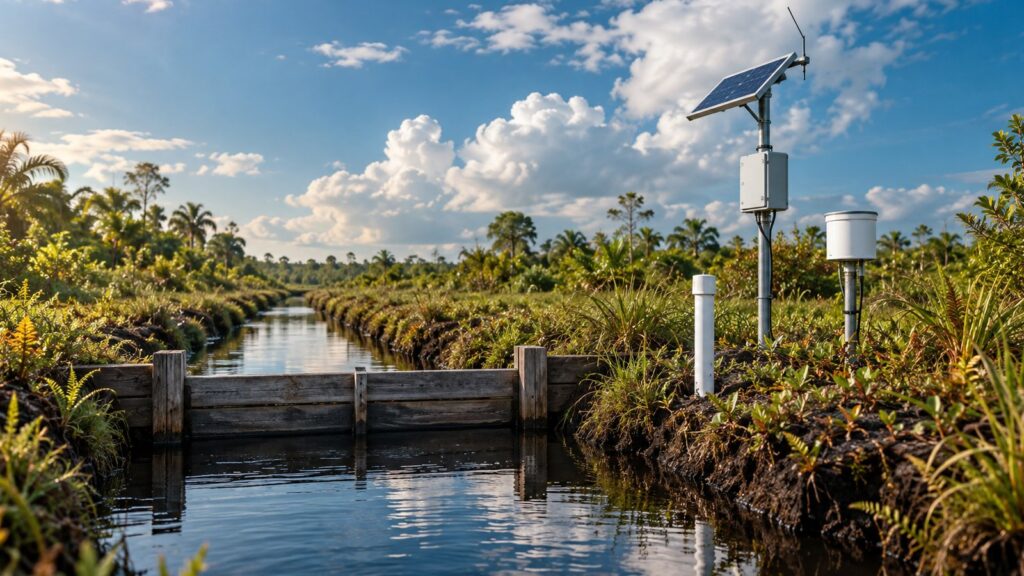
When peatland concessions get hit with written warnings or Red PROPER ratings, the culprit usually isn’t bad canal management. It’s often just dead sensors. Humic acid eats through standard metal, or a weak telemetry unit drops the connection to the ministry server. You can prevent these failures if you build your monitoring program around the actual field conditions. This guide covers what you need to meet KLHK rules: dipwell quotas, acid-proof sensor materials, solid benchmarks driven into mineral soil, and telemetry that actually works through remote blank spots to reach the SiMATAG-0.4m portal.
KLHK Regulations and the 0.4-Meter Threshold
Government Regulation (PP) No. 71/2014 and PP No. 57/2016 Article 23 paragraph (3) draw a hard line. If the groundwater level drops more than 0.4 meters below the peat surface, you violate the standard criteria for peat ecosystem damage. Let the water drop further, and the peat dries out. Subsidence accelerates. Aerobic oxidation releases massive carbon emissions. Worse, you create a prime environment for peat smoldering fires that are almost impossible to put out.
The SiMATAG-0.4m portal tracks this compliance using four color zones. Purple means inundated. Green means you are safe within the 0.4m limit. Yellow is a warning, and Red means critical status. If you fail to maintain groundwater levels or miss your data uploads to SiMATAG-0.4m, expect an immediate hit to your environmental permit compliance and PROPER ratings.
Monitoring Point Criteria and Rain Gauge Ratios
You cannot just place dipwells wherever it looks convenient. Minister of Environment and Forestry Regulation (Permen LHK) No. P.15/2017 Article 2 paragraph (4) requires monitoring points in at least 15% of your main crop blocks. You have to install them right at the block’s center (centroid). The rules allow a 50-meter tolerance radius so you can reuse existing wells if they happen to sit close enough.
Permen LHK P.15/2017 also demands automatic daily readings via data loggers. You need at least one automatic logger station per water management zone. The logger has to record groundwater elevation, timestamp, local rainfall, and the peat subsidence rate. On top of that, you must install at least one Automatic Rain Gauge (ARR) for every 20 groundwater monitoring points. This proves the exact correlation between local rain events and your water level dynamics.
Peat Water Corrosivity and Sensor Materials
Tropical peat water is basically a mild acid bath. High concentrations of humic and fulvic acids keep the pH around 3.0 to 4.5. Over-drain the peat and expose pyrite to oxygen, and that pH can crash below 3.0. Standard stainless steel like SS304 or even SS316L will not survive. Leave it submerged in aggressive humic acid, and pitting corrosion will destroy the housing.
You need sensor housings built from Titanium (Grade 2/5) or PVDF polymer. Pair that with a pure Al2O3 ceramic diaphragm, and the sensor can survive highly acidic peat water for years. Ceramic diaphragms handle overpressure spikes up to tens of times the normal measuring range, and they shrug off abrasion from sediment particles that would ruin a thin metal membrane. For the cabling, specify heavy-duty Polyurethane (PUR) or Teflon (PTFE/FEP) jackets. Standard PVC rots under microbiological decay and UV radiation.
| Sensor Component | Standard Material (High Risk) | Acid-Resistant Material (Recommended) |
|---|---|---|
| Sensor Housing | Stainless Steel SS304 / SS316L | Titanium Grade 2/5 or PVDF Polymer |
| Sensor Diaphragm | Thin Metal Membrane (0.02 mm) | Pure Al2O3 Capacitive Ceramic |
| Cable Jacket | Standard PVC | Heavy-duty Polyurethane (PUR) or Teflon |
Dipwell Construction and Subsidence Benchmarks
Build your dipwells from 2- to 3-inch Schedule 40 or AW PVC pipes. Use 0.5 mm factory slotted screens. They let fluid flow smoothly without compromising the pipe’s structural strength. You must wrap the slotted section in a non-woven geotextile filter sock with a 100–150 micrometer pore size. Skip the filter sock, and colloidal peat fibers will clog the slots fast.
At the bottom of the well, add a tightly capped 20–30 cm sump. This catches sediment and keeps your level sensor out of the mud. Finally, peat breathes and subsides. If you don’t anchor your reference point, your measurements will drift. Drive a benchmark pin straight through the peat and anchor it firmly into the hard mineral soil layer below. Tie your well elevation reference permanently to that pin.
Vented Cable Protection and Telemetry Architecture
Vented gauge hydrostatic pressure sensors use an internal vent tube capillary to compensate for barometric pressure. In a tropical swamp, that capillary needs serious protection. Fit the vent with a desiccant cartridge or aneroid bellows, or condensation will flood the sensor’s electronics.
Remote areas have terrible network stability, so your data logger needs a rugged architecture. The GEOVOS 1000 Datalogger uses persistent local store-and-forward memory. If the telemetry signal drops, it saves the measurement data locally—holding up to 90 days of logs—and pushes the backlog when the signal returns. Power the station with a solar panel and a battery bank large enough to run for 7 to 14 days straight during overcast weather.
SiMATAG-0.4m Integration and Argatech Solutions
Your data has to hit the KLHK SiMATAG-0.4m server in a specific payload format. The encrypted API requires the monitoring point ID, timestamp, groundwater elevation, rainfall, and instrument diagnostics. Aside from the automated data, Permen LHK P.15/2017 Article 8 still requires you to compile measurement reports and submit them to the Director General of PPKL KLHK every quarter.
Running a station in a peatland requires physical defense against soil subsidence, standardized grounding to survive lightning strikes, and tough enclosures to keep wildlife out. Fortuna Argatech builds an integrated Automatic Water Level Recorder (AWLR) and GEOVOS 1000 Datalogger system specifically for these harsh peatland environments. It combines anti-corrosion sensors, rain gauges, and direct automatic API reporting to the KLHK SiMATAG-0.4m portal, so your compliance data always gets through.
Share this article
Share this insight with your team.
Related Articles
Similar topics from the same category.

8 mandatory monitoring criteria for PROPER Blue rating under PermenLH 7/2025: SPARING, AQMS, B3, waste, peatland, mining, and SIMPEL audit.

Compare TDR and FDR soil moisture sensor principles, dielectric calibration limits for tropical peat, and multi-depth telemetry integration via GEOVOS 1000.

Permen LHK 14/2024 ties SPARING telemetry to daily administrative fines. Understand the formula, sensor risks, and edge validation defense.