Multi-Parameter Probe vs Single Sensors: Which Water Quality Setup Fits Your Site?
Compare multiparameter sensor probes and single-parameter sensors on flexibility, maintenance, cabling, replacement cost, and regulatory fit.
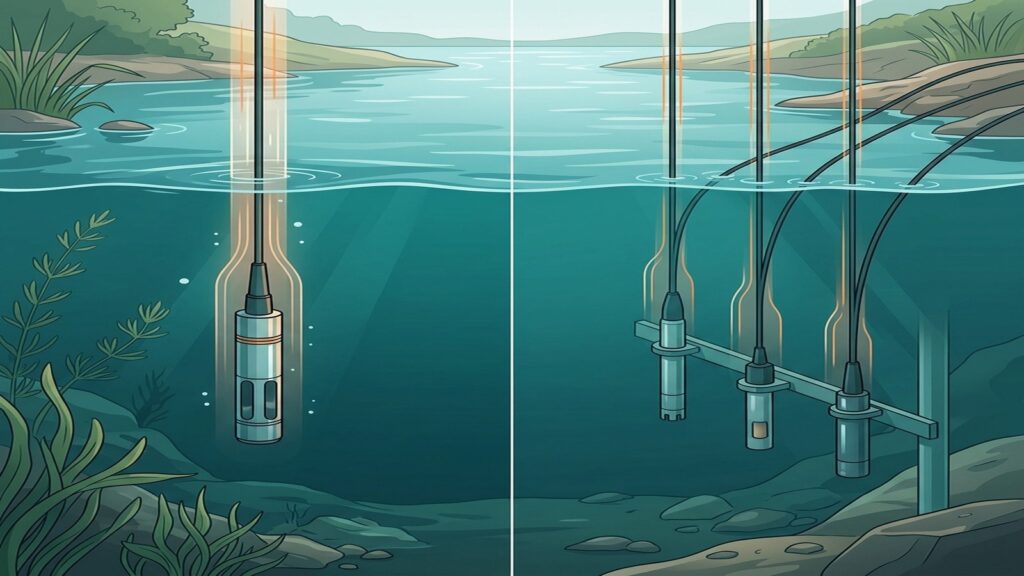
A multiparameter sensor probe combines several sensing elements inside a single housing. An individual single-parameter sensor measures one parameter independently. Neither architecture is universally superior — the right configuration depends on how many parameters you need, how often you can access the site for maintenance, how far the sensors sit from the data logger, what your replacement budget looks like, and which regulatory program applies.
This guide compares both architectures across five operational dimensions so your procurement decision reflects field conditions rather than assumptions.
What each architecture actually does
A multiparameter probe — often called a sonde — houses multiple sensing elements (pH, dissolved oxygen, conductivity, turbidity, temperature, and others) inside one cylindrical unit. A single cable connects it to the data logger or gateway. Field monitoring agencies such as the USGS deploy multiparameter sondes widely for both portable and permanent water quality stations.
Individual single-parameter sensors each measure one parameter with their own cable, connector, and mounting hardware. Fortuna Argatech supplies individual sensors including a COD sensor (RIKA RK500-25, UV method, IP68) and a turbidity sensor (BOQU, RS485 Modbus, IP68), each operating independently.
The distinction is not about measurement quality. An electrochemical pH sensor, for example, delivers equivalent results whether it sits inside a sonde or operates as a standalone unit — provided calibration procedures are followed correctly. What differs is how each architecture affects installation complexity, maintenance logistics, replacement cost structure, and system flexibility in the field.
When a multiparameter probe fits best
Multiparameter probes offer clear operational advantages in specific conditions.
Tight spaces and pontoon deployments. ONLIMO river water quality monitoring stations typically mount a multiparameter probe on a pontoon. Space is limited, and installing four or five individual sensors with separate mounting hardware on a small floating platform creates unnecessary mechanical complexity. The risk of tangled cables and mechanical damage from river currents also increases as more separate sensors share a single floating platform.
Four or more parameters at the same measurement point. When you need pH, DO, conductivity, and turbidity measured at the same depth and position, a single probe eliminates multiple mounting brackets, cable glands, and cable runs. One multi-conductor cable replaces four or five parallel lines. The smaller footprint inside the enclosure panel also simplifies cabinet design and servicing.
Long cable distances from the panel. When the data logger panel sits far from the measurement point, running a single cable to one probe is simpler and cheaper than pulling multiple sensor cables in parallel. The sensor cable selection guide covers distance and shielding considerations in more detail.
When individual sensors make more sense
There are deployment contexts where separate single-parameter sensors are the more practical choice.
Independent replacement. If one sensor fails, only that sensor needs replacement or factory service. A multiparameter probe with a failed element often requires the entire unit to be pulled from service — taking all parameters offline during the process. For stations with continuous uptime obligations such as SPARING, losing all parameters simultaneously can create regulatory compliance risk.
Different measurement positions. Individual sensors can be installed at different depths or locations in the water column. This matters for stratified water bodies, multi-stage treatment processes, or sites where turbidity and TSS sensors need to be positioned differently from pH or DO sensors.
Phased deployment. Teams can start with two parameters and add more sensors in later budget cycles without replacing the probe housing. Installation methods — submersible, flow cell, or bypass — can also be chosen per sensor based on each parameter’s requirements.
Protocol flexibility. Individual sensors typically communicate via RS-485 Modbus or 4-20 mA, which most data loggers support natively. Some multiparameter probes use proprietary protocols (SDI-12, vendor-specific RS-232 or RS-485 variants) that may require adapters or specific data logger models. Before selecting a probe, confirm that the data logger already installed at the site supports the probe’s output protocol.
Five-dimension tradeoff comparison
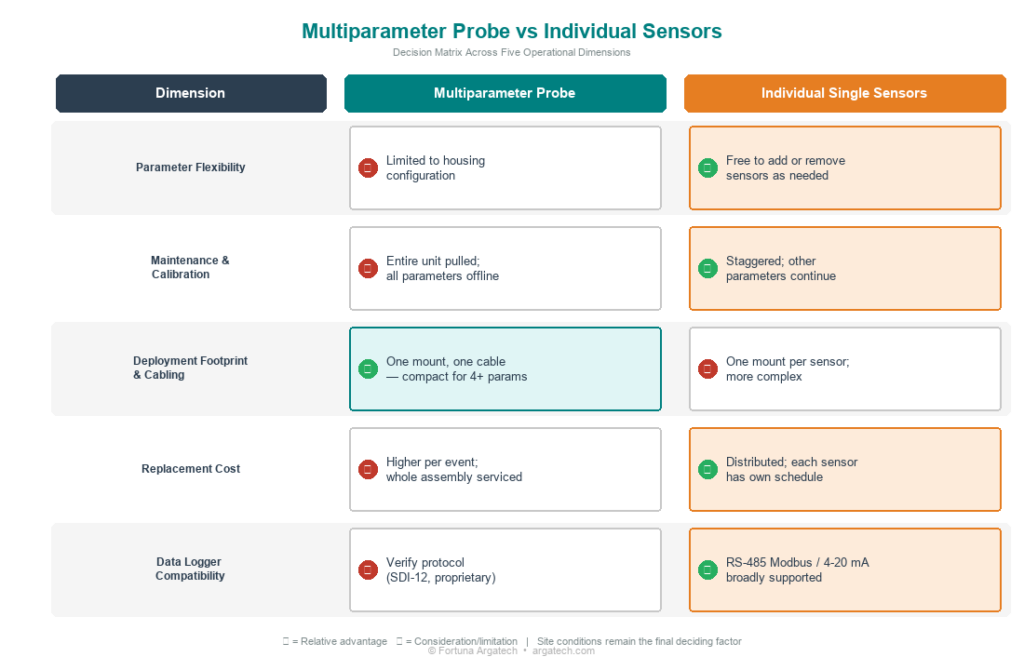
The table below summarizes the key operational tradeoffs. Site-specific conditions remain the final deciding factor.
| Dimension | Multiparameter Probe | Individual Single Sensors |
|---|---|---|
| Parameter flexibility | Limited to the housing configuration; adding a new parameter may require a different unit | Free to add or remove sensors as needed |
| Maintenance and calibration | Entire unit must be pulled; all parameters go offline together | Can be staggered; other parameters continue measuring |
| Deployment footprint and cabling | One mount, one cable — compact for 4+ parameters at one point | One mount and cable per sensor; more complex for many parameters |
| Replacement cost | Higher per failure event — the whole assembly may need factory service | Distributed — each sensor has its own lifespan and replacement schedule |
| Data logger compatibility | Verify the protocol (SDI-12, proprietary RS-232/485) | Generally RS-485 Modbus or 4-20 mA, broadly supported |
The water quality sensor maintenance guide covers cleaning and calibration intervals that apply to both architectures. The key difference is logistical: whether the entire unit comes out of the water or just the sensor that needs service.
Indonesian regulatory context: SPARING and ONLIMO
Indonesian regulations do not explicitly mandate one architecture over the other, but parameter requirements influence which configuration is more practical.
SPARING under Permen LHK No. 80/2019 (amending Permen LHK P.93/2018) requires continuous monitoring of pH, TSS, COD, and flow at the compliance point. Each parameter uses a different measurement method — UV absorption for COD, nephelometric for TSS, electrochemical for pH — and sensors may need to be positioned at different points in the effluent channel. SPARING installations therefore often use individual sensors per parameter.
ONLIMO river water quality monitoring typically measures pH, DO, turbidity, conductivity, and temperature. These parameters are usually measured at a single point in the water column, making a multiparameter probe on a pontoon the common ONLIMO configuration.
Both programs have technical requirements that may evolve. Verify the current regulatory version and implementation guidance before finalizing a configuration.
What to check before deciding
Before issuing a procurement specification, evaluate these site-specific factors:
- Water type: industrial wastewater, river, drinking water, or process water — each has different fouling characteristics and parameter needs.
- Number of required parameters: fewer than three typically favors individual sensors; four or more at one point starts favoring a multiparameter probe.
- Maintenance access frequency: remote sites with limited access should weigh the risk of losing all parameters versus one parameter during service.
- Cable distance from panel to sensor: long distances favor the single-cable multiparameter approach; short distances reduce that advantage.
- Budget structure: lump-sum or phased procurement affects the choice between one complete probe and incremental sensor additions.
- Existing data logger compatibility: verify supported protocols before selecting a specific probe or sensor model.
There is no single correct answer for every site. The optimal configuration is determined by the combination of factors above, not by the abstract superiority of one architecture.
Fortuna Argatech provides system integration for both architectures — from individual sensor configurations to complete multiparameter monitoring systems. The integration team can help map your parameter requirements, site conditions, and budget to the most appropriate configuration. To discuss your project’s specific needs, contact the Fortuna Argatech team.
Share this article
Share this insight with your team.
Related Articles
Similar topics from the same category.

Poor weather station placement can cause 50% data bias. Learn the WMO-No. 8 and Indonesian BMKG siting standards for AWS sensors in industrial and mining sites.

Explore a technical engineering comparison between solid-state ultrasonic anemometers and mechanical cup-and-vane sensors for industrial weather stations.

Technical guide to conductivity sensors: comparing toroidal (inductive), 2-electrode, and 4-electrode contacting probes for industrial water and wastewater.