Landslide Extensometer: Function, Working, Main Benefits
A landslide extensometer helps detect small slope changes early. Learn how it works, why it matters, and how it supports faster mitigation.
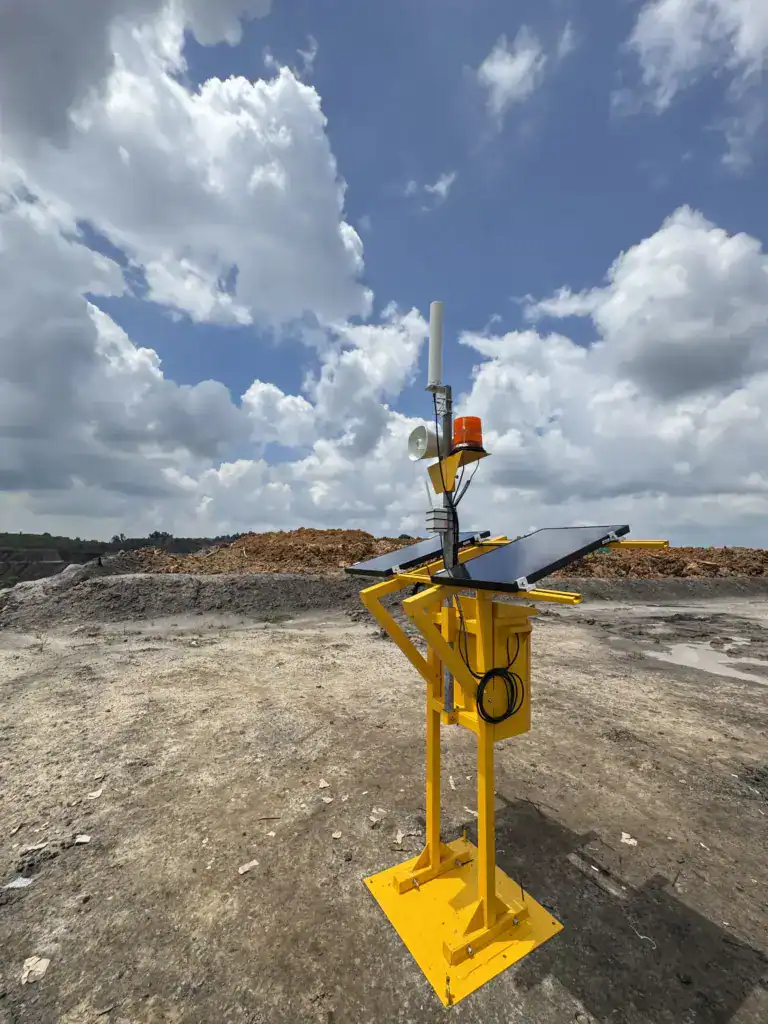
Landslide extensometer monitoring helps detect small slope changes before visible damage appears. Landslides often begin with small slope changes that are hard to see from the surface. The U.S. Geological Survey (USGS) explains that landslides can happen with little or no warning, and they may move slowly or very quickly. Because of that, visual checks alone are often too late. The National Disaster Management Authority of Indonesia (BNPB) also publishes a preparedness message titled “Longsor – Mencegah Dampak” or “Landslides – Preventing Impacts,” which shows how important early mitigation is.
This is where a landslide extensometer becomes useful. In simple terms, it is used to read length change or strain. In slope monitoring, that data helps show whether soil is stretching, shifting, or changing shape before failure happens. Fortuna Argatech places it among the geotechnical sensors used in its landslide early warning system, connected to a real-time monitoring dashboard.
What is a landslide extensometer?
Britannica describes an extensometer as an instrument used to measure strain. In simple language, it reads distance or length changes between two reference points. When used on a slope, even a small change can be an early sign that the ground is becoming unstable. That is why a landslide extensometer is valuable in geotechnical monitoring.
The role of a landslide extensometer
An extensometer helps technical teams see whether strain or displacement is increasing over time. It does not stop the landslide, but it gives clearer data before major damage becomes visible.
Why is a landslide extensometer suitable for slope monitoring?
In slope monitoring systems, an extensometer is rarely used alone. In Fortuna Argatech’s landslide early warning materials, it appears alongside inclinometers, piezometers, rain gauges, data loggers, and IoT gateways. This sensor combination helps teams understand whether ground movement is driven by slope deformation, groundwater, or rainfall.
How a landslide extensometer works in the field
A measurement point is installed
The extensometer is placed at a point that represents the moving zone, such as a cliff, slope, or cracked area. The goal is not to guess conditions from far away, but to capture real structural change.
Data is read continuously
After installation, the sensor sends data to a data logger or monitoring system. In Fortuna Argatech’s landslide early warning articles, the data is shown on an online dashboard and transmitted wirelessly, so operators do not need to visit the site constantly. A landslide extensometer is most useful when the data trend is reviewed over time.
Alerts and follow-up action
If the change goes beyond the safe threshold or shows an unusual trend, the system can trigger warnings. In this setup, the extensometer is the data source, while final decisions should still be based on other sensors and expert assessment.
When is it most useful?
Slopes that already show cracks
An extensometer is especially useful when a slope begins to show small changes such as cracks or slight displacement. The data helps teams determine whether the change is temporary or continuing to grow. That makes a landslide extensometer useful at the earliest stage of instability.
Areas near critical infrastructure
On road cuts, settlements below hills, or project sites, an extensometer can provide earlier warning before a small issue becomes damage. This matters when access and safety are at stake.
Sites monitored with other sensors
When combined with rain gauges, inclinometers, and groundwater sensors, the extensometer provides a fuller picture. That matches Fortuna Argatech’s approach of putting several sensors into one monitoring flow.
Why does a landslide extensometer matter?
Landslides can develop without obvious signs. USGS notes that landslides may move very slowly or very quickly, which often leaves little time to respond. That is why small strain changes are more valuable than waiting for visible failure. A landslide extensometer gives teams an earlier signal.
For technical teams, extensometer data helps:
- identify change trends before cracks widen
- separate temporary movement from continuing deformation
- add context to rainfall and groundwater data
- support inspection, access restriction, or early evacuation decisions
For general landslide guidance, see USGS Landslide Basics and BNPB Landslides – Preventing Impacts.
For communities and local governments, the benefit is simple: more time to prepare. That is why this approach aligns with BNPB’s landslide mitigation guidance.
Landslide extensometer vs. inclinometer
In simple terms, an extensometer reads length change or displacement between points. An inclinometer focuses on changes in slope angle. They are often used together because they complement each other.
If the extensometer helps answer “Is the ground stretching or shifting?”, the inclinometer helps answer “Which part is starting to tilt or change direction?”. Together, they provide a much clearer view of slope conditions.
Landslide extensometer in Argatech solutions
Fortuna Argatech presents the extensometer as part of a sensor-based landslide early warning system with wireless communication and a real-time dashboard. For practical context, see also Fortuna Argatech Landslide Early Warning System, the BPBD Brebes landslide project, and the Gunungkidul landslide article.
This shows that the landslide extensometer is not just a measuring device. It is part of a mitigation workflow: sensors detect change, the system processes data, and field teams get a clearer basis for action.
Conclusion
A landslide extensometer helps detect the small changes that often signal early slope instability. When installed alongside other sensors, it provides more useful information for monitoring, inspection, and mitigation. The earlier the trend is seen, the sooner teams can respond.
If safety and early response matter, one device is not enough. A connected system is what gives the extensometer its real value.
FAQs
What is a landslide extensometer for?
To read small length changes or displacement on a slope.
Can an extensometer work in real time?
Yes, if it is connected to the right data logger and monitoring system.
What is the difference between an extensometer and an inclinometer?
An extensometer reads strain/displacement between points, while an inclinometer reads slope-angle change.
Is one extensometer enough for evacuation decisions?
Not by itself; it works better with other sensors and expert review.
Are Argatech’s technical specifications published?
Not stated / need verification on the official product page.
When is it most useful?
When a slope starts showing small changes or needs continuous monitoring.
Sources
- Britannica. (n.d.). Extensometer. https://www.britannica.com/technology/extensometer
- BNPB. (2024, July 24). Longsor – Mencegah Dampak. https://bnpb.go.id/siaga-bencana/longsor-mencegah-dampak
- USGS. (n.d.). Landslide Basics. https://www.usgs.gov/programs/landslide-hazards/landslides-101
- Fortuna Argatech. (2025, December 15). Gunungkidul Rawan Longsor Saat Hujan Deras. https://www.ewslongsor.id/artikel/gunungkidul-rawan-longsor-saat-hujan-deras/
- Fortuna Argatech. (2026, February 10). EWS Longsor BPBD Brebes sebagai Inovasi Tanggap Dini. https://www.ewslongsor.id/portofolio/ews-longsor-bpbd-brebes-sebagai-inovasi-tanggap-dini/
Share this article
Share this insight with your team.
Related Articles
Similar topics from the same category.
Poor weather station placement can cause 50% data bias. Learn the WMO-No. 8 and Indonesian BMKG siting standards for AWS sensors in industrial and mining sites.
Explore a technical engineering comparison between solid-state ultrasonic anemometers and mechanical cup-and-vane sensors for industrial weather stations.

Technical guide to conductivity sensors: comparing toroidal (inductive), 2-electrode, and 4-electrode contacting probes for industrial water and wastewater.