Environmental Noise Monitoring Sensors: Real-Time Sound Level Meters for Industrial and Regulatory Compliance
Select the right environmental noise monitoring sensor for industrial and workplace compliance. Class 1 vs Class 2, LAeq metrics, and telemetry.
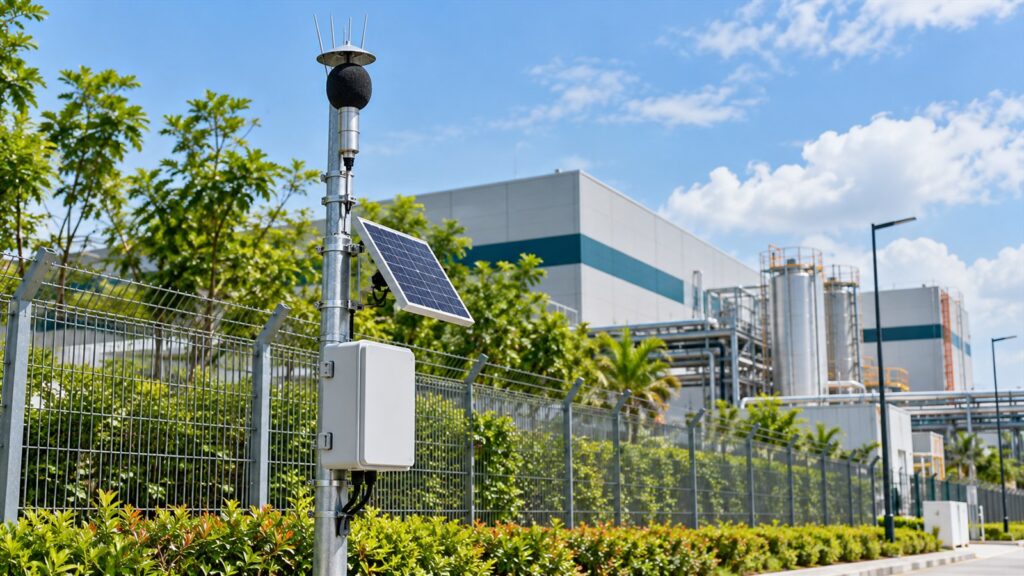
Industrial facilities in Indonesia deal with two separate noise regulations protecting two different populations. Mix them up and it gets expensive fast. An environmental noise monitoring sensor on the perimeter fence line measures sound leaving the property into surrounding neighborhoods, where limits drop as low as 55 dB(A). Inside the plant, occupational rules let workers take up to 85 dB(A) for eight hours. Relying on handheld spot checks for either regime leaves you open to fines and community complaints that a continuous monitoring setup would have caught.
Two Compliance Regimes: Environmental Boundary Noise vs Occupational Exposure
Two completely different statutes govern noise for Indonesian industry. On the environmental side, Ministerial Decree KEP-48/MENLH/11/1996 caps noise at the outer property line: 70 dB(A) for industrial zones, 55 dB(A) for adjacent residential areas. Other land-use designations sit between those figures. Offices get 65 dB(A), government facilities 60 dB(A), green open spaces 50 dB(A). Government Regulation PP No. 22/2021, Articles 207-208, reinforces noise as one of three mandatory environmental nuisance parameters that facility operators must test periodically or continuously. On top of that, Ministry of Industry Regulation Permenperin No. 26/2025 on Industrial Estate Standards obligates estate managers to monitor noise emissions at the perimeter buffer zone.
Workplace noise is a completely separate statute. Ministry of Manpower Regulation Permenaker No. 5/2018 sets the occupational threshold value (NAB) at 85 dB(A) for an eight-hour daily exposure, applying a 3 dB exchange rate: every 3 dB increase halves the permitted duration. So at 88 dB(A), workers get four hours. At 91 dB(A), two hours. The absolute ceiling is 140 dBC peak.
Here is the part people get wrong. Perimeter limits protect communities from continuous sound pollution around the clock. Occupational limits protect workers whose exposure is managed through shifts and hearing protection. Treating an 85 dB(A) workplace reading as proof of environmental compliance is a mistake that will trigger enforcement action when the boundary fence limit is only 55 dB(A).
Why Spot Sampling Fails Industrial Disputes and Environmental Audits
Indonesian National Standard SNI 8427:2017 specifies that environmental noise measurement requires recording the energy-equivalent level LAeq over 10-minute windows each hour across a full 24-hour cycle to compute daytime (LS), nighttime (LM), and day-night (LSM) values. A handheld sound level meter captures a single snapshot. That is typically 120 readings at five-second intervals over ten minutes. It will not catch sporadic nighttime spikes from loading operations or cooling towers cycling on, let alone emergency venting that residents complain about at 2 AM.
When a community dispute reaches the local environmental agency, the operator needs timestamped continuous time-series data. A ten-minute grab sample taken during business hours six months ago carries almost no weight. ISO 1996-2:2017 requires Class 1 instrumentation for measurements used in legal enforcement and dispute resolution, meaning both data continuity and instrument precision matter if you want records that hold up.
Key Acoustic Metrics: Instantaneous SPL vs LAeq, Frequency Weighting, and Day-Night Penalty
Not every decibel reading has the same legal weight. An integrating-averaging sound level meter computes LAeq, the energy-equivalent continuous sound level over a defined period T. That single number represents cumulative acoustic energy from fluctuating sources and is the metric mandated by KEP-48/1996 and SNI 8427:2017. A plain SPL meter showing instantaneous levels cannot produce a valid LAeq. Different instrument, different output.
Frequency weighting controls which part of the sound spectrum the instrument emphasizes. A-weighting (dBA) follows human hearing sensitivity, rolling off very low and very high frequencies. Both KEP-48/1996 and Permenaker 5/2018 require it. C-weighting (dBC) keeps a flat response across 31.5 Hz to 8 kHz, which makes it the right choice for evaluating low-frequency machinery hum from compressors and generators, and for checking peak impulsive noise against the 140 dBC ceiling.
Then there is time weighting. Fast mode (125 ms time constant) tracks rapidly fluctuating sounds. Slow mode (1,000 ms) smooths readings for steady-state industrial noise. For long-term environmental evaluation, the LSM day-night metric applies a +5 dB(A) penalty to nighttime measurements (22:00-06:00) before comparing the combined 24-hour value against the zone limit, plus a 3 dB(A) measurement tolerance. Beyond averages, percentile statistics matter. L10 (exceeded 10% of the time, representing peak events), L50 (median), and L90 (exceeded 90%, representing background residual noise) help engineers isolate intermittent sources from steady background.
Sensor Decision Matrix: When Do You Need IEC 61672 Class 1 vs Class 2?
IEC 61672-1:2013 splits sound level meters into two accuracy classes:
| Parameter | Class 1 | Class 2 |
|---|---|---|
| Tolerance at 1 kHz | +/-1.1 dB | +/-1.4 dB |
| Frequency range | 16 Hz – 20 kHz | 20 Hz – 8 kHz |
| Operating temperature | -10 deg C to +50 deg C | 0 deg C to +40 deg C |
| Primary application | Legal enforcement, AMDAL permits, dispute resolution | Internal plant surveys, trend monitoring, screening |
| Required by ISO 1996-2 for legal use | Yes | No |
If your measurement data goes into regulatory reporting under KEP-48/1996, AMDAL/RKL-RPL submissions, or dispute evidence, ISO 1996-2 requires Class 1 instrumentation. Class 2 is fine for internal plant floor surveys and daily trend dashboards where legal enforceability is not the point. Specifying Class 1 everywhere increases capital cost. Specifying Class 2 for boundary fence compliance creates a legal vulnerability. Pick based on how the data will actually be used.
Outdoor Microphone Protection for Long-Term Reliability in Tropical Climates
Putting a precision microphone outdoors in tropical Southeast Asia is a different game than lab conditions. Sustained humidity above 90% RH, monsoon downpours, salt air near the coast, bird fouling on the housing: any of these can degrade diaphragm sensitivity within weeks. A permanent outdoor station needs an all-weather microphone protection kit. That means an open-cell polyurethane windscreen to knock down aerodynamic turbulence, a hydrophobic membrane that repels rain while staying acoustically transparent, a stainless steel bird spike cage, and a micro-heater or silica gel desiccant pack to stop condensation from forming on the diaphragm.
Mounting matters too. Position the microphone at least 3.5 meters from any reflective wall or building facade to reduce acoustic reflection artifacts. For temporary surveys, mount at 1.2 to 1.5 meters above ground. Permanent installations go higher, 3.5 to 4 meters on an instrument pole, which also cuts vandalism risk and ground-reflection interference.
Telemetry Integration Architecture: RS-485 Modbus, GEOVOS 1000 Datalogger, and Wind Correlation
Continuous noise data sitting inside a standalone meter is not doing anyone much good. Industrial telemetry connects the sensor to a centralized monitoring dashboard where HSE teams review trends and catch threshold breaches in real time. Audit-ready reports come out of the same platform.
Fortuna Argatech connects outdoor noise sensors via RS-485 Modbus RTU to the GEOVOS 1000 datalogger. The datalogger computes LAeq over 10-minute intervals at the edge and buffers time-series data locally. From there it pushes everything to a cloud platform over 4G LTE. Solar-powered enclosures let you deploy at remote perimeter points with no grid dependency.
Wind correlation is where source identification gets interesting. When a complaint says factory noise is disturbing a residential neighborhood, you need directional evidence. Pair the noise sensor with an Argatech Weather Station measuring wind speed and direction, and you can determine whether sound was propagating downwind toward the complainant or upwind from an unrelated source like a highway. Wind speeds above 5 m/s also generate aerodynamic noise on the microphone itself, so concurrent met data helps you validate or flag suspect readings.
Tiered Alarm Strategy and Field Calibration Verification Protocol
Waiting until noise exceeds the legal limit before reacting is already too late. A tiered alarm threshold configuration gives you an operational buffer. The Argatech telemetry architecture supports configurable alarm levels. An Early Warning advisory at 65 dB(A) gives operators time to identify the source and dial back output. A Critical Alarm at 70 dB(A) fires multi-channel notifications (WhatsApp, SMS, email) before a formal exceedance is recorded.
Calibration discipline is non-negotiable. Run field calibration verification before and after each monitoring campaign using a portable acoustic calibrator conforming to IEC 60942:2017. The calibrator produces a reference tone of 94 dB or 114 dB at 1,000 Hz. For Class 1 instruments, deviation between the calibrator reference and sensor reading must stay within +/-0.5 dB. If it drifts beyond that, the data from that period is suspect and an auditor can challenge it.
Keep a documented calibration log: pre-deployment readings, post-retrieval readings, calibrator serial number, ambient conditions. That is the baseline quality assurance an environmental auditor expects. For facilities that need defensible compliance records, continuous monitoring with disciplined calibration and tiered alerting builds the data backbone that spot sampling cannot deliver.
For technical consultation on noise monitoring integration or AQMS and environmental telemetry systems, contact the Fortuna Argatech engineering team.
Share this article
Share this insight with your team.
Related Articles
Similar topics from the same category.
Monitoring station OPEX budget planning guide covering five cost pillars, cross-station comparison, hidden costs, and a modular worksheet for annual budgeting.

8 mandatory monitoring criteria for PROPER Blue rating under PermenLH 7/2025: SPARING, AQMS, B3, waste, peatland, mining, and SIMPEL audit.

Compare TDR and FDR soil moisture sensor principles, dielectric calibration limits for tropical peat, and multi-depth telemetry integration via GEOVOS 1000.