Electrochemical Gas Sensors in AQMS Stations: Mitigating Cross-Sensitivity and Tropical Environmental Drift
Engineering guide to resolving O3/NO2 cross-sensitivity, Arrhenius thermal drift, and tropical humidity transients in AQMS electrochemical gas sensors.
Why Ambient Gas Sensors Often Trigger False Spikes During Heatwaves and Post-Rain
You deploy an integrated Air Quality Monitoring System (AQMS) in a tropical industrial zone. Suddenly, operators flag mysterious NO2 or SO2 data spikes. These spikes trigger false ISPU pollution alarms under Permen LHK No. 14 Tahun 2020. Operations stop. The regulator calls. The twist? There is no industrial emission. The spikes happen during blistering hot afternoons or right after a heavy monsoon downpour.
The root cause is physics. Electrochemical gas sensors have inherent limitations. Uncompensated cells suffer from reduction cross-sensitivity between ozone and NO2. They generate exponential Arrhenius background currents at temperatures above 30°C. They produce transient non-Faradaic capacitive spikes when relative humidity shifts suddenly. Operators must understand this environmental interference. Otherwise, you end up chasing ghosts.
Amperometric Principles and the Role of Auxiliary Electrodes in 4-Electrode Architecture
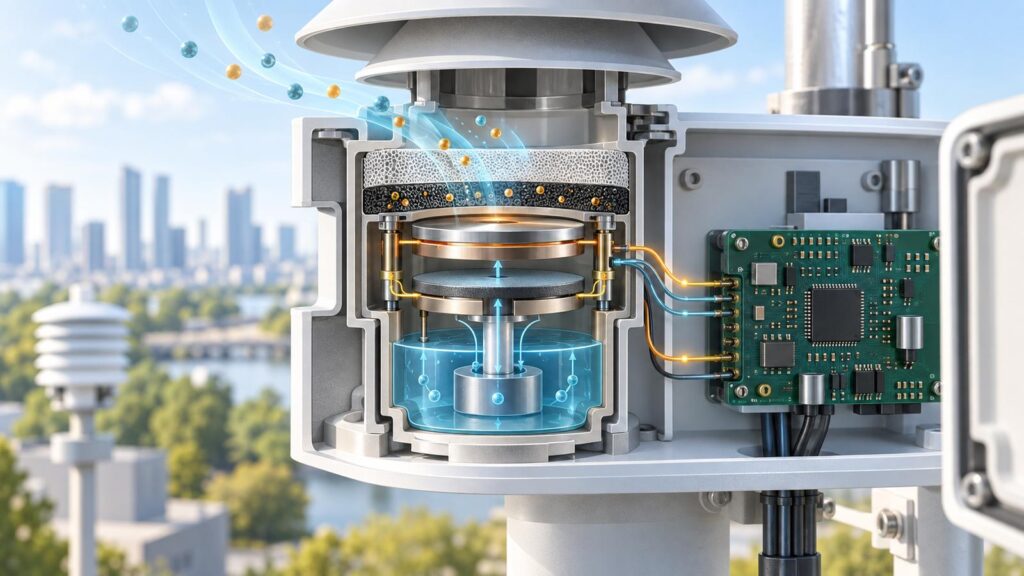
Measuring sub-ppm ambient gas concentrations relies on Faraday’s Law. Target gas molecules diffuse through a hydrophobic porous membrane. They hit a three-phase boundary (gas, liquid electrolyte, solid catalyst) on the Working Electrode (WE) and undergo a redox reaction. This generates a tiny electrical current proportional to the gas concentration. Microamperes or nanoamperes.
Conventional 3-electrode cells use a Working, Counter, and Reference Electrode. They work fine for ppm-level industrial safety. For ppb-level ambient air monitoring, they fail. The zero-current baseline drift from thermal interference easily drowns out the weak Faradaic signal of trace gases.
Modern environmental monitoring demands a 4-electrode architecture. We add an Auxiliary Electrode (AE). It shares the identical catalytic material and electrolyte immersion as the Working Electrode. But it remains physically shielded from ambient gas contact. The AE measures pure thermal background current. Nothing else. Pair this with an ultra-low noise Individual Sensor Board (ISB) potentiostat. The circuit maintains independent working potentials for the WE and AE against the Reference Electrode. You get dual analog voltage outputs. This provides resolution down to the sub-ppb level.
Cross-Reactivity Mechanisms of Ozone (O3) and Nitrogen Dioxide (NO2) Reduction
Electrochemical sensors struggle to differentiate ozone (O3) and nitrogen dioxide (NO2). Both are powerful oxidizing agents. Both undergo identical electrochemical reduction reactions on standard carbon or gold working electrodes. An unprotected NO2 sensor responds to O3 with nearly 100% cross-sensitivity. It reads ozone as nitrogen dioxide.
Engineering fixes this hardware flaw in two ways. The hardware approach installs a manganese dioxide (MnO2) catalytic filter over the NO2 sensor inlet. The MnO2 acts as a scrubber. It selectively decomposes O3 molecules into oxygen with over 99% efficiency. It leaves the NO2 molecules alone.
The alternative is differential pairing. A total oxidant (OX) sensor measures combined NO2 and O3. An MnO2-filtered NO2 sensor measures only NO2. The datalogger calculates pure ozone by subtracting the NO2 reading from the OX reading.
This differential math has limits. In high-traffic corridors with dense diesel exhaust, NO2 dominates. Nitric oxide titration depletes O3. Under these conditions, differential subtraction propagates errors. You occasionally get fictitious negative ozone estimates.
Reducing Gas Interference (CO/SO2) and Active Carbon Filters
Similar cross-sensitivity plagues reducing gases like carbon monoxide (CO) and sulfur dioxide (SO2). Both undergo electrochemical oxidation at the working electrode. Standard CO sensors are highly sensitive to hydrogen sulfide (H2S), SO2, and volatile organic compounds (VOCs).
We fix CO signal integrity with active carbon filtration. High-surface-area activated carbon sits directly in the diffusion path. It chemically adsorbs H2S and heavy hydrocarbons before they hit the electrode catalyst. SO2 sensors require similar selective filtration to block NO2 and H2S. You must specify the correct target-specific chemical filter. Otherwise, mixed organic emissions will trigger fake CO or SO2 pollution events.
Tropical Thermodynamics: Arrhenius Thermal Kinetics and H2SO4 Hygroscopic Swelling
Operating compact AQMS micro-sensor stations in tropical climates is brutal. The thermodynamics work against you. First, ambient temperatures climb above 30°C. The electrochemical thermal background current increases exponentially. It follows Arrhenius kinetics with an activation energy around 70 kJ/mol. Uncompensated, this baseline drift fakes dozens to hundreds of ppb during a hot afternoon.
Next is the electrolyte. The cell uses dilute sulfuric acid (H2SO4). It is highly hygroscopic. In prolonged tropical humidity above 80% RH, thermodynamic equilibrium shifts. The electrolyte absorbs atmospheric water vapor. Fluid volume expands by 150% to 200%. This dilutes the acid concentration and depresses the ionic mass transfer rate.
Sudden relative humidity shifts trigger a different failure. The rapid d(RH)/dt change during a monsoon storm destabilizes the electric double-layer capacitance at the working electrode interface. A transient non-Faradaic capacitive current fires. The instrumentation sees an electrical surge and registers a massive false pollutant spike. Readings jump 50 to 200 ppb for several minutes before stabilizing.
Firmware Compensation Algorithms: Evaluating AAN 803-05
A 4-electrode cell only gives you raw electrical potential. Active software compensation is mandatory. Alphasense Application Note AAN 803-05 outlines four thermal compensation algorithms. They correct the working electrode (WE) baseline using the auxiliary electrode (AE). Pick the wrong one in your datalogger firmware, and the sensor fails in tropical heat.
| Algorithm | Equation | Tropical Stability | Failure Risk |
|---|---|---|---|
| Algorithm 1 | WE_c = (WE_u – WE_0) – n_T * (AE_u – AE_0) | High | Safe. Scales linearly using factory coefficient n_T. |
| Algorithm 2 | WE_c = (WE_u – WE_0) – (WE_0 / AE_0) * (AE_u – AE_0) | Low | High risk of numerical instability. Small AE_0 divisors amplify noise at high temperatures. Causes fictitious negative concentrations. |
| Algorithm 3 | WE_c = (WE_u – WE_0) – (WE_u / AE_u) * (AE_u – AE_0) | Moderate | Relies on dynamic reading ratios. Drifts unpredictably during transient spikes. |
| Algorithm 4 | WE_c = WE_u – (WE_0 + n_T * (AE_u – AE_0)) | High | Safe. Highly stable for continuous outdoor baseline correction. |
For a robust GEOVOS 1000 datalogger deployment, Algorithms 1 and 4 are mathematically stable. Algorithm 2 is dangerous for tropical deployments. Its reliance on zero-baseline ratios (WE_0 / AE_0) guarantees divisor instability when ambient temperatures peak. The software outputs negative pollution values.
Tangential Pneumatic Manifold Sampling Design
Firmware algorithms alone cannot protect cells from monsoon moisture transients. You need a physical buffer. Build a low-dead-volume pneumatic sampling manifold from inert materials like PTFE or PVDF. This stabilizes the air mass before it hits the sensor membrane.
Manage the d(RH)/dt shock with tangential flow. Route ambient air across the sensor hoods at a strictly controlled rate of 500 standard cubic centimeters per minute (sccm). This tangential velocity prevents overpressure turbulence on the hydrophobic diffusion membrane. It maintains a t90 response time under 30 seconds.
Install the sampling diaphragm pump downstream on the negative suction side. Mechanical heat, valve friction particles, and lubricant outgassing from the pump must not contaminate the reactive gas sample. Downstream placement guarantees a clean sample hits the cell.
Metrological Standards and Argatech System Integration
Electrochemical gas sensors do not replace the absolute primary reference methods of a laboratory chemiluminescence analyzer without collocation calibration. But metrological standards rigorously evaluate them for indicative monitoring. The European CEN/TS 17660-1 standard dictates Class 1 uncertainty limits (<25% or 15 ppb) and strict interference testing protocols. The US EPA Air Sensor Guidebook mandates specific field evaluation baselines (R² > 0.70, bias < 20%).
Tropical environments demand rigorous system engineering to meet these standards. Fortuna Argatech solves this by integrating 4-electrode multiparameter air quality sensors with ultra-low noise ISB potentiostats. The GEOVOS 1000 edge-computing telemetry unit applies Algorithm 1 and 4 compensation. A 500 sccm tangential downstream manifold protects the cells. The resulting AQMS generates highly defensible continuous data. When operators calculate ISPU index values for regulatory compliance, the results reflect genuine ambient air quality. No false alarms from tropical climate drift.
Share this article
Share this insight with your team.
Related Articles
Similar topics from the same category.

8 mandatory monitoring criteria for PROPER Blue rating under PermenLH 7/2025: SPARING, AQMS, B3, waste, peatland, mining, and SIMPEL audit.

Compare TDR and FDR soil moisture sensor principles, dielectric calibration limits for tropical peat, and multi-depth telemetry integration via GEOVOS 1000.

Permen LHK 14/2024 ties SPARING telemetry to daily administrative fines. Understand the formula, sensor risks, and edge validation defense.