UV-Vis vs Wet-Chemical COD Analyzers: Selecting the Right Sensor for Continuous Wastewater Monitoring
A comprehensive engineering guide comparing reagent-free UV-Vis optical probes and wet-chemical analyzers for continuous industrial wastewater COD monitoring.
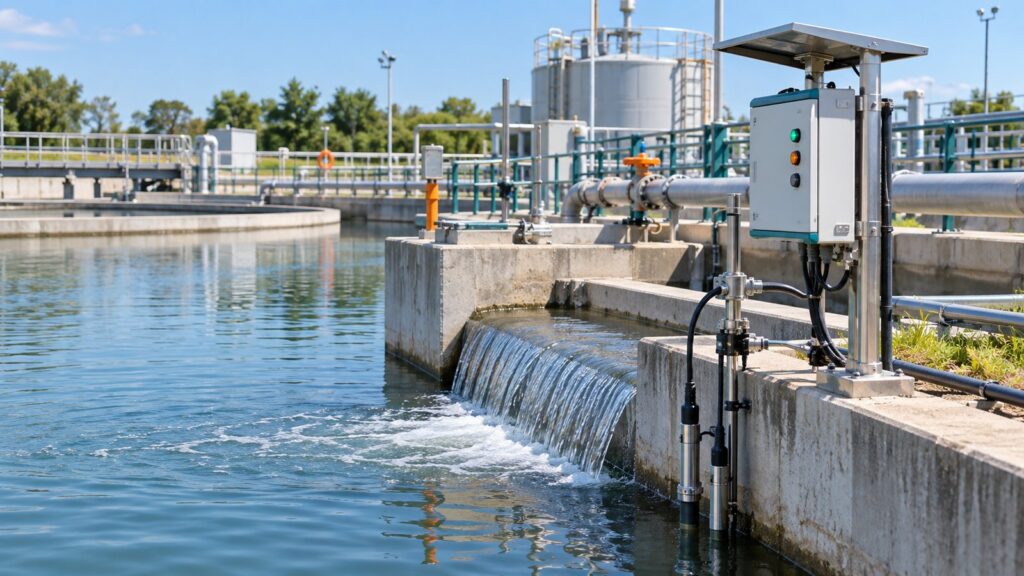
Indonesia’s Ministry of Environment and Forestry (KLHK) doesn’t leave much room for interpretation. Under Permen LHK No. P.80/2019 Article 6, 12 key industrial sectors must implement the Continuous Online Wastewater Quality Monitoring System (SPARING). You have to integrate telemetry. You have to measure Chemical Oxygen Demand (COD) precisely at the final compliance outfall. It is a non-negotiable legal requirement.
When selecting continuous COD monitoring equipment, you basically have two choices. Option one is the automated wet-chemical analyzer. It is an electromechanical box built to replicate old-school laboratory acid-digestion procedures. The chemistry is sound. It adheres to classical oxidation principles. But it generates toxic hazardous waste right there at the monitoring site. Plus, you get stuck with a 15 to 30-minute measurement lag per cycle.
Option two relies on optics. The UV-Vis spectrophotometric probe measures the Spectral Absorption Coefficient at 254 nm. Optical instruments check organic absorption instantly. They don’t consume a single drop of chemical reagents. The catch? You must establish a site-specific matrix calibration curve against your local wastewater composition. Get this right. It protects your facility from wasted capital and spiraling maintenance costs. You also ensure compliance with the strict SPARING data availability rules evaluated during PROPER audits.
Principles of Wet-Chemical Dichromate Oxidation: Stoichiometry and SNI 6989.2:2019 Compliance
From a regulatory view, the gold standard for COD measurement is SNI 6989.2:2019 and ISO 15705. These protocols use the closed-reflux spectrophotometric method. You take organic compounds in the effluent. You oxidize them fully with potassium dichromate in a highly concentrated sulfuric acid bath.
During this redox reaction, the dichromate ion acts as a heavy-duty oxidizer. It needs extreme heat to work. We are talking about a 150°C thermal destruction environment sustained for two full hours. To force straight-chain aliphatic compounds to break down, the mix requires a silver sulfate catalyst. You also have to dump in toxic mercury sulfate to suppress interference from naturally occurring chloride ions.
Field-deployed wet-chemical analyzers squeeze this entire laboratory procedure into an outdoor cabinet. Inside, it is a micro-fluidic nightmare. Delicate peristaltic pumps, multi-position selector valves, and high-pressure thermal reaction vessels work together to mix hazardous reagents. To mimic continuous monitoring, manufacturers crank the cycle speed down to 15 or 30 minutes per test. Running repeated acid boils in a harsh industrial environment absolutely wrecks microscopic mechanical systems. Capillary wear is a constant headache. Anomalous fluidic clogging from suspended solids in dirty effluent will happen sooner rather than later.
Principles of UV-Vis Spectroscopy and SAC254: Reagent-Free Organic Measurement
Optical probe sensors take a completely different approach. They use the physics of photon absorption instead of mechanical destruction reactors. Based on DIN 38404-3, these instruments measure how much light gets absorbed as it travels through the fluid. The metric is the Spectral Absorption Coefficient of ultraviolet radiation at 254 nm.
It all comes down to the Beer-Lambert Law. Conjugated carbon double bonds and complex organic macromolecules absorb electromagnetic energy in the 254 nm band. These are the main components of most biological pollutants. As ultraviolet photons cross the sensor’s optical pathlength, they lose energy. The internal processor calculates the logarithmic difference between the reference light and the absorbed light. That tells you the organic load.
The sensor operates with zero chemical injections. It is a completely consumable-free piece of hardware. Data acquisition finishes in two to ten seconds. That being said, photometry has a hard physical limit. Purely saturated straight-chain aliphatic organic compounds exhibit weak ultraviolet absorption. Think pure methanol, ethanol, or industrial acetic acid residues. Because of this asymmetric molecular absorption, you cannot just plug and play. You must empirically calibrate SAC254 sensors to match your specific organic load profile. Get that calibration right, and your optical COD estimation will reliably mirror standard laboratory destruction tests.
The B3 Hazardous Waste Dilemma at Effluent Channels: Toxicity and PP 22/2021 Risks
Dragging an aggressive wet-chemical reactor out of the lab and parking it by an outfall channel creates a massive legal headache. These analyzers spit out destruction residues heavily contaminated with hexavalent chromium. It is a highly persistent, mutagenic heavy metal. The instrument’s waste stream is a lethal soup of mercury sulfate, residual silver sulfate, and highly corrosive sulfuric acid.
Indonesian Government Regulation (PP) No. 22 of 2021 is incredibly clear on this. Analytical waste containing heavy metals is classified as B3 Hazardous and Toxic Waste. Plant operators cannot let a single drop of this residue leak into public waterways. Installing an analyzer cabinet means you must build specialized, corrosion-resistant secondary containment vessels on the monitoring pad. You also need mandatory B3 warning labels.
Owning one of these machines burdens your facility with endless bureaucratic paperwork. Every kilogram of chemical residue requires licensed disposal manifest documents. You have to pay specialized third-party incineration companies to haul it away. Screw up these storage protocols, and you invite a fatal B3 pollution violation. It is a terrible irony to get fined for pollution right at your environmental compliance monitoring point.
Response Time Dynamics: The Speed of Shock Load Detection
Controlling industrial wastewater treatment plants requires fast diagnostics. A massive spike in organic pollutant loads can wipe out the biomass of your activated sludge. We call this a shock load. If highly concentrated effluent blows past the control threshold toward the outfall, your monitoring sensor is the last line of defense.
Automated wet-chemical analyzers rely on batch sampling. The machine has to inject a sample, mix it with acid, heat the reactor to 150°C, wait, and then read the color. This process takes 15 to 30 minutes. That is a massive lag time. By the time the unit transmits a danger notification to the SPARING database, millions of liters of contaminated effluent have already hit the river.
Optical probe designs win entirely on real-time data transmission. Capturing light photons bypasses all that destructive chemical mixing. The sensor calculates and finalizes COD parameter results in less than 10 seconds. You get massive, second-by-second high-frequency telemetry data streams. This empowers system integration experts to autonomously resolve offline transmission failures. More importantly, you can trigger emergency automatic interlock valves instantly to stop catastrophic spill disasters.
Local Matrix Calibration Methodology and Turbidity Correction
Optical absorption sensors require field correlation adjustments. Factory wastewater is a highly complex matrix, not clear distilled water. Suspended particle clumps, biological IPAL sediment seepages, and thick solution coloration cause physical light scattering. Solid object reflections deviate the wave radiation. This introduces a false absorbance reading that ruins the precision of the COD sensor.
Modern in-situ spectrometer sensors handle this with dual-beam referenced optics. They emit a second infrared wave spectrum, usually at the 550 nm or 860 nm band. Molecular organic compounds do not absorb light in this specific near-infrared zone. The reference sensor records the scattering interference caused by particulate turbidity. The internal processor then compensates the primary reading through mathematical optical protection calculations.
Every industrial branch is different. A paper manufacturing plant dumps ultra-high aromatic lignin. A food processing facility breaks down short-chain sugars. Both scenarios require a specific linear regression formula constant. You have to establish this site-specific matrix calibration. Verify this local correlation by aligning the instrument’s calibration spectrum against accredited KAN laboratory wet methods. Pull at least 5 grab samples across different concentration ranges to capture the factory’s fluctuating water load. Finally, you have to keep the optical lenses clean from industrial slime biofouling. Equip the probes with rotary mechanical wiper blades or automatic air compressor blow-pressure systems.
Total Cost of Ownership (TCO) Analysis: A 5-Year CAPEX and OPEX Comparison
Equipment procurement always comes down to the balance between capital expenditure (CAPEX) and daily operational expenditure (OPEX). On the CAPEX side, automated chemical reactor analyzers look attractive. Their initial purchase prices are often equivalent to, or sometimes cheaper than, top-tier UV-Vis optical probes.
The math falls apart entirely when you factor in the OPEX. Wet-chemical analyzers bleed money. You have to constantly purchase and ship imported, highly concentrated toxic reagent bottles. You pay logistical costs and manifest document fees for third-party B3 waste disposal. Motorized hydraulic valves break. Corrosive acid shreds elastic peristaltic hose capillaries. The routine maintenance and replacement parts skyrocket the actual cost of these machines far beyond the initial quote.
Look at the TCO over a 5-year lifecycle. Integrating optical probe sensors slashes the total cost of ownership. Expect savings past the 60% threshold, sometimes pushing an 80% margin. You completely eliminate toxic reagent purchases. You zero out hazardous manifest disposal fees. The OPEX burden is exceptionally light. Your only real obligation is reserving maintenance intervals to inspect the lenses and renew the local matrix regression slope. Doing this every 1 to 3 months is plenty.
SPARING Procurement Decision Matrix and Fortuna Argatech Integration Solutions
The Ministry of Environment (KLHK) compliance guidelines fully permit the use of UV-Vis spectrophotometric optical COD sensors for SPARING installations. The integration is valid as long as you compile technical comparison documents from certified KAN labs and align the matrix coefficient curve formulas with empirical test data. Heavy industrial sectors cannot afford regulatory missteps. Smart plant managers partner with professional Fortuna Argatech instrumentation system engineering to build robust system architectures and avoid massive penalty fines.
Adaptive, compressor-compensated ultraviolet optical probes handle the dynamic flow variability of dirty manufacturing environments. You can fully submerge the long cylindrical probes directly into murky outfall discharge pools. Alternatively, you can pull fluid through hydraulic bypass flow cell pump shields to protect the sensor from large factory scrap debris. These rugged designs harmonize perfectly with integrated SPARING monitoring stations or continuous automated ONLIMO surface water quality systems.
Argatech’s system integration unites toxic-free optical sensors with corporate-class GEOVOS 1000 panel data logger recording modules. The station’s edge computing handles the multiple linear regression algorithms to automatically correct factory effluent readings in real time. The telemetry encoding guarantees stable data transmission, easily shattering the 95% uptime compliance boundary.
The comparative matrix below outlines the 10 foundational elements that should determine your SPARING instrumentation purchase.
Optical COD Sensor vs Wet-Chemical Analyzer Comparison Matrix
| B2B Decision Parameter | UV-Vis Optical COD Sensor (SAC254) | Wet-Chemical Digestion Analyzer |
|---|---|---|
| Fundamental Measurement Principle | Spectral photon absorption at 254 nm UV radiation | Potassium dichromate oxidation reaction in 150°C sulfuric acid |
| Chemical Reagent Consumption | Zero chemicals, entirely reagent-free | Consumes a continuous supply of bottled corrosive reagents |
| Secondary Waste Generation | No chemical waste produced | Toxic B3 hazardous waste residues |
| Response Time Dynamics | Instantaneous real-time measurement (1 to 10 seconds) | Slow reactor heating cycle (15 to 30 minutes) |
| Reliability and Hydraulic Risk | Stable passive optics, requires wiper or air purge for biofouling | Mechanical pumps and micro-valves prone to wear and clogging |
| Spill Detection Capability | Detects shock loads instantly | Prone to missed alarms due to wide testing gaps |
| Turbidity Water Compensation | Automatic 550/860 nm dual-beam infrared reference feature | Relies on internal mechanical wire filters that clog easily |
| KLHK SPARING Regulatory Validation | Accepted provided lab correlation matrix calibration is applied | Accepted as an equivalent replication of standard lab methods |
| Estimated Total Cost of Ownership | Highly economical, drastic OPEX reduction | Huge routine bills for waste disposal and reagent supply |
| SPARING Environmental Recommendation | The absolute modern choice for hazard-free continuous telemetry | Strictly not recommended for outdoor outfall monitoring installations |
Finalizing your quality analysis system at the compliance boundary locks in your technical strategy for decades. Ditch the pollution-generating chemical reactors. Avoid the trap of PP 22/2021 compliance fines. Protect the environment with instruments that actually align with a green industry vision.
Share this article
Share this insight with your team.
Related Articles
Similar topics from the same category.

Monitoring station OPEX budget planning guide covering five cost pillars, cross-station comparison, hidden costs, and a modular worksheet for annual budgeting.

8 mandatory monitoring criteria for PROPER Blue rating under PermenLH 7/2025: SPARING, AQMS, B3, waste, peatland, mining, and SIMPEL audit.

Compare TDR and FDR soil moisture sensor principles, dielectric calibration limits for tropical peat, and multi-depth telemetry integration via GEOVOS 1000.