Remote Telemetry Battery Selection: VRLA (Gel/AGM) vs. LiFePO4 in Tropical Climates
Technical comparison of telemetry station battery options in tropical climates. Learn why LiFePO4 and VRLA GEL outperform AGM under high heat and pulse loads.
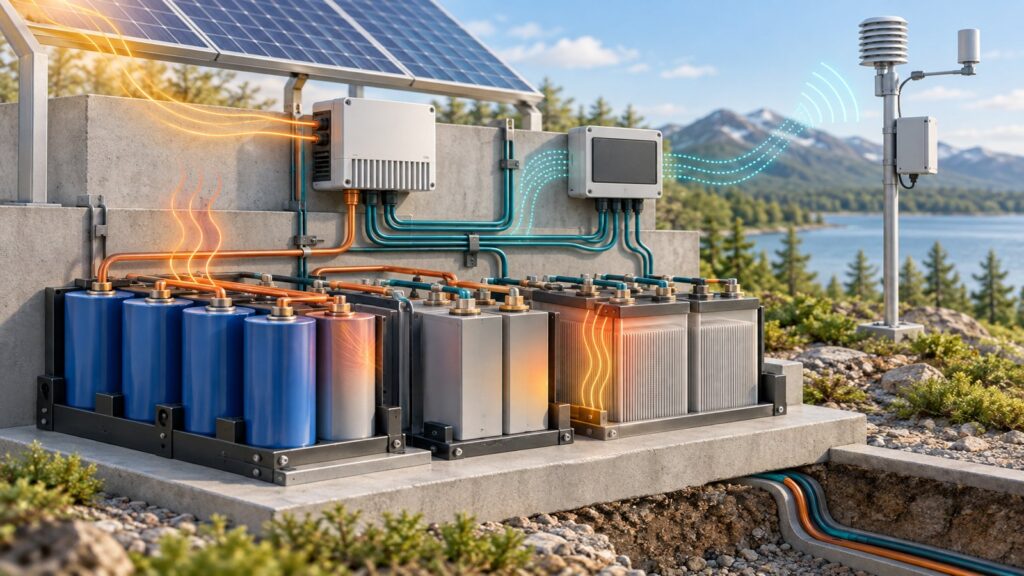
The telemetry station battery is usually the first thing to die in the field. Monsoon rains. Extreme dry seasons. Both are brutal. When a remote environmental monitoring station goes dark, people usually blame the cellular modem. They are wrong. The root cause is almost always the off-grid DC power system. It simply fails to supply enough current during transient voltage sags.
For O&M teams, replacing batteries every year in isolated locations is not just a waste of hardware. It is a logistical nightmare. Tropical climates push enclosure temperatures past 50°C. If you do not understand the electrochemistry of your battery, you will fail. This guide breaks down exactly why LiFePO4 (Lithium Iron Phosphate) and VRLA GEL destroy standard VRLA AGM in the field. We will also cover how to integrate a Smart Battery Management System (BMS) with environmental dataloggers to stop data blackouts before they happen.
VRLA Electrochemistry: AGM vs. GEL Under Heat
Valve Regulated Lead-Acid (VRLA) batteries have run off-grid solar deployments for decades. But internal cell architecture determines survival rates under heavy solar radiation. The market gives you two main options: AGM (Absorbent Glass Mat) and GEL.
VRLA AGM units suspend liquid sulfuric acid electrolyte in thin glass fiber mats. When operating temperatures rise, problems compound fast. These glass mats act as thermal insulators. Heat builds up at the lead plates during charging and high-current discharging. It gets trapped. It cannot dissipate out to the battery casing. The result? Localized hot spots. Accelerated positive plate grid corrosion. Gas venting through pressure valves. Eventual, fatal electrolyte dry-out. AGM is terrible at handling heat.
VRLA GEL batteries use fumed colloidal silica to bind the sulfuric acid electrolyte into a thixotropic gel. Heat transfer is fundamentally different here. The gel maintains physical contact with both the internal cell plates and the outer walls. This creates a direct conductive path. It dumps heat efficiently. No isolated hot spots. The semi-solid state of the gel also prevents acid stratification. Heavy acid will not settle at the bottom of the casing.
LiFePO4: Massive Gains in Cycle Life and Energy Efficiency
For remote telemetry, LiFePO4 (Lithium Iron Phosphate) completely outclasses legacy lead-acid. The secret is the chemistry. LiFePO4 uses a stable orthorhombic olivine crystal structure. It relies on strong covalent bonds between phosphorus and oxygen (P-O).
That structural integrity stops oxygen release even past 270°C. The battery is incredibly heat-resistant. It practically eliminates the risk of catastrophic thermal runaway. Forget the fires you see with high-voltage NMC or LCO lithium chemistries in electric vehicles. At normal operating ranges (25°C to 35°C), an industrial LiFePO4 pack yields 2,000 to 4,000 charge-discharge cycles at an 80% Depth of Discharge (DoD). This completely wrecks VRLA AGM. AGM degrades past usability in just 300 to 500 cycles at a shallow 50% DoD.
Internal resistance (IR) dictates performance under load. Industrial LiFePO4 packs maintain an ultra-low IR below 20 mΩ. Aging VRLA batteries regularly spike over 150 mΩ. Blame advancing sulfation and thermal corrosion. LiFePO4 also boasts a round-trip energy efficiency of 92% to 96%. VRLA crawls behind at 75% to 85%. That efficiency gap means LiFePO4 batteries absorb solar charging current fast. They hit full capacity within short two-to-three-hour solar windows.
Arrhenius Degradation, Heat Aging, and the Peukert Trap
Engineers designing remote DC power supplies face two major physical constraints. Thermal degradation inside enclosures. High transient pulse currents from RF telemetry.
Arrhenius Thermal Aging
Chemistry does not care about your budget. The Arrhenius chemical kinetics rate law states a simple rule. For every 10°C increase above nominal 25°C, destructive reaction rates inside a lead-acid battery double. A VRLA battery designed for 5 years at 25°C drops to 2.5 years at 35°C. At 45°C, it degrades to barely 15 months. In tropical regions, uncooled metal enclosures hit 45°C to 55°C daily. You are literally cooking the battery to death.
Burst Currents and the Peukert Trap
Data transmission requires power. Industrial 4G LTE-M modems, CAT-1 devices, and satellite transceivers pull brief pulse currents of 2 to 3 Amps when broadcasting. Peukert’s Law dictates that a battery’s effective capacity drops under a heavy load if its Peukert exponent is high.
VRLA batteries have a Peukert exponent of 1.15 to 1.30. An RF transmitter demands 3A. The VRLA battery is already weak from months of Partial State of Charge (PSoC) operations during the monsoon. The result is a sharp voltage sag. The voltage drops below 11.0V. The modem and solar controller trigger an automatic brownout cut-off. The station reboots endlessly. Field teams replace the modem. The modem was fine. The true culprit was a Peukert-induced voltage sag. LiFePO4 solves this. It has an extremely flat discharge curve and a nearly ideal Peukert exponent of 1.02 to 1.05. Its capacity stays rock-solid under high burst loads.
Engineering Decision Matrix: Comparing VRLA AGM, VRLA GEL, and LiFePO4
Determining the appropriate battery architecture requires a hard look at lifecycle calculations. The following engineering matrix evaluates VRLA AGM, VRLA GEL, and LiFePO4 across key measured parameters.
| Technical & Operational Parameter | VRLA AGM (Absorbent Glass Mat) | VRLA GEL | LiFePO4 (Lithium Iron Phosphate) |
|---|---|---|---|
| Cycle Life (80% DoD) | Low (≈ 200 – 300 cycles) | Moderate (≈ 500 – 600 cycles) | Very High (≈ 2,000 – 4,000+ cycles) |
| Enclosure Heat Tolerance (>40°C) | Poor (Dry-out & Thermal Runaway Risks) | Good (Stable Thermal Dissipation) | Excellent (Strong Crystal Structure, BMS mandatory) |
| Discharge Voltage Curve | Gradual linear drop | Gradual linear drop | Very flat (Stable at 12.8V – 13.2V) |
| Peukert Exponent (RF Pulse Loads) | 1.15 to 1.30 (Severe voltage drop) | 1.10 to 1.25 | 1.02 to 1.05 (Capacity holds under pulse load) |
| PSoC Tolerance (Monsoon Readiness) | Highly Vulnerable to Permanent Sulfation | Moderately Vulnerable | Immune to PSoC Sulfation |
| Energy Efficiency (Solar Charging) | ≈ 75% to 80% | ≈ 80% to 85% | ≈ 92% to 96% (Fast recovery) |
| Internal Resistance (New) | ≈ 30 to 50 mΩ | ≈ 40 to 60 mΩ | < 20 mΩ |
| Power Management Protection (BMS) | External Solar Controller Only | External Solar Controller Only | Mandatory Integrated Smart BMS |
| Initial Capital Expenditure (CAPEX) | Low | Moderate | High (2x to 2.5x AGM) |
| Total Cost of Ownership (5-Year TCO) | High (3-4 replacements + tech dispatch costs) | Moderate | Very Low (Eliminates field replacements) |
VRLA GEL and LiFePO4 both outclass AGM. If you are strapped for initial capital, GEL is an acceptable technical compromise. But there is a catch. Deploying VRLA GEL requires outdoor enclosures with double-roof solar radiation shields. You must keep internal temperatures below 30°C.
Smart BMS Integration and Field Recommendations
The real advantage of a LiFePO4 pack is the Smart BMS interface. Industrial BMS goes way beyond passive cell balancing. It cuts charge current if internal temperatures hit 55°C (per IEC 62619 standards). It immediately blocks short circuits. Your power system must enforce a recovery hysteresis threshold for Low Voltage Disconnect (LVD). For example, shed the load at 11.8V and reconnect only above 12.8V. Do this to prevent relay hunting from unloaded voltage rebound.
Continuous wastewater monitoring (SPARING), automatic water level recorders (AWLR), and remote water quality stations (ONLIMO) require absolute reliability. Monitoring battery health is not optional. It is a strict operational requirement. Integrate the Smart BMS via RS-485 Modbus RTU into the GEOVOS 1000 Datalogger. This feeds State of Charge (SoC), State of Health (SoH), individual cell voltages, and thermal conditions straight to the central dashboard. You see the failure coming weeks in advance.
Upgrading to LiFePO4 with Modbus RTU telemetry monitoring is the only rational move for industrial O&M programs. It wipes out unexpected hardware replacement costs. It stops data transmission failures dead. Do the math on your load requirements. Ensure your dataloggers can actually read smart field BMS data.
Share this article
Share this insight with your team.
Related Articles
Similar topics from the same category.

Monitoring station OPEX budget planning guide covering five cost pillars, cross-station comparison, hidden costs, and a modular worksheet for annual budgeting.

8 mandatory monitoring criteria for PROPER Blue rating under PermenLH 7/2025: SPARING, AQMS, B3, waste, peatland, mining, and SIMPEL audit.

Compare TDR and FDR soil moisture sensor principles, dielectric calibration limits for tropical peat, and multi-depth telemetry integration via GEOVOS 1000.