River Water Quality Standards PP 22/2021 × ONLIMO Sensor Selection: Technical Procurement and Alarm Guide
Map Indonesia's PP 22/2021 river water quality standards to sensor measuring ranges, detection limits, and alarm thresholds for ONLIMO procurement.
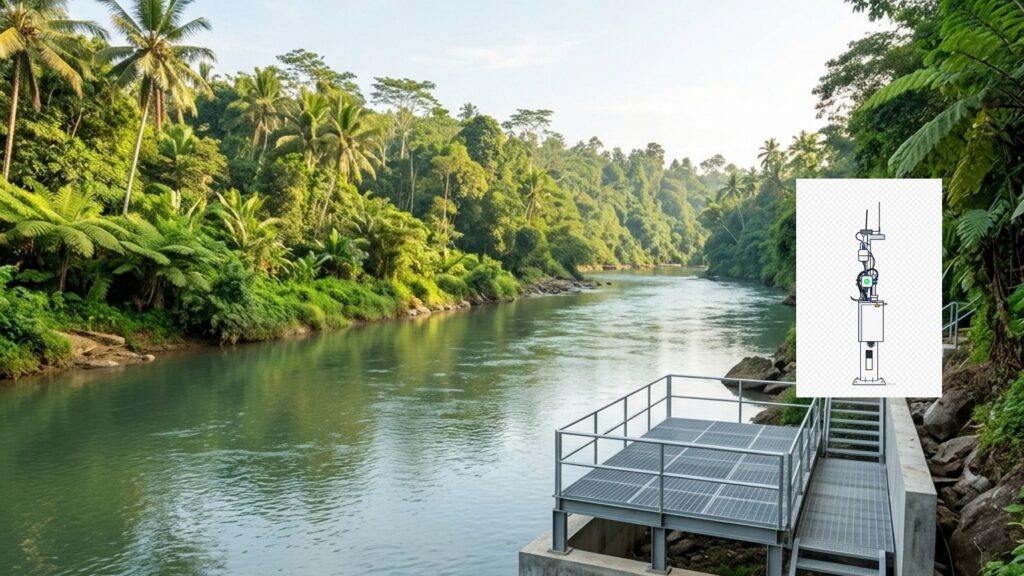
Indonesia’s river water quality standards PP 22/2021 split every national river body into four designated-use classes. Each class carries its own numeric thresholds for dissolved oxygen, organic load, suspended solids, and nutrients. Pick the wrong sensor specifications and the station cannot tell Class I drinking-water quality apart from Class II recreational water. Expensive telemetry hardware becomes a compliance liability. This guide maps PP 22/2021 Annex VI Part I thresholds directly to sensor measuring ranges, detection limits, optical path lengths, and multi-tier alarm logic so procurement teams can write defensible specifications for ONLIMO river monitoring stations.
Indonesia’s Four River Water Quality Classes Under PP 22/2021
Government Regulation (Peraturan Pemerintah) No. 22 of 2021 replaced the older PP 82/2001 framework and set four water quality classes for rivers and similar water bodies across Indonesia. Class I designates raw drinking-water sources. Class II covers recreational water, freshwater aquaculture, livestock watering, and crop irrigation. Class III permits aquaculture, livestock, and irrigation at relaxed thresholds. Class IV allows only agricultural irrigation.
Annex VI Part I assigns numeric limits to each class. Key parameters for online stations:
| Parameter | Class I | Class II | Class III | Class IV |
|---|---|---|---|---|
| pH | 6.0–9.0 | 6.0–9.0 | 6.0–9.0 | 6.0–9.0 |
| DO (min) | 6 mg/L | 4 mg/L | 3 mg/L | 1 mg/L |
| BOD (max) | 2 mg/L | 3 mg/L | 6 mg/L | 12 mg/L |
| COD (max) | 10 mg/L | 25 mg/L | 40 mg/L | 80 mg/L |
| TSS (max) | 50 mg/L | 100 mg/L | 100 mg/L | 400 mg/L |
| TDS (max) | 1,000 mg/L | 1,000 mg/L | 1,000 mg/L | 2,000 mg/L |
| Temperature | ±3 °C from ambient | ±3 °C | ±3 °C | ±3 °C |
| Nitrate | 10 mg/L | 10 mg/L | 20 mg/L | 20 mg/L |
The Director General of Pollution and Environmental Damage Control (Ditjen PPKL) under the Ministry of Environment and Forestry (KLHK) mandates continuous online monitoring through ONLIMO stations on priority watersheds, governed by Perdirjen PPKL No. P.8/2019. Data from these stations feeds the Water Quality Index (IKA), which drives Indonesia’s national Environmental Quality Index (IKLH) reported by regional governments.
Why Wastewater Sensors Fail at River Stations
The most common procurement mistake in Indonesian ONLIMO tenders is copying sensor specifications from industrial wastewater monitoring (SPARING) documents into river station requirements. The root cause is metrology mismatch.
A SPARING COD sensor typically covers 0–2,000 mg/L with a limit of detection (LOD) around 15–20 mg/L. That range handles factory effluent fine. It cannot tell a Class I river reading at 10 mg/L from a Class II reading at 25 mg/L because both values sit within or near the sensor’s noise floor. The datalogger records false-zero values or flatlined readings that hide early contamination signals upstream.
Same problem with DO. A polarographic Clark-cell probe consumes oxygen molecules during measurement. In slow-moving river segments during dry season, that consumption creates a localized oxygen-depleted boundary layer around the membrane. The probe reads artificially low. A station reporting 5.2 mg/L when actual concentration is 6.3 mg/L incorrectly trips a Class I violation alarm.
Tropical rivers pile on another problem. Natural suspended sediment, clay particles, and aggressive biofilm growth foul optical surfaces faster than pretreated industrial effluent. Sensors without automated cleaning mechanisms drift within weeks.
For a detailed comparison of SPARING and ONLIMO system architectures, see the difference between SPARING and ONLIMO guide.
Physicochemical Sensor Specifications: pH, Temperature, Conductivity, and Turbidity
pH
River stations need a glass combination electrode with an open-junction porous PTFE diaphragm and double-junction gel electrolyte reference. Open junctions resist clogging from fine silt that would seal a ceramic frit within days. The double-junction design isolates the internal reference from sample contamination, cutting junction potential drift. Measuring range should cover at least pH 0–14 with ±0.1 resolution, comfortably spanning the 6.0–9.0 band across all four classes.
Temperature
An RTD element (PT100 or PT1000) with ±0.1 °C to ±0.2 °C accuracy does two jobs. First, it monitors the ±3 °C deviation limit mandated by PP 22/2021 for all classes. Second, it feeds automatic temperature compensation (ATC) data to every other electrochemical and optical sensor in the probe assembly. Without a tightly calibrated temperature channel, pH, conductivity, and DO readings all pick up extra error.
Conductivity and TDS
A four-electrode conductivity cell or toroidal inductive sensor gets rid of electrode polarization artifacts common in variable-mineral river water. Minimum measuring range of 0–5,000 µS/cm with automatic compensation to the 25 °C reference standard covers TDS calculations for all four classes (1,000 mg/L for Classes I–III, 2,000 mg/L for Class IV). The conductivity-to-TDS conversion factor should be adjustable; mineral composition varies between watersheds.
Turbidity and TSS
Turbidity measurement uses 90° infrared scattered-light detection at 860 nm per ISO 7027-1:2016. This optical surrogate gives a continuous TSS estimate without gravimetric lab analysis. The catch: converting nephelometric turbidity units (NTU) to mass concentration (mg/L TSS) is site-specific. Each station needs an initial field calibration curve built by comparing sensor readings against laboratory gravimetric results from the same water body. Motorized wipers on the optical window are mandatory for tropical deployments.
Why Luminescent Optical DO Is Non-Negotiable for Rivers
Dissolved oxygen sits at the center of river quality assessment because its alarm logic runs inverted. Every other pollutant triggers when readings climb above a ceiling. DO triggers when readings drop below a floor (6 mg/L for Class I, 4 mg/L for Class II, 3 mg/L for Class III, 1 mg/L for Class IV).
Luminescent optical DO sensors (ASTM D888-18, Test Method C) measure oxygen through dynamic fluorescence quenching. A blue LED excites a luminophore coating. Oxygen molecules collide with the excited luminophore and shorten its emission decay time. More oxygen means faster quenching. Less oxygen means longer decay. The sensor reads phase shift, not consumed molecules.
That matters in the field. A polarographic or galvanic probe consumes oxygen at the membrane surface during measurement. In flowing water, fresh oxygen replaces what the probe takes. In slow or stagnant conditions (common in lowland Indonesian rivers during dry season) consumption outpaces replacement, and the probe reads artificially low. Luminescent probes consume zero oxygen and have zero flow dependency. They read accurately even in standing water.
Maintenance drops too. Optical DO probes need no electrolyte refills, no sacrificial anode replacement, and no fragile Teflon membranes. Calibration stability in freshwater holds for 6–12 months before field verification is needed.
For a deeper look at DO measurement physics, see dissolved oxygen saturation vs mg/L.
UV-Vis Spectrophotometry for Reagent-Free COD, BOD, and Nitrate Estimation
Standard BOD5 testing requires a five-day laboratory incubation period (SNI 6989.72). No sensor replicates that biological process in real time. Online COD and BOD values from river stations are optical surrogates derived from UV-Vis spectral absorption measurements. Procurement documents must state this distinction clearly.
An in-situ UV-Vis spectrophotometer probe scans across 200–750 nm wavelengths. Organic compounds absorb strongly at 254 nm (the spectral absorption coefficient SAC254, per DIN 38404-3). The probe runs multivariate correlation algorithms against a reference matrix to estimate COD equivalents. Simultaneous turbidity compensation at 550 nm or 700 nm strips particle-scattering interference from the organic absorption signal.
Optical path length selection matters more than most specs realize. For river water with low organic concentrations (Class I COD ≤ 10 mg/L, Class II ≤ 25 mg/L), the spectrophotometer needs a 5 mm or 10 mm path length to hit a LOD below 1 mg/L. Industrial wastewater spectrophotometers use 1–2 mm path lengths because high concentration would saturate a longer path. Put a short-path industrial probe on a river station and you get the same metrology blind spot as the COD range mismatch described earlier.
The UV-Vis probe also picks up nitrate (NO3-N) simultaneously through spectral deconvolution in the 210–220 nm range. This optical approach delivers more stable readings in open water than ion-selective electrodes, which suffer from chloride interference and temperature drift.
Multi-Tier Alarm Architecture Based on Designated Water Class
An ONLIMO station without properly configured alarm thresholds records data. It does not warn anyone. The alarm architecture should follow a two-level design tied directly to the station’s designated water quality class.
Level 1, Warning (Pre-alarm): Set at 80–85% of the PP 22/2021 threshold for the station’s designated class. For a Class II station monitoring COD (limit 25 mg/L), the warning fires at roughly 20–21 mg/L. That gives upstream response teams time to investigate before a regulatory exceedance hits.
Level 2, Critical Exceedance: Set at 100% of the statutory limit. A COD reading at or above 25 mg/L at a Class II station trips the critical alarm, flagging a regulatory breach.
Inverted DO alarm: Because DO uses a minimum threshold instead of a maximum, the alarm logic flips. A Class I station sets its critical alarm at DO ≤ 6 mg/L and its warning at roughly 7.0–7.5 mg/L (about 115–125% of the minimum). Configure the datalogger comparison operator as less-than-or-equal, not greater-than.
Persistence filter (debounce): Air bubbles, floating debris, and transient hydraulic turbulence spike readings for seconds to minutes. A datalogger that triggers alarms on every single-cycle exceedance floods operators with false positives. Set a persistence counter requiring at least three consecutive measurement cycles above (or below, for DO) the threshold before validating the alarm. This debounce window kills noise without delaying genuine contamination detection.
Station Installation, Anti-Fouling Protection, and GEOVOS 1000 Telemetry
Deployment method
ONLIMO stations use either direct immersion (in-situ probe in a perforated protective pipe within the river channel) or an ex-situ flow cell (a submersible pump draws river water into a measurement chamber inside a shore-side shelter). The flow cell approach gives better protection against flood-borne debris, log impacts, and extreme water level swings.
Anti-fouling systems
Every optical probe (turbidity, DO, and UV-Vis) needs an automated cleaning mechanism that runs before each measurement cycle. Motorized wiper blades are standard for turbidity and DO. UV-Vis probes may use compressed air-blast systems. Skip these, and biofilm in tropical waters builds fast enough to shift optical readings by 10–30% within two weeks.
Power and telemetry
Remote watershed locations need autonomous solar-powered operation. The Fortuna Argatech Datalogger GEOVOS 1000 provides galvanically isolated RS-485 Modbus RTU and SDI-12 ports for sensor integration, intelligent solar charge management with LiFePO4 battery autonomy of 3–5 days, and non-volatile store-and-forward memory to buffer data during cellular outages. The system supports automatic transmission to the Ditjen PPKL KLHK data server. Water level monitoring can be added by pairing a radar-based Automatic Water Level Recorder (AWLR) with the station.
The Fortuna Argatech ONLIMO system has passed the KLHK connectivity verification test (reference: KT.142/PPA/PPPMA/PKL.2/12/2022), confirming protocol compliance with the KLHK central data server.
Procurement Specification Checklist for ONLIMO Tender Documents
A technically sound Terms of Reference (Kerangka Acuan Kerja / KAK) for an ONLIMO river station procurement in Indonesia should include these minimum specification items:
- Target water class declaration — State the PP 22/2021 designated class. Every sensor range, LOD, and alarm threshold derives from this choice.
- Measuring range matched to class — COD sensor range must resolve at least 0.5 mg/L increments at the class ceiling (e.g., 0–100 mg/L with LOD < 1 mg/L for Class I/II river stations, not 0–2,000 mg/L).
- DO sensor technology — Specify luminescent optical method per ASTM D888-18. Reject polarographic or galvanic probes for unattended river deployment.
- UV-Vis optical path length — Require 5 mm or 10 mm path length for ambient water monitoring. Document the distinction from 1–2 mm industrial path lengths.
- Anti-fouling mechanism — Mandate motorized wiper blades or compressed air-blast on all optical probes. Specify cleaning cycle interval (minimum once per measurement cycle).
- Turbidity-to-TSS calibration — Require site-specific empirical calibration at each station using local sediment samples analyzed against laboratory gravimetric results per ISO 7027-1:2016.
- Multi-tier alarm configuration — Include warning and critical thresholds per class, inverted DO alarm logic, and a minimum three-cycle persistence filter.
- Telemetry and data integrity — Require store-and-forward non-volatile memory, galvanic isolation, and demonstrated KLHK connectivity test compliance.
- Solar power autonomy — Minimum 3-day battery autonomy during overcast conditions with intelligent charge management for LiFePO4 cells.
- KLHK connectivity certification — Require documented proof of passing the Ditjen PPKL connectivity verification test for data transmission protocol compliance.
Getting sensor specification right at the procurement stage determines whether an ONLIMO station produces legally defensible water quality data or generates noise. The regulatory thresholds in PP 22/2021 are not abstract numbers. They are the engineering constraints that set every sensor’s measuring range, detection limit, optical path geometry, and alarm boundary. Build the specification around the target water class, and the station works. Copy it from an industrial wastewater tender, and the data fails before the first calibration check.
Sources: PP No. 22/2021 Annex VI Part I (JDIH BPK RI), Perdirjen PPKL P.8/2019, ASTM D888-18, ISO 7027-1:2016, US EPA Selection of OWQM Technologies (EPA 600-R-17-024).
Share this article
Share this insight with your team.
Related Articles
Similar topics from the same category.

Monitoring station OPEX budget planning guide covering five cost pillars, cross-station comparison, hidden costs, and a modular worksheet for annual budgeting.

8 mandatory monitoring criteria for PROPER Blue rating under PermenLH 7/2025: SPARING, AQMS, B3, waste, peatland, mining, and SIMPEL audit.

Permen LHK 14/2024 ties SPARING telemetry to daily administrative fines. Understand the formula, sensor risks, and edge validation defense.