HPAL Nickel Smelter Effluent Monitoring: Permen LH 9/2006 Compliance, Cr(VI) ORP Control, and SPARING Telemetry
How HPAL nickel smelters build wastewater monitoring systems meeting Permen LH 9/2006, control Cr(VI) via ORP, and transmit to SISPEK.
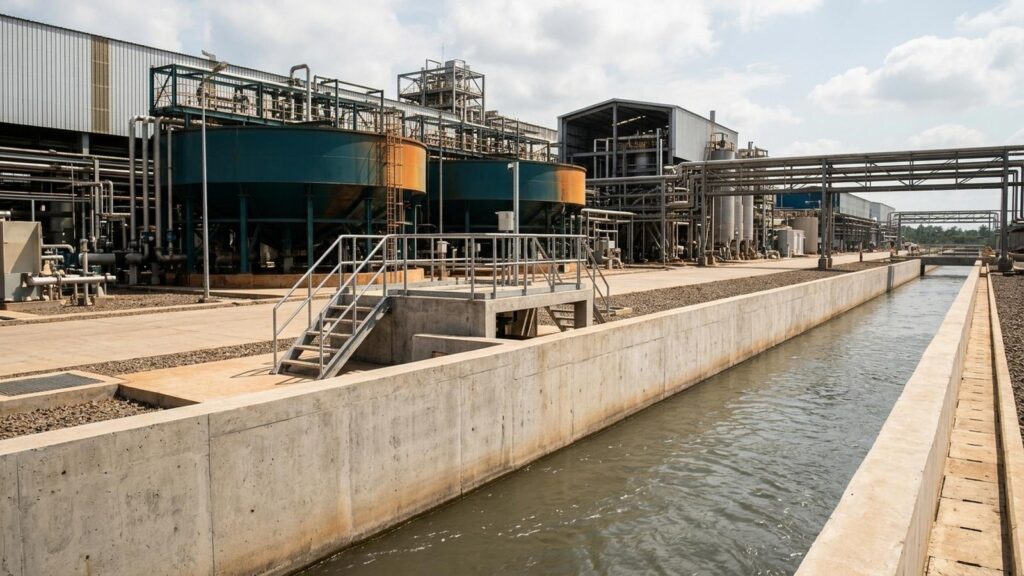
Indonesia’s laterite nickel downstreaming boom put High Pressure Acid Leach (HPAL) technology at the center of the global EV battery supply chain. The same autoclaves that pull nickel and cobalt from low-grade limonite ore also produce one of the mining sector’s nastiest effluent streams: sulfuric acid slurry at pH 1.0 to 2.0, sulfate loads above 10,000 mg/L, dissolved heavy metals including carcinogenic hexavalent chromium. Under Permen LH No. 09/2006, smelter outfalls face tight discharge ceilings. Permen LHK No. 14/2024 now lets regulators issue administrative fines up to IDR 3 billion per violation based on continuous telemetry records alone. HPAL nickel smelter wastewater monitoring isn’t optional engineering anymore. It’s a legal survival requirement.
Below: the process chemistry, regulatory limits, instrumentation problems, and telemetry architecture that smelter operators at Morowali, Weda Bay, Obi Island, and Pomalaa need to get right.
What Makes HPAL Effluent So Difficult to Treat
HPAL technology forces sulfuric acid through laterite ore at temperatures above 245 °C and pressures of 4–5 MPa. What comes out is brutal. The discharge carries free acid at pH 1.0–2.0, sulfate above 10,000 mg/L, and a long list of dissolved metals: iron, aluminum, nickel, cobalt, manganese, magnesium, chromium.
Chromium is the one that’ll keep you up at night. Laterite ore contains ultramafic chromite minerals (FeCr₂O₄). During leaching and downstream oxidation, some of that chromium converts to hexavalent chromium, Cr(VI), a known carcinogen. Cr(VI) dissolves as chromate or dichromate anions that stay stubbornly soluble even in alkaline conditions. Unlike trivalent metals that precipitate as hydroxides when you raise pH, Cr(VI) passes straight through a lime neutralization step and into the receiving water body.
The bottom line: HPAL effluent is far more hazardous than conventional acid mine drainage. You need a multi-stage treatment train with precision instrumentation at every step.
Regulatory Limits: Permen LH 9/2006 Discharge Standards for Nickel Processing
Indonesian law is specific. Under Permen LH No. 09/2006 (Processing Annex), nickel processing facilities must hold final outfall concentrations within these ceilings:
| Parameter | Maximum Limit | Unit |
|---|---|---|
| pH | 6–9 | — |
| TSS | 100 | mg/L |
| Nickel (Ni) | 0.5 | mg/L |
| Hexavalent Chromium Cr(VI) | 0.1 | mg/L |
| Total Chromium (Cr) | 0.5 | mg/L |
| Iron (Fe) | 5 | mg/L |
| Cobalt (Co) | 0.4 | mg/L |
| Copper (Cu) | 2 | mg/L |
| Cadmium (Cd) | 0.05 | mg/L |
| Zinc (Zn) | 5 | mg/L |
| Lead (Pb) | 0.1 | mg/L |
Mining vs. processing matters. Mining operations get a TSS allowance of 200 mg/L; smelters and HPAL plants face the stricter 100 mg/L cap. COD and BOD aren’t listed in Permen LH 9/2006 for nickel processing, but site-specific Environmental Permits (AMDAL/RKL-RPL) or receiving water body standards under PP No. 22/2021 may still require them.
Here’s where it gets expensive. Permen LHK No. 14/2024 introduced a penalty formula (DA = UBP × TD × W) that calculates administrative fines from continuous telemetry data. Regulators can impose these fines through Indirect Routine Supervision, no physical inspection needed. Any outfall breach recorded by SPARING telemetry becomes grounds for enforcement. Persistent non-compliance also disqualifies a facility from achieving PROPER Blue rating under Permen LH No. 7/2025, which directly affects operational permits.
Why Cr(VI) Reduction Demands ORP Control at Acidic pH
The 0.1 mg/L hexavalent chromium limit is the single hardest parameter for HPAL plants to meet. Many operators get the chemistry wrong.
A common mistake: pumping raw acid effluent directly into a lime neutralization tank, expecting that raising pH to 8.5 will precipitate everything. It won’t. Cr(VI) exists as a dissolved anion. It doesn’t form an insoluble hydroxide the way Cr(III) does. Raise pH alone and chromate ions stay in solution. Outfall fails.
You need a dedicated reduction reactor upstream of neutralization. Chemical reductants (sodium metabisulfite Na₂S₂O₅, sulfur dioxide SO₂, sodium bisulfite NaHSO₃, ferrous sulfate FeSO₄) convert Cr(VI) to Cr(III). This reaction only runs at practical speed when pH sits between 2.0 and 3.0. Above pH 4.0, kinetics slow to a crawl, wasting reductant chemicals and demanding impractically long retention times.
Continuous ORP (oxidation-reduction potential) sensors are the process control backbone here. The instrumentation system feeds reductant dosing based on real-time ORP feedback, holding the setpoint between +250 and +300 mV (vs. Ag/AgCl reference). Once ORP confirms complete reduction, the now-trivalent chromium flows into neutralization, precipitating as Cr(OH)₃ at pH values above 7.5.
Skip this ORP-controlled reduction step and no amount of lime will bring Cr(VI) below the regulatory ceiling.
Two-Stage Lime Neutralization and the Gypsum Scaling Problem
After chromium reduction, the effluent still carries extreme acidity and dissolved metals across the periodic table. Two-stage neutralization handles both.
Stage 1: Limestone (CaCO₃) raises pH to 3.5–4.5. Iron (Fe³⁺) and aluminum (Al³⁺) precipitate as stable hydroxide solids at this range. Using limestone first instead of hydrated lime cuts reagent costs by 50–70% and produces denser, easier-to-dewater sludge.
Stage 2: Hydrated Lime (Ca(OH)₂) pushes pH to 7.5–8.5, precipitating nickel, cobalt, zinc, and Cr(III) hydroxides. Precision matters. Above pH 8.5, amphoteric compounds like aluminum hydroxide can re-dissolve back into the liquid phase. You need to hold outfall pH within the 7.5–8.5 corridor, safely below the regulatory upper limit of 9.0.
Now the gypsum problem. Neutralizing sulfuric acid with calcium compounds produces calcium sulfate dihydrate (CaSO₄·2H₂O). When sulfate loads exceed 10,000 mg/L, gypsum supersaturation is massive. Crystals form fast. They deposit thick scale on reactor walls, pipe interiors, sensor electrodes, everything exposed.
Standard commercial pH sensors with convex glass bulbs and ceramic micro-junctions fail within days here. Laterite particles grind the glass. Sulfuric acid attacks the reference electrolyte bridge. Gypsum crystals plug the junction. Measurement dies. Any continuous monitoring strategy for HPAL effluent has to deal with all four of these attack vectors.
Selecting Sensors That Survive HPAL Conditions
Picking sensors for HPAL outfall monitoring is an engineering decision, not a catalog exercise. The environment demands specific material choices for corrosion and scaling resistance.
pH sensors need titanium, PVDF, or Hastelloy C-276 bodies to resist sulfuric acid corrosion. Flat-glass electrodes outperform convex designs because they shed laterite particles and gypsum deposits more effectively, and they tolerate mechanical cleaning. The reference system needs double or triple PTFE porous junctions to block heavy metal ion poisoning and gypsum infiltration.
ORP sensors in the acidic reduction reactor face the same corrosion challenges plus high dissolved metal loads. Industrial-grade ORP electrodes with dual-junction, poison-resistant reference systems hold stable readings where standard probes drift within hours.
TSS sensors based on infrared light scattering (860 nm, ISO 7027) with sapphire optical windows resist abrasion from laterite slurry particles. Automatic wiper mechanisms keep the optical path clear between measurement cycles.
One rule across all sensor types: automatic cleaning is mandatory. Motorized wipers or programmed jet-wash cycles using dilute acid solution clear gypsum deposits at regular intervals without stopping operations. Skip the cleaning step and you’ll get false exceedance readings, premature sensor response time degradation, and enforcement action you could have prevented.
SPARING Station Architecture: Datalogger GEOVOS 1000 and SISPEK Integration
Under Permen LHK No. P.80/2019 (jo P.93/2018), nickel smelters must operate a continuous wastewater quality monitoring system (SPARING) at the compliance outfall, transmitting data directly to KLHK’s SISPEK server with a minimum data completeness (uptime) of 85%.
Fortuna Argatech builds integrated SPARING stations around the Datalogger GEOVOS 1000 platform. The architecture connects titanium-body pH sensors, industrial ORP electrodes, optical TSS sensors, and AWLR (Automatic Water Level Recorder) level sensors for neutralization ponds and settling basins. Communication runs through RS-485 Modbus and 4–20 mA analog inputs.
The GEOVOS 1000 applies edge computing algorithms that solve a problem most operators overlook: wiper gating. When automatic cleaning cycles run, sensors produce erratic readings. The datalogger freezes data transmission during cleaning intervals, validates signal stability, then resumes sending to SISPEK. This prevents false breach alarms that could trigger regulatory penalties.
The edge intelligence also covers sensor drift detection and alarm persistence filtering. A digital output relay can trigger a refrigerated (4 °C) automatic water sampler when parameters approach or exceed thresholds, capturing physical evidence samples for independent ISO/IEC 17025 laboratory verification. During enforcement proceedings, those samples are your legal defense.
Multi-network telemetry (4G LTE with satellite or LoRaWAN fallback) keeps data flowing from remote smelter sites across Sulawesi, Maluku, and Halmahera, where single-carrier cellular coverage is unreliable.
AWLR level monitoring at neutralization ponds and settling basins (KPL) provides early warning against overflow events during intense tropical rainfall. This is a real risk at Indonesian mining operations. A single overflow can release thousands of cubic meters of untreated acidic water into coastal ecosystems.
Building a Defensible Monitoring Architecture
HPAL smelters operate under a regulatory framework that ties financial penalties directly to continuous monitoring data. Cr(VI) doesn’t respond to shortcuts. Gypsum scaling doesn’t pause for maintenance windows. SISPEK doesn’t accept excuses for data gaps.
A defensible monitoring architecture starts at the reduction reactor with ORP-controlled Cr(VI) conversion, continues through precision-controlled two-stage neutralization, and depends on sensor hardware engineered for sulfuric acid and gypsum conditions. Edge-intelligent data logging that filters cleaning artifacts before transmission closes the loop.
Fortuna Argatech provides the integrated SPARING monitoring technology for this environment: corrosion-resistant analytical sensors, automatic cleaning systems, the GEOVOS 1000 datalogger with SISPEK-compliant telemetry, all purpose-built for Indonesia’s nickel downstreaming sector. If you’re planning a new outfall station or upgrading existing instrumentation, contact Argatech’s technical team for an engineering consultation.
Share this article
Share this insight with your team.
Related Articles
Similar topics from the same category.
Wire datalogger relay pulses to refrigerated autosamplers at SPARING outfalls. Persistence filters, 4 °C preservation, and ISO 17025 Chain of Custody.
A technical guide comparing UV absorption spectrophotometry and ISE probes for online nitrate monitoring in rivers, ONLIMO stations, and industrial wastewater.

An Industrial AQMS Sensor is required to avoid factory closures due to strict air pollution laws. Learn how Fortuna Argatech provides the ultimate solution.