Engineering Acid Mine Drainage Monitoring in Settling Ponds for SPARING Compliance
Acid mine drainage monitoring guide: pH/TSS sensor hardening, manganese dosing, Parshall flume flow, and SPARING telemetry for coal mining.
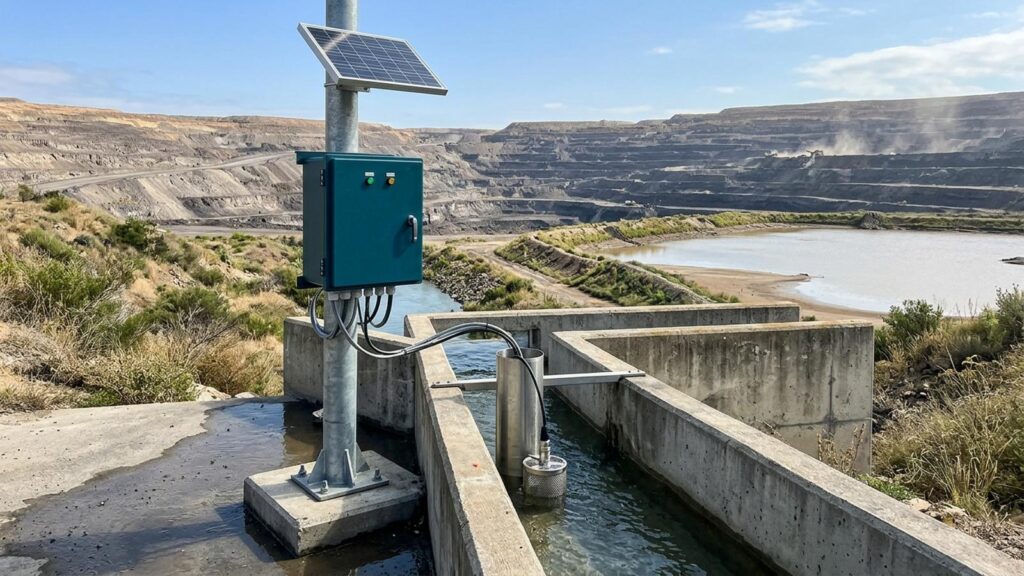
Acid mine drainage monitoring at Indonesian coal operations breaks down fast. Standard instruments hit water at pH 2–4, dissolved iron starts precipitating ferric hydroxide scale within hours, and the sensors go blind. The real problem is regulatory. Kepmen LH 113/2003 sets effluent limits at pH 6–9, TSS 400 mg/L, total iron 7 mg/L, and total manganese 4 mg/L for mining discharge. Permen LHK 80/2019 then requires continuous online transmission of pH, TSS, and flow data to the Ministry of Environment and Forestry (KLHK) every hour. Miss the transmission window or blow the limits, and the operation faces sanctions up to permit suspension. What follows covers the engineering decisions that keep acid mine drainage monitoring systems running at settling pond outfalls.
AMD Geochemistry and Indonesian Regulatory Framework
Pyrite oxidation drives everything. When FeSâ‚‚ contacts oxygen and water, the reaction produces sulfuric acid and ferrous iron. Mine water pH drops to 2–4. Neutralization with lime or calcium hydroxide then triggers rapid oxidation of Fe²⺠to Fe³âº, which hydrolyzes into amorphous ferrihydrite. Miners call it “yellow boy,†that orange-yellow coating. The same chemistry that treats the water wrecks unprotected sensors.
Indonesian regulation works on two tracks. Kepmen LH 113/2003 sets the effluent quality standards: pH 6–9, TSS ≤ 400 mg/L, Fe ≤ 7 mg/L, Mn ≤ 4 mg/L for coal mining discharge. Coal washing facilities face a tighter TSS limit of 200 mg/L. Kepmen ESDM 1827/2018 requires daily monitoring at the compliance point before discharge enters public water bodies.
Permen LHK 80/2019 adds the telemetry mandate. Mining sectors (coal, gold, copper, nickel) must install SPARING systems measuring pH (0–14 range), TSS (0–2,000 mg/L range), and flow at capacities matching maximum outfall discharge. Data transmits automatically to KLHK servers at minimum hourly intervals. The regulation does not specify how to pull this off in acid mine drainage conditions. That gap is where operations lose compliance.
Iron Scaling (Yellow Boy) and Sensor Failure Modes
Ferrihydrite precipitation is aggressive. At neutral pH, amorphous Fe(OH)₃ coats every wetted surface within 24–72 hours. Conventional ceramic-junction pH electrodes clog first. The porous diaphragm that completes the reference cell circuit plugs with iron oxide, isolating the reference electrolyte. Response time stretches from seconds to minutes, readings drift by >1 pH unit, and the sensor goes dead for all practical purposes.
Optical TSS sensors fail in parallel. The ISO 7027 nephelometric principle relies on an 860 nm light path through a sapphire or glass window. Ferrihydrite films and settled sludge on that window scatter light before it reaches the sample. The sensor reports falsely elevated turbidity that correlates to nothing real.
Material selection matters throughout the acid zone. Carbon steel and 304 stainless pit and fail. Titanium Grade 2, PVDF, PTFE, and polyurethane survive. Every mounting bracket, sensor body, and cable gland needs material specification review before procurement. Skip this step and you will be replacing hardware within weeks.
pH and TSS Sensor Engineering: Open-Junction, Flat-Glass, Auto-Wiper
Sensor selection for acid mine drainage determines whether you get data or downtime. Three design features separate working pH electrodes from scrap.
Flat-glass membrane profile. Bulb-style glass membranes trap precipitate in the curved surface geometry. Flat glass sheds scale mechanically and cleans without shadow zones. It is a simpler surface, and simpler survives.
Annular polymer junction with open porosity. PTFE or similar porous polymer diaphragms resist clogging because the pore structure lacks the tortuous ceramic paths where ferrihydrite nucleates and grows. The open junction maintains electrolytic contact even when partially fouled.
Double-junction gel polymer electrolyte. A secondary reference chamber buffers the primary Ag/AgCl reference from sulfide poisoning and iron contamination. The gel matrix eliminates liquid junction potential drift and refill maintenance.
For TSS, ISO 7027 nephelometry at 860 nm is the standard. But the optical window demands active cleaning. A mechanical wiper blade, programmed to sweep before each measurement cycle, removes ferrihydrite film and settled solids. Ultrasonic cleaning helps but cannot replace mechanical action for heavy sludge. The wiper schedule must match the measurement interval. Scheduled wiper cycles matched to site conditions keep the window clear. High-sludge events may demand more frequent sweeps.
Both sensor types need integrated temperature compensation. Acid mine drainage temperature swings from pre-dawn chill to midday solar heating shift pH readings significantly without automatic temperature compensation (ATC).

The Manganese Dilemma: Dosing Control Within pH 6–9 Limits
Manganese creates a regulatory trap. Dissolved Mn²⺠oxidizes to MnO₂ effectively only above pH 9.0–9.5 without strong chemical oxidants like permanganate or chlorine. But Kepmen LH 113/2003 caps effluent pH at 9.0. Push pH high enough to precipitate manganese and you risk violating the upper limit, unless the water is re-acidified before the compliance point.
Closed-loop dosing control handles this. Continuous pH monitoring at the neutralization reactor outlet feeds a PID controller driving lime slurry injection pumps. The controller targets a reactor pH high enough for manganese oxidation—a target range around pH 8.5–8.8 depending on site-specific conditions—while a downstream pH probe at the final outfall verifies the effluent stays ≤ 9.0 after any re-acidification or CO₂ stripping. Real-time data prevents both under-dosing (manganese breakthrough) and over-dosing (pH violation, reagent waste).
This requires two things the regulation does not explicitly name: redundant pH measurement points and automated actuation. Manual jar tests and periodic grab samples cannot track the kinetics of manganese oxidation in variable flow. The SPARING mandate for continuous pH data makes closed-loop control feasible, provided the sensors survive the chemistry.
KPL Outfall Flow Measurement: Self-Cleaning Parshall Flume vs Non-Contact Radar
Flow measurement at settling pond outfalls fails on sediment. Conventional V-notch weirs (ISO 1438) act as sediment traps. Sludge accumulates upstream, raising the zero datum and shifting the stage-discharge curve. Errors of 20–30% show up within weeks of commissioning.
Parshall flumes (ISO 9826 / ASTM D1941) solve this hydraulically. The converging throat accelerates flow to supercritical velocity, creating a self-cleaning scour that keeps sediment in suspension through the measurement section. The head measurement point (Ha) sits upstream in the converging section, clear of the throat where solids concentrate. Properly sized for the design flow range, a Parshall flume holds reliable accuracy with minimal maintenance.
Where civil construction for a flume is impractical (retrofit sites, temporary discharge points, deeply incised channels) non-contact radar provides an alternative. Surface velocity radar (24 GHz) paired with a radar level meter (26 GHz or 80 GHz FMCW) calculates discharge via the velocity-area method without any wetted components. Acid corrosion and abrasive wear become non-issues. The tradeoff: radar requires a stable hydraulic profile and sufficient straight run for velocity profiling. Turbulent, aerated, or highly variable cross-sections degrade accuracy.
For new KPL designs, the Parshall flume with ultrasonic or radar level sensing at Ha remains the primary recommendation. For retrofits, the radar velocity-area system avoids excavation and concrete work.
Off-Grid Telemetry Architecture: GEOVOS 1000 Datalogger and Solar Power
Settling ponds sit in open pits. Grid power is kilometers away and cellular coverage is spotty at best. The telemetry station must generate, store, and manage its own power while keeping data intact through connectivity gaps.
The Fortuna Argatech SPARING mining system uses the GEOVOS 1000 datalogger as the edge controller. Galvanically isolated RS-485 Modbus RTU and SDI-12 ports protect the processor from lightning-induced transients and ground potential rise, both common in open-pit environments where the station is the tallest grounded object for kilometers.
Store-and-forward memory buffers every SPARING parameter (pH, TSS, flow, plus diagnostic channels) during cellular outages. When connectivity restores, the logger transmits the complete gap-free record to the KLHK server automatically. No manual intervention. No data loss.
Power comes from a photovoltaic array sized for the site’s worst-month solar insolation, charging LiFePO₄ batteries with 3–5 days of autonomy. LiFePO₄ chemistry tolerates the temperature extremes of Indonesian open pits better than VRLA: longer cycle life, no thermal runaway risk. The enclosure carries IP66/NEMA 4X rating with industrial lightning protection on all field wiring entries.
This architecture delivers the >95% uptime that KLHK audits verify. It also supports remote firmware updates, configuration changes, and diagnostic access. That matters when the nearest technician is a four-hour drive away.
Preventive Maintenance Protocol and Field Calibration
Even hardened instruments need scheduled attention. Here is a field protocol that maintains >95% data uptime.
Weekly: Visual inspection of sensor wipers, flume approach section, and solar panel soiling. Verify cellular signal strength and battery voltage at dawn.
Biweekly: pH electrode chemical cleaning. Remove the probe, soak the sensing end in 5–10% HCl for 5–10 minutes to dissolve ferrihydrite, rinse thoroughly with deionized water, then recondition in 3.8 M KCl solution until the electrode stabilizes before reinstallation. Check buffer calibration against standard NIST-traceable buffers (pH 4, 7, and 10 as applicable).
Monthly: TSS sensor window inspection and wiper blade condition check. Replace worn blades. Verify optical zero against clean water reference.
Quarterly: Full multipoint pH calibration (three buffers minimum). Flow verification at the flume or radar cross-section: compare logger reading against manual current meter or bucket-and-stopwatch at low flow. Battery capacity test under load.
Annually: Electrode replacement (pH glass membranes degrade irreversibly). Flume geometry survey for settlement or erosion. Lightning protection grounding resistance test (verify site-specific threshold per local standards).
Document every action in the station log. KLHK audits check for maintenance records matching the SPARING data stream. A missing calibration entry is a compliance finding.
The engineering decisions compound. Flat-glass pH with open junction survives the chemistry. Mechanical wiper on TSS optics keeps the light path clear. Parshall flume hydraulics reject sediment. Solar-powered GEOVOS 1000 with store-and-forward keeps data flowing. Together they form a system that meets Kepmen LH 113/2003 limits and Permen LHK 80/2019 transmission mandates without daily babysitting.
Each subsystem decision connects to the others. A Parshall flume that scours sediment also delivers a stable hydraulic profile for the radar level sensor measuring head at Ha. The GEOVOS 1000 galvanic isolation protects the logger and every Modbus-connected sensor on the bus from a single lightning event. LiFePO₄ battery autonomy of 3–5 days means a week of overcast monsoon skies does not silence the station. The mechanical wiper on the TSS probe prevents false-high readings that would trigger unnecessary lime overdosing, closing the loop on reagent waste.
For operations specifying new or upgrading existing acid mine drainage monitoring, the Fortuna Argatech SPARING mining integration packages hardened sensors, flume or radar flow options, and the GEOVOS 1000 telemetry core into a single warranted system. The alternative is piecing together components that were never tested in pH 3 water with 200 mg/L iron, then learning the failure modes during a compliance audit.
Share this article
Share this insight with your team.
Related Articles
Similar topics from the same category.
Monitoring station OPEX budget planning guide covering five cost pillars, cross-station comparison, hidden costs, and a modular worksheet for annual budgeting.

8 mandatory monitoring criteria for PROPER Blue rating under PermenLH 7/2025: SPARING, AQMS, B3, waste, peatland, mining, and SIMPEL audit.

Compare TDR and FDR soil moisture sensor principles, dielectric calibration limits for tropical peat, and multi-depth telemetry integration via GEOVOS 1000.