5 Fatal Mistakes During Weather Sensor Installation in Plantations
Master the exact technical guidelines and strictly avoid the 5 most fatal mistakes during Weather Sensor Installation in commercial agricultural fields.
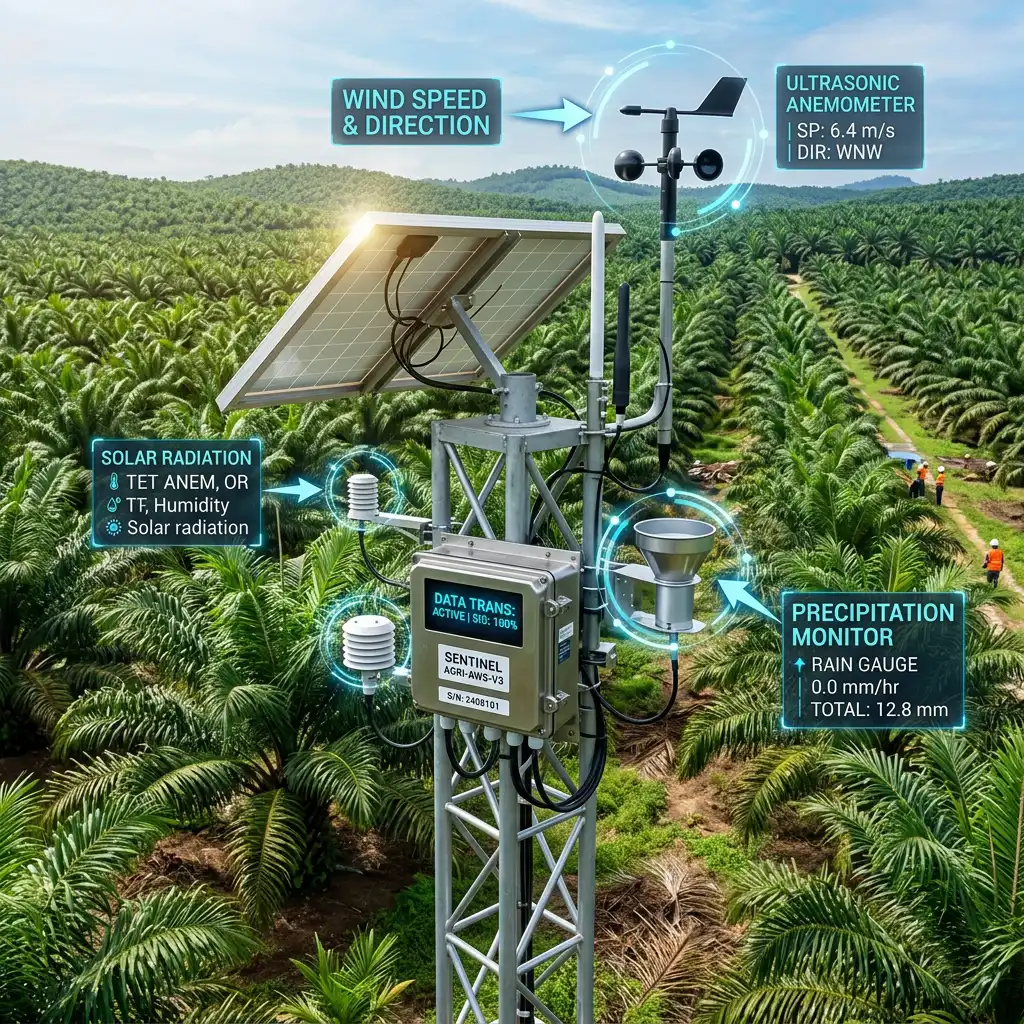
Owning a highly advanced Automatic Weather Station (AWS) is an incredibly brilliant business investment for managers overseeing massive palm oil plantations and commercial agricultural sectors. Highly accurate climatic data permanently empowers the corporation to securely determine precise irrigation schedules, aggressively predict pest outbreak potentials, and flawlessly prevent harvest failures. However, no matter how remarkably expensive your telemetry technology is, all that gathered data instantly becomes utterly useless garbage if you commit fatal technical errors during the physical Weather Sensor Installation process out in the field.
Countless massive companies completely waste hundreds of millions of rupiah simply because they lazily placed the telemetry tower in the entirely wrong location or carelessly ignored strict electrical wiring guidelines. If the instrument records fundamentally flawed rainfall data, the subsequent agronomic decisions executed will absolutely result in devastating financial losses.
Operating as the absolute leading experts in environmental compliance and advanced telemetry, Fortuna Argatech has strictly compiled the top five most catastrophic errors you must ruthlessly avoid when executing a Weather Sensor Installation across your operational sites.
1. Mounting the Anemometer Obstructed by Tall Trees
The absolute most classic error encountered during Weather Sensor Installation is securely positioning the monitoring tower directly adjacent to physical buildings or heavily buried underneath the dense canopy of towering trees. The anemometer (the delicate sensor explicitly designed to accurately measure wind speed and direction) demands a massively expansive open space allowing the wind currents to blow freely without encountering physical friction. If this specific sensor is severely shielded by massive palm oil leaves, the recorded wind velocity transmitted to the data logger will constantly read significantly lower than reality. The strict global operational standards recommended by the WMO legally require the anemometer to be precisely mounted at an exact height of ten meters in a completely unobstructed open field.
2. Completely Ignoring the Solar Panel Tilt Angle
Remote telemetry systems actively operating in deeply isolated plantation fields rely entirely on a rugged solar panel serving as the primary electrical energy source. The second fatal error frequently committed is carelessly installing the solar panel completely flat horizontally or aiming it precisely toward an area heavily choked by tree shadows during the late afternoon. The solar panel must always be accurately aimed completely straight toward the equator line utilizing an exact tilt angle ranging strictly between 10 to 15 degrees. This specific mathematical angle flawlessly maximizes raw energy absorption while naturally allowing heavy rainwater to effortlessly wash away accumulated dust dirt.
3. Exposing the Temperature Sensor to Direct Thermal Radiation
The highly sensitive ambient air temperature and relative humidity (RH) sensor modules inherently feature a specialized protective outer shell formally known as a radiation shield. If an exhausted technician incorrectly assembles this critical component, the intensely scorching midday tropical sunlight will brutally bake the naked sensor circuitry directly. Consequently, the recorded air temperature violently spiking on your digital dashboard could heavily display five degrees significantly hotter than the true environmental reality. The delicate temperature probe must absolutely always reside safely inside the anti-radiation shield featuring flawless air circulation ventilation.
4. Uneven Installation of the Delicate Rain Gauge
The automated Tipping Bucket Rain Gauge fundamentally operates exactly like an incredibly sensitive mechanical water scale. If you carelessly bolt this exact instrument onto a slanted supporting pole or a severely vibrating tower structure, the internal mechanical scale will wildly swing by itself simply due to raw gravity or heavy wind vibrations. This terrifying mechanical error automatically generates massive quantities of completely fake rainfall records (frequently called ghost data). You must absolutely guarantee the strict usage of a liquid spirit level tool to permanently ensure the rain gauge is physically mounted perfectly parallel with the flat surface of the earth.
5. Utilizing Wiring Systems Vulnerable to Extreme Weather
A complete industrial telemetry ecosystem firmly consists of dozens of complex communication cables actively connecting the various external sensor instruments straight into the central data logger terminal box. Dangerously leaving these delicate wires completely naked or merely wrapped in cheap electrical tape is a highly guaranteed recipe for instant destruction. Brutal ultraviolet radiation, aggressive chewing by field rats, and heavy rainwater seepage will permanently trigger massive electrical short circuits. Every single communication cable line must be securely inserted deep inside heavily fortified, fully waterproof industrial-grade PVC protective piping.
Do not ever allow your expensive monitoring system investment to utterly rot away simply due to careless technical negligence. If your corporation actively requires highly skilled professional manpower, the elite engineering team at Fortuna Argatech is constantly standing by to perfectly optimize your plantation telemetry infrastructure.
FAQ
Where is exactly the absolute best geographical location to install a weather station in a plantation?
The absolute most optimal location is right in the exact middle of a massive, extremely flat grassy field. The physical distance between the central station tower and the nearest tall tree or heavy building must strictly be at least ten times the exact height of that specific obstacle (For example, if a massive 5-meter tree exists, the sensitive sensor must be placed completely clear at least 50 meters directly away from that exact tree).
Exactly how often should these sensitive weather sensors be manually recalibrated?
To actively secure highly valid industrial-grade data, the mechanical tipping rain gauge and the spinning anemometer are heavily recommended to be manually brushed clean and rigorously recalibrated at least once every six months, particularly right before the violent transition into the extreme tropical rainy season.
What specific actions must be taken if the solar panel is suddenly covered by heavy volcanic dust or bird droppings?
Thick layers of accumulated dust sediment can rapidly crush the battery charging efficiency by up to a massive 40 percent. The operational field technicians must routinely wipe down the sensitive surface of the solar panel utilizing a soft damp cloth every single month during their standard patrol routines.
Can this specific weather station data be directly accessed from a regular mobile smartphone?
Absolutely. The rugged data logger machines proudly manufactured by Fortuna Argatech are natively equipped with advanced cellular communication modules or radio LoRa transmitters that seamlessly broadcast precise climatic data every single minute straight toward a secure dashboard application residing on the field manager’s smartphone.
Why is the precise rainfall data on my sensor drastically different compared to the general weather forecast on the internet?
Public weather applications readily available on the internet frequently display highly generalized data gathered from high-altitude satellite imagery or distant airport stations located dozens of kilometers entirely away from your specific plantation. Heavy tropical rainfall is an incredibly hyper-local physical phenomenon, meaning your privately installed local weather station delivers micro-climate data that is infinitely more precise for your exact coordinates.
Sources and Bibliography
- World Meteorological Organization (WMO). (n.d.). Guide to Agricultural Meteorological Practices.
- Fortuna Argatech. (n.d.). Best Practices for Advanced Weather Telemetry Installation. https://argatech.com
- Indonesian Agency for Meteorology, Climatology, and Geophysics (BMKG). Standard Operating Guidelines for Agricultural Climate Observation.
Share this article
Share this insight with your team.
Related Articles
Similar topics from the same category.
An Ultrasonic Flow Sensor is crucial for measuring open water channels precisely. Discover its 5 essential features from Fortuna Argatech.
A Mining TSS Sensor must be installed in settling ponds to avoid severe penalties. Discover the 5 critical reasons here.
Floods caused 51% of Indonesia's 2025 disasters. Discover the 5 essential Flood EWS components that transform any city into a resilient urban center.