Datalogger GEOVOS 1000: Reliable Real-Time Data Monitoring
GEOVOS 1000 makes sensor data easier to collect, store, and monitor in one organized system.
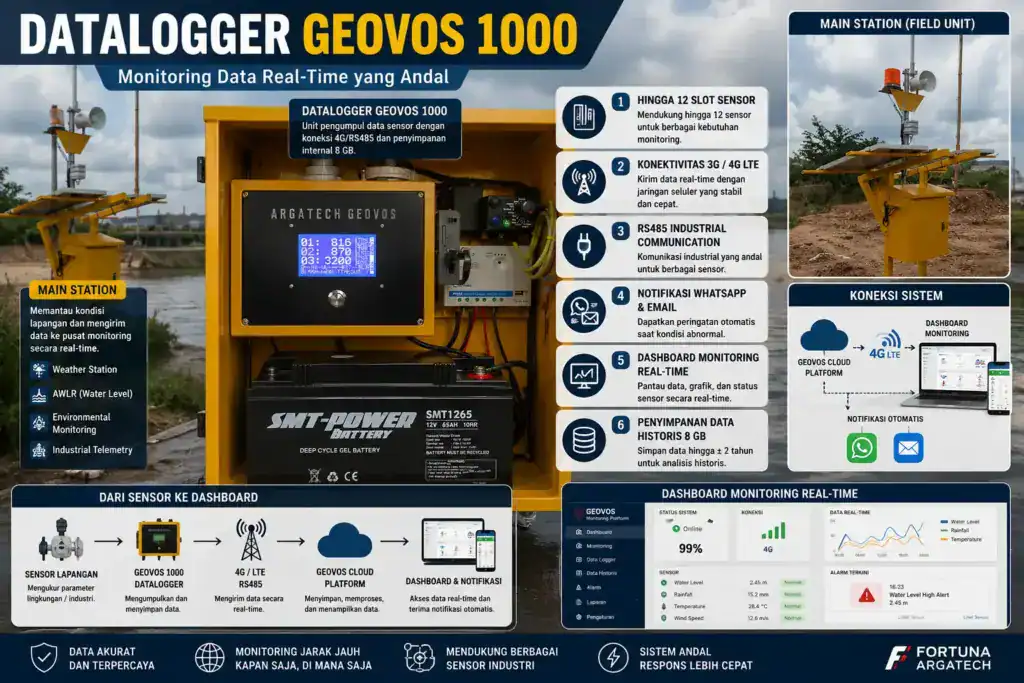
Datalogger GEOVOS 1000 is the unit that makes sensor data readable, stored, and sent to a monitoring platform. On Fortuna Argatech’s official product page, the device is described with 3G/4G HSDPA/LTE, RS485, the GEOVOS Monitoring Platform dashboard, 8 GB storage, and support for up to 12 sensor slots.
DwyerOmega describes a data logger as a tool that automatically tracks and records measurements over time. That is why data loggers matter for long-term monitoring and analysis.
What is a data logger?
A data logger collects data from sensors, stores it, and sends it into a monitoring system. In industrial settings, it ensures the data is not only visible in the moment but also available later for review and decision-making.
If a sensor is the field instrument, the data logger is the layer that turns readings into operational data.
Why does GEOVOS 1000 matter?
It connects sensors to the dashboard
GEOVOS 1000 acts as a central data collector. That helps teams understand field conditions without reading each sensor manually.
It preserves history
The official product page lists 8 GB of internal storage, equal to about 2 years of data. That matters for trends, audits, and incident review.
It supports multiple input channels
GEOVOS 1000 supports up to 12 sensor slots, making it suitable for broader monitoring setups.
It sends alerts faster
WhatsApp notifications for 5 numbers and email support faster response when conditions change.
Key specifications
All specifications below refer to Fortuna Argatech’s official product page: https://argatech.com/sensor/datalogger-geovos-1000/ (no date).
- Model: GEOVOS 1000
- Processor: Atheros AR9331 400 MHz
- RAM: 64 MB
- Storage: 8 GB (about 2 years of data)
- Communication: 3G/4G HSDPA/LTE, RS485
- Transfer speed: up to 21.6 Mbps
- Sensor slots: up to 12
- Notifications: WhatsApp (5 numbers), Email
- Dashboard: GEOVOS Monitoring Platform
What do these specs mean in the field?
- 12 sensor slots let one unit serve multiple measurement points.
- RS485 works well with many industrial sensors used on site.
- 4G keeps data flowing to a remote dashboard.
- WhatsApp and email shorten the response chain when conditions change.
- 8 GB storage helps retain history so trends can be reviewed later.
Datalogger in the monitoring ecosystem
In Argatech’s product lineup, centralized data collection is also reflected in SPARING, ONLIMO, AQMS, Weather Station, AWLR, and EXTENSOMETER. That shows how critical the data logger layer is across connected monitoring systems.
When is a logger like this used?
A logger like GEOVOS 1000 fits when:
- sensors are far from the control room
- historical data must be retained
- the team needs one central dashboard
- alerts must be sent automatically
- the system combines RS485 devices and cellular connectivity
Main benefits
- more organized data collection
- faster trend reading
- quicker operational response
- better remote monitoring
- less risk of losing field data
Conclusion
Datalogger GEOVOS 1000 serves as the center of a connected monitoring system. With 12 sensor slots, 4G, RS485, internal storage, and automatic notifications, it helps teams work with data that is cleaner, faster to access, and easier to act on.
FAQ
What is Datalogger GEOVOS 1000?
It is a data collection, storage, and transmission unit for connected monitoring.
Is it a sensor or a data logger?
It is a data logger, not a field sensor.
How many sensors can it handle?
Up to 12 sensor slots.
Can it be used for remote monitoring?
Yes, it supports 3G/4G HSDPA/LTE and the GEOVOS Monitoring Platform dashboard.
Does it send automatic alerts?
Yes, it supports WhatsApp for 5 numbers and email.
Can it be used outside hydrology?
Yes, as long as the monitoring scenario and sensor integration fit the application.
Sources
- Fortuna Argatech. (no date). Datalogger Geovos 1000. https://argatech.com/sensor/datalogger-geovos-1000/
- DwyerOmega. (no date). What are Data Loggers? https://www.dwyeromega.com/en-us/resources/blog/what-are-data-loggers
Share this article
Share this insight with your team.
Related Articles
Similar topics from the same category.
Poor weather station placement can cause 50% data bias. Learn the WMO-No. 8 and Indonesian BMKG siting standards for AWS sensors in industrial and mining sites.
Explore a technical engineering comparison between solid-state ultrasonic anemometers and mechanical cup-and-vane sensors for industrial weather stations.

Technical guide to conductivity sensors: comparing toroidal (inductive), 2-electrode, and 4-electrode contacting probes for industrial water and wastewater.