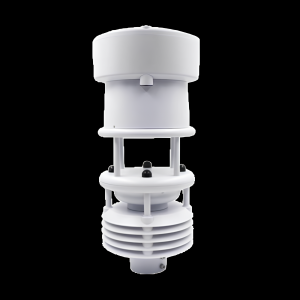
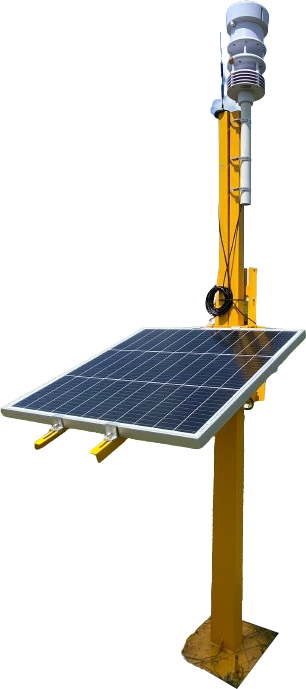
An Automatic Weather Station Sensor (All-in-One Weather Station) is a highly integrated meteorological instrument designed for continuous outdoor environmental monitoring of key weather parameters. These systems combine multiple sensors into one rugged housing to simultaneously measure temperature, humidity, atmospheric pressure, wind speed, wind direction, rainfall, illumination, and optionally UV/irradiation, providing reliable weather data via digital communication interfaces such as RS485/Modbus.
All-in-One weather stations are widely used in fields such as meteorological observation, environmental monitoring, agriculture, smart cities, transportation safety, energy systems, and hydrological monitoring due to their robust design and high reliability.
Working Principle
All-in-One weather stations integrate independent sensing elements for each parameter (e.g., thermistors for temperature, capacitive humidity sensors, barometric transducers, ultrasonic anemometers for wind, optical/piezo sensors for rainfall, and photodiodes for light/UV). These elements feed data into an onboard processing module that digitally fuses and outputs synchronized weather data through standard interfaces like RS485/Modbus, making the unit easy to integrate with data loggers, IoT platforms, and environmental monitoring systems.